
THE G-20 IN PITTSBURGH
by Tom Over 9-23-09
<br><br>
On Tuesday, Sept 22, activists from Philadelphia, New York City, Pittsburgh and other cities held a mock funeral procession to demand better policies for addressing the AIDS pandemic, a day ahead of the arrival of delegates for the G-20.
<br><br>
The approximately 50 participants in the New Orleans-style funeral march drew a mix of interest, irritation, and amusement from onlookers in the business district of downtown Pittsburgh.
<br><br>
At the head of the funeral march where pallbearers carried a cardboard coffin, a man shouted into a microphone while someone else carried a portable amplifier, “when people with AIDS are under attack, what do we do ?” and marchers shouted in unison, “fight back!”
<br><br>
Amidst the early afternoon bustle of an weekday, the demonstrators repeated this call-and-answer and similar chants as the funeral march made its way around the perimeter of the David L. Lawrence Convention Center, the site of the G-20 Summit later this week.
<br><br>
Erica Goldberg works with ACT UP Philadelphia. She said global health is not on the agenda of the G-20 Summit.
“One of the things that some of the G-20 nations have promised us is funding for the global fund to fight, TB, malaria, and HIV/AIDS. This is all really important, especially if we want to meet the United Nations’ Millennium goal of eradicating these diseases by 2015. As of right now, this won’t be met. We have to hold our leaders accountable. They are the ones making decisions for the poorer countries,” Goldberg said.
<br><br>
She commented on the timing of the demonstration. “We wanted this to be the first thing they (the G-20 delegates) see. They’re coming here tomorrow. We’re holding them accountable. This needs to be on the agenda.”
<br><br>
She said AIDS activists chose Sept 22, two days before the official start of the G-20 Summit, and one day before the arrival of the delegates, so as to not have to compete with other protests. Also, she said the AIDS activists figured there would be less of a chance of conflict with police if they staged their protest earlier in the week.
<br><br>
“We hope that this will hit the papers tomorrow, that it’s the first thing they see when they walk in, that they have this on their conscience and know we’re not going away,” Goldberg said. She urges people to contact legislators about supporting the Global Fund to Fight AIDS, Tuberculosis, and Malaria.
“President Obama, as much as I love him, went back on his promise to fulfill the funding,” Goldberg said.
<br><br>
She commented on how drug companies factor into all of this. “ Medication does not need to be this expensive. They can definitely lower their prices. We have big drug interests lobbying to prevent AIDS medication from getting” to developing nations.
<br><br>
Goldberg said debt cancellation for developing nations is a factor that comes into play.
“When you don’t cancel debts of nations and they have to pay back loans to the IMF and the World Bank, they won’t have the funds necessary for getting AIDS medication, or they might get the medication but can’t pay the health professional because of their debt.
<br><br>
She said vested interested motivated by huge profits stand in the way of doing a better job of addressing tuberculosis, malaria, and HIV/AIDS. “We have the power, the ability, and the medication.”
World News

BANGKOK, Thailand -- When Barack Obama became the first American
president to visit communist Laos on Sept. 6-8, he arrived in the most
heavily bombed country on earth where people continue to perish from
U.S. explosives dropped during a war which ended more than 40 years
ago.
President Obama's trip to Laos is seen by some as Washington's
effort to woo Southeast Asia away from China's embrace.
He had bilateral meetings with Lao President Bounnhang Vorachith,
who was promoted from the vice presidency in January when several
other top leaders shifted, prompting speculation that Vientiane wants
to ease away from financial dependence on Beijing and revitalize
traditional ties with Hanoi.
In 1975, Washington lost its "secret war" in Laos -- along with
similar defeats in Cambodia and Vietnam that same year when communists
achieved victories across Indochina.
"Obama's diplomatic visit to Vientiane certainly isn't the time,
nor the place, to find value or fault in anything the U.S.A. did in
Laos," said James "Mule" Parker in an interview.

As I read of the latest coup in Brazil, once again removing a democratically elected leader from power, my anger surged. Not again! However, as I see and read about the ongoing massive protests, as well as calls by prominent community leaders to mobilize in defense of your country's democracy, I feel great hope for Brazil. Having been a nonviolent activist for many years, I would like to support Brazilian activists to develop a nonviolent strategy that will increase your chances of success.
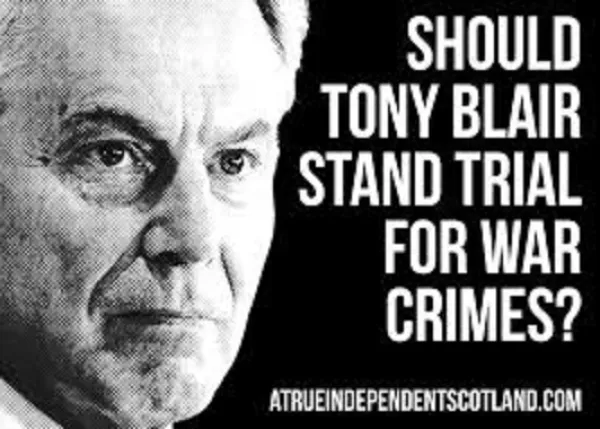
I realize that, living here in the United States, the nation doing the most in the world to create wars, proliferate nukes, and destroy the habitability of the earth's climate, I really have a duty to pick someone in the United States as the worst individual human being alive.

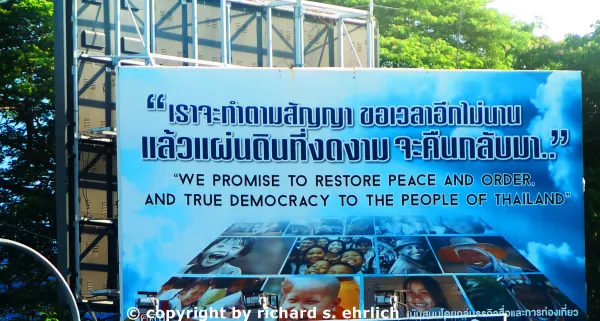
BANGKOK, Thailand -- Thailand's Constitutional Court has upheld a law
that metes out 10 years imprisonment to anyone who voices an opinion
about the junta's favored draft constitution, or campaigns for or
against it before a scheduled nationwide August 7 referendum.
"If the draft constitution does not pass, a new one has to be
written," coup-installed Prime Minister Prayuth Chan-ocha said on June
28, one day before the court ruling.
The court's decision and Mr. Prayuth's orchestration of a new
constitution contrast sharply with dissidents, politicians, local
media, Thai and international human rights groups and others who have
asked that the draft and referendum be open to public debate,
criticism and changes.
Voters decide on the junta's draft constitution on August 7 by
casting a "yes" or "no" vote.
Some see the referendum as a popularity test of the junta as it
enters a third year in power.
Before retiring as army chief and general, Mr. Prayuth led
Thailand's U.S.-trained military in a bloodless May 2014 coup against


BANGKOK, Thailand -- Free speech and pro-democracy activists, Thai
journalists and others are encrypting their telephone and message
conversations, shrinking their Facebook presence and finding other
ways to avoid the coup-installed military junta's Internet war against
political discussions, satire and demands for regime change.
Two years after seizing power on May 22, 2014, the junta says it
must monitor and censor Internet to stop illegal online activity --
not just politics -- including thieves, counterfeiters, human
smugglers and black-marketeers dealing in weapons and drugs.
National security and keeping peace in the streets are also
priorities for blocking online content, the junta says, pointing to
political clashes in Bangkok during 2010 and 2014 which left more than
120 people dead.
China muzzles pro-democracy Internet activity with a so-called
Great Firewall, which is much more efficient than Thailand's blocks
against online news, opinions and other data.
The U.S.-trained Thai military does not appear skilled enough to
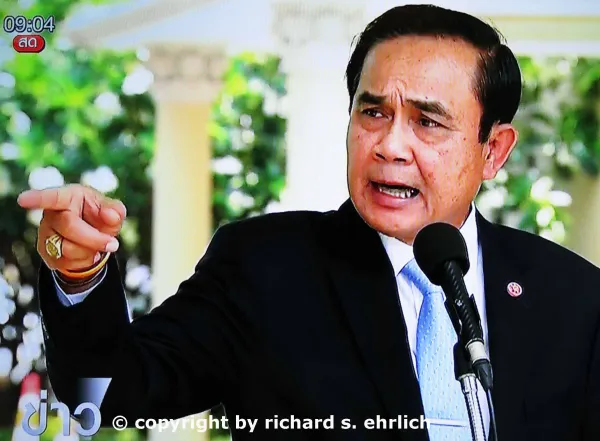
BANGKOK, Thailand -- Coup-installed junta leader Prayuth Chan-ocha
said he does "not violate any human rights" because he is not using
violence to enforce his edicts including a new crackdown against
anti-regime jokes, political comments on Facebook, and subversive
graphic T-shirts.
After twice meeting President Obama during trips to California and
Washington DC this year, Prime Minister Prayuth shrugs off U.S. and
international criticism of his regime but promises to enforce his
absolute power without brutality.
"Exercising my power must not violate any human rights. By
'violate,' I mean using violence," the coup leader said on May 3.
"We never touched them at all, because we have always been careful."
Mr. Prayuth was describing his junta's treatment during the past
two years against dozens of political dissidents who suffered arrests,
week-long "attitude adjustment" detentions in military camps, and
longer imprisonment for civilians convicted in Bangkok's Military
Court.

BANGKOK, Thailand -- Coup-installed junta leader Prayuth Chan-ocha
said he does "not violate any human rights" because he is not using
violence to enforce his edicts including a new crackdown against
anti-regime jokes, political comments on Facebook, and subversive
graphic T-shirts.
After twice meeting President Obama during trips to California and
Washington DC this year, Prime Minister Prayuth shrugs off U.S. and
international criticism of his regime but promises to enforce his
absolute power without brutality.
"Exercising my power must not violate any human rights. By
'violate,' I mean using violence," the coup leader said on May 3.
"We never touched them at all, because we have always been careful."
Mr. Prayuth was describing his junta's treatment during the past
two years against dozens of political dissidents who suffered arrests,
week-long "attitude adjustment" detentions in military camps, and
longer imprisonment for civilians convicted in Bangkok's Military
Court.

We once again owe the great reporter Seymour Hersh a serious debt for his reporting, in this case for his London Review of Books articles on President Barack Obama's war making, now published as a book called The Killing of Osama bin Laden. Despite the title, three of the four articles are about Syria.
But there is a shortcoming in how Hersh tells history, as in how many reporters do. I've watched Hersh do interviews about the topic on Democracy Now and never once heard him mention the U.S. public. In his book, the public gets one mention: "The proposed American missile attack on Syria never won public support, and Obama turned quickly to the UN and the Russian proposal for dismantling the Syrian chemical warfare complex." Taken in isolation, that sentence suggests what I think is an important causal relationship. Taken in the context of a book that spends many pages offering other explanations for Obama's decision, that one sentence seems to be simply stating two unrelated incidents in chronological order.
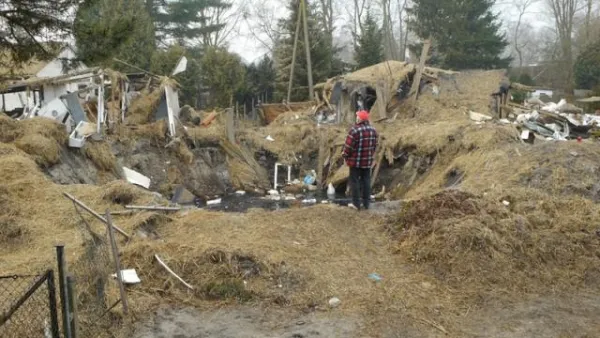
If the bombing occurs when the bombs that have been dropped from U.S. airplanes explode, then the United States just bombed Germany and has been bombing Germany every year for over 70 years.
There are still over 100,000 yet-to-explode U.S. and British bombs from World War II lying hidden in the ground in Germany. Notes the Smithsonian Magazine: