
Global


Remarks by China's United Nations Ambassador, Geng Shuang, on the situation in Occupied Palestine on May 24 were impeccable, in terms of their consistency with international law.
Compared to the United States’ position, which perceives the UN, and particularly the Security Council, as a battleground to defend Israeli interests, the Chinese political discourse reflects a legal stance based on a deep understanding of the realities on the ground.

“One nation, under God . . .”
Interesting addition to the Pledge, considering, you know, the separation of church and state. I actually remember it — it was 1954. I was in third grade, and had been reciting the Pledge with my classmates every morning for several years by then. I thought it was kind of cool, getting to say “God” without swearing.
“The push to add ‘under God’ to the pledge,” according to the History Channel, “gained momentum during the second Red Scare, a period when U.S. politicians were keen to assert the moral superiority of U.S. capitalism over Soviet communism, which many conservatives regarded as ‘godless.’”
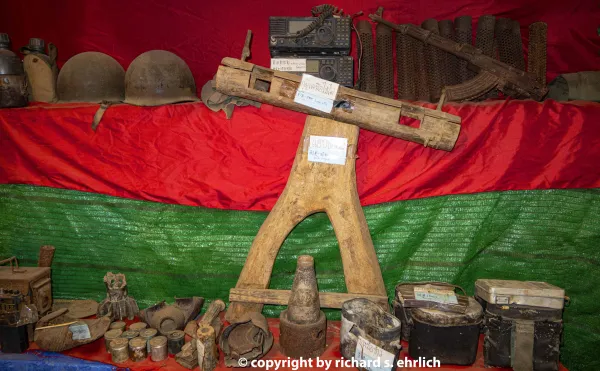
BAN RAK THAI, Thailand -- Rotting weapons, faded battlefield photos, and rough-sketched jungle maps from defeated, anti-communist, U.S.-equipped Chinese Kuomintang (KMT) guerrillas are cherished in this northern border village.
The KMT and China stopped killing each other decades ago.
Today, the KMT's descendants graciously serve China's fun-seeking tourists, sheltering them in cozy, Chinese-themed hotels and quenching them with locally grown, fermented oolong tea.
KMT families are thankful their victorious former foe is boosting their local economy.
The traumatic reversals in fortune on both sides display the way China's monetized soft power is influencing in this Southeast Asian country.
"Some Chinese come here and see these things, and say they are sorry for the way the KMT were treated so hard, years ago," said Wang Ja Da, gesturing inside his thatch-roofed restaurant at shelves displaying his family's rusty, decrepit machine gun alongside metal helmets, canteens, ammunition cartridge boxes, and other KMT equipment.
The dusty display is dotted with photos of armed, uniformed KMT who did not survive.

We have it on the very best but very secret source that Trump has clandestine plans to return the Statue of Liberty to the French as soon as he returns to the White House. Amongst his followers, Trump has been heard to say the statue no longer reflects our pure white values. Some also say he’s been secretly heard to confide to his Maga Mites: “Give us your tired, your poor, your huddled masses from shithole countries like Hell we would. Thanks but no thanks."
Truth be told, Trump clearly refutes the claim that the U.S. should be the champion of the poor and the dispossessed, a nation that draws its strength from its pluralism. The true gospel according to Trump: America’s greatness is the result of its white and Christian origins. Institutions stand diluted by a stream of alien blood, with all its inherited misconceptions respecting the relationships of the governing power to the governed,”. His government is dedicated to permanently halting the unalloyed welcome to all peoples.


There are a lot of anonymous bureaucrats that man the offices in the nation’s capital. If one were to mention the name Wendy Sherman at a Washington DC cocktail gathering it is likely that few in the room will have ever heard of her, but she has long been one of the most important players in Democratic Party administrations when it comes to foreign policy in key parts of the world. Sherman, the Deputy Secretary of State, will be retiring this summer after more than thirty years with the Foreign Service. She has been a fixture in often controversial top level policy making since Bill Clinton was in the White House, where she served as a top adviser to Secretary of State Madeleine Albright, also taking on the role of lead negotiator in the ultimately unsuccessful talks to stop North Korea’s ballistic missile program in the late 1990s.

Composer Andrew Lloyd Webber and lyricist Tim Rice’s Joseph and the Amazing
Technicolor Dreamcoat is, like their 1971 Broadway hit Jesus Christ Superstar, a rock
rendition of a tale from the Bible. Framed through the prism of a pop sensibility, these
ancient sagas are rendered with the style and sound of the late sixties/early seventies,
giving them a contemporary, hip veneer.
Whereas Superstar adapts the New Testament, Dreamcoat is derived from Genesis, the
very first book in the Old Testament. Joseph (Chris McCarrell) is the favorite of his
father Jacob’s (Peter Allen Vogt) dozen sons in Canaan, land of the Biblical Jews. A
clever young man, Joseph has the gift to interpret dreams – yet, somehow, he can’t
foresee that his envious siblings will turn on him. The betrayal of his brothers causes
Joseph to end up in Egypt, where his interpretation of the Pharoah’s (Daniel Dawson)
dreams leads to his being appointed as the Egyptian monarch’s righthand man.
I’d guestimate that only around 10 percent of this production is actually derivative of the
Old Testament tales. Dreamcoat spins a crowd pleasing two-act musical less than two
