
Global

As he begins to campaign for the White House, Gov. Gavin Newsom is toying with extending operations at two of the world’s most dangerous atomic reactors, sited at the aptly named Diablo Canyon, nine miles west of San Luis Obispo.
The coastal nukes are surrounded by a dozen earthquake faults, just 45 miles from the San Andreas, whose eruption could send an apocalyptic radioactive cloud into Los Angeles County, just 180 miles downwind. Potential human casualties could far exceed ten millon. The economic and ecological devastation would be incalculable.
Newsom’s emergence as a potential atomic triggerman has been tortured and tragic. Long marketed as an environmentalist, Newsom has fiercely criticized the state’s largest utility, for good reason.
Since 2000, Pacific Gas & Electric has twice fled to bankruptcy.
In 2010, PG&E’S under maintained gas lines caused a San Bruno explosion that killed eight people while burning 19 homes. Its grid mismanagement ignited huge fires that devastated northern California forests while killing more than 80 people, incinerating the entire town of Paradise (which Trump famously mis-labelled “Pleasure”).

#101 Gree-Gree
We start the GREE-GREE gathering #101 with a remarkable report from DEEPA DRIVER on the torturous treatment of JULIAN ASSANGE. Reporting from London, Deepa gives us a brilliant history of Wikileaks and its astounding impact on the world of internet journalism. She also fills us in on the horrific treatment being criminally imposed on its founder and the courageous willingness to bust official secrecy that he represents.

Is an insurrection percolating in the MAGA universe? A civil war?
One thing I notice as I read the growing warnings that this is the case is the assumption that suddenly the USA has become a divided nation, a splintered democracy, when, in point of fact, it has always been deeply – and for much of its history, good God, legally – divided.
Indeed, Jim Crow America was the prime model for a certain would-be European dictator.
You may have heard of Adolf Hitler. In Mein Kampf, the biography he wrote before he came to power, he “praises America,” according to Alex Ross, writing in the New Yorker, “as the one state that has made progress toward a primarily racial conception of citizenship,”
WASHINGTON -
Declaring that “President Biden has been neither bold nor inspiring” and “his prospects for winning re-election appear to be bleak,” the national activist organization RootsAction announced today that it will launch a campaign to prevent his renomination.
With an email list of 1.2 million current supporters in the United States, RootsAction issued a statement saying it is committed to nationwide organizing to prevent Biden from being the Democratic Party’s 2024 nominee for president. This is the first time that a large national organization has announced such plans.
“In 2024 the United States will face the dual imperatives of preventing a Republican takeover of the White House and advancing a truly progressive agenda,” RootsAction said in a statement. With so much at stake, renominating Biden “would be a tragic mistake.” The statement concluded: “A president is not his party’s king, and he has no automatic right to renomination. Joe Biden should not seek it. If he does, he will have a fight on his hands.”
The full RootsAction statement announcing the #DontRunJoe campaign is posted at DontRunJoe.org.

Español abajo
Kreyol anba a
Dear President López Obrador,
We, the undersigned, condemn in the strongest possible terms Mexico’s spearheading of the renewal of the mandate of the United Nations Integrated Office (BINUH) in Haiti. The Haitian people view BINUH’s presence as a foreign occupation that, since 2004, has suppressed Haiti’s independence and sovereignty. We agree. We want you, President AMLO, to seriously consider your role and the role of the Mexican Republic in extending the UN’s mission and continuing the repression of the Haitian people.

The Israeli government had then justified its siege as the only way to protect Israel from Palestinian “terrorism and rocket attacks”. This remains the official Israeli line until this day. Not many Israelis - certainly not in government, media or even ordinary people - would argue that Israel today is safer than it was prior to June 2007.
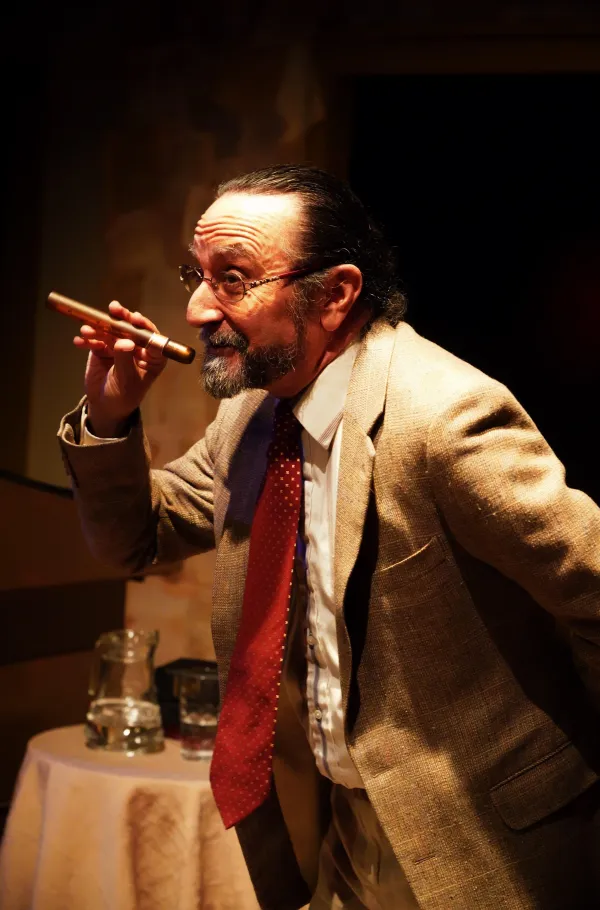
Playwright Willard Manus’ The Funny Man is a one-man show starring Sam Aaron as the Oscar-winning humorist S. J. Perelman, who The New York Times called “an artist whose nonpareil gift of ridicule, dazzling verbal effects, polished style, and keen observation made him a unique and precious figure in our literature.” The conceit of this solo show is that Perelman has been invited to the University of California at Santa Barbara in order to deliver a lecture on creative writing in 1976, when the screenwriter/playwright/author/essayist was 72. The Brickhouse Theatre’s stage is adorned by Zad Potter with a lectern, from which Aaron as the ersatz Perelman holds forth on the literary life, as well as Hollywood, Broadway, comedy, monogamy, travel, The New Yorker magazine and about what one suspects is the guest lecturer’s favorite subject: Himself.

In this day and age of superheroes deluging the big screen with their derring-do, it’s a delight to discover a production performed on the live stage about three very real women grappling with the various vicissitudes of everyday life. This revised revival of playwright Ernest Thompson’s The West Side Waltz is about a trio of females of different ages who reside in an apartment building on Manhattan’s West 72nd Street. The Waltz part of the title refers to the fact that widowed 70-ish Margaret Mary Elderdice (Ellen Geer) is a former classical concert pianist, while her 50-ish neighbor Cara Varnum (Melora Marshall) accompanies her on the violin for household duets. And I suppose that Waltz could also refer to the dance of life that this play poignantly choreographs on the outdoor stage of Will Geer’s Theatricum Botanicum.

(Dedicated to the memory of Ghassan Kanafani, an iconic Palestinian leader and engaged intellectual who was assassinated by the Israeli Mossad on July 8, 1972)
This is, according to the Italian socialist Antonio Gramsci, the ‘interregnum’- the rare and seismic moment in history when great transitions occur, when empires collapse and others rise, and when new conflicts and struggles ensue.
The Gramscian ‘interregnum, however, is not a smooth transition, for these profound changes often embody a ‘crisis,’ which “consists precisely in the fact that the old is dying and the new cannot be born”.
“In this interregnum a great variety of morbid symptoms appear,” the anti-fascist intellectual wrote in his famous “Prison Notebooks”.

I’ve made my own choices along the path of life — spiritual, mental, physical. I declared myself a non-believer in my parents’ religion at age 16. I’d just read the book Exodus, by Leon Uris, and couldn’t tolerate the church’s teaching that all non-believers, including all Jews, were going to hell.
Bye bye, church on Sunday. My mother was devastated, but we slowly came to terms with one another. On a family vacation that summer, as we were driving on the Chicago Skyway, the radio announced a tornado warning. Mom later wrote a published essay that ended thus: “Three Christians and one agnostic prayed.”