
Global
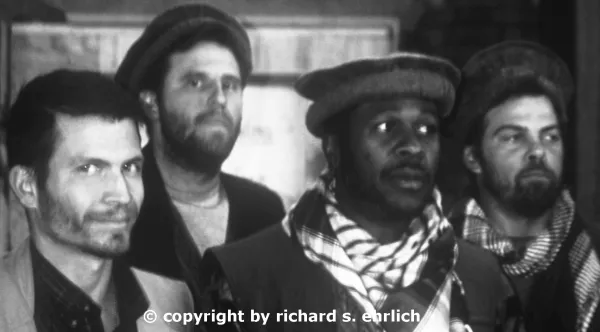
BANGKOK, Thailand -- When the U.S. invasion of Afghanistan secured Bagram Air Base in January 2002, a Special Operations officer said he motivated newly arrived 82nd Airborne Division troops with a human skull, because the young Americans became enthusiastic when they saw death's head.
"I'm a skull worshipper," Special Operations Command Sergeant-Major Raymond V. Cordell said in an interview at the time in Bagram Air Base, 42 miles (67 kilometers) north of Kabul.
A human skull, given to him by fellow soldiers, was mounted in his office at MacDill Air Force Base's Special Operations Command headquarters in Florida, he said.
"Apparently they got on the Internet and typed in 'skulls'. And what came up under 'skulls' were medical services, where you could actually buy one.
"They got together and chipped in all their money. I don't even want to know how much it cost them for just the skull.
"He [the skull] wears the actual 82nd [Airborne Division] beret. It's the maroon beret, which is the sign of the American paratrooper on jump status.


Since the Civil War, midterm elections have enabled the president’s party to gain ground in the House of Representatives only three times, and those were in single digits. The last few midterms have been typical: In 2006, with Republican George W. Bush in the White House, his party lost 31 House seats. Under Democrat Barack Obama, his party lost 63 seats in 2010 and then 13 seats in 2014. Under Donald Trump, in 2018, Republicans lost 41 seats. Overall, since World War II, losses have averaged 27 seats in the House.
Next year, if Republicans gain just five House seats, Rep. Kevin McCarthy or some other right-wing ideologue will become the House speaker, giving the GOP control over all committees and legislation. In the Senate, where the historic midterm pattern has been similar, a Republican gain of just one seat will reinstall Mitch McConnell as Senate majority leader.

“The Palestinian Authority’s days are numbered”. This assertion has been oft repeated recently, especially after the torture to death on June 24 of a popular Palestinian activist, Nizar Banat, 42, at the hands of PA security goons in Hebron (Al-Khalil).
The killing - or ‘assassination’ as some Palestinian rights groups describe it - of Banat, however, is commonplace. Torture in PA prisons is the modus operandi, through which Palestinian interrogators exact ‘confessions’. Palestinian political prisoners in PA custody are usually divided into two main groups: activists who are suspected by Israel of being involved in anti-Israeli occupation activities and others who have been detained for voicing criticism of the PA’s corruption or subservience to Israel.


As Jews and refugees increasingly come under attack, the Wallis Annenberg Center for the Performing Arts returns to live theater with the world premiere of a play about a Jewish immigrant. Tevye in New York! imagines what happened to the Ukrainian dairyman depicted in the popular Broadway musical Fiddler on the Roof, which in turn is based on Sholem Aleichem’s short stories written in the 1890s. As those familiar with Fiddler may recall, the show ends with a pogrom (race riot) that, with only a three day notice (!!!) expels Tevye and his family from their Ukrainian village of Anatevka, and those beleaguered, bewildered, wandering Jews embark on their long march to America.

The two biggest cities on the shores of Lake Erie are now centers of political upheaval. For decades, Buffalo and Cleveland have suffered from widespread poverty and despair in the midst of urban decay. Today, the second-largest cities in New York and Ohio are battlegrounds between activists fighting for progressive change and establishment forces determined to prevent it.
Many Palestinians believe that the May 10-21 military confrontation between Israel and the Gaza Resistance, along with the simultaneous popular revolt across Palestine, was a game-changer. Israel is doing everything in its power to prove them wrong.
Palestinians are justified to hold this viewpoint; after all, their minuscule military capabilities in a besieged and impoverished tiny stretch of land, the Gaza Strip, have managed to push back - or at least neutralize - the massive and superior Israeli military machine.
However, for Palestinians, this is not only about firepower but also about their coveted national unity. Indeed, the Palestinian revolt, which included all Palestinians regardless of their political backgrounds or geographic locations, is fostering a whole new discourse on Palestine - non-factional, assertive and forward-thinking.
The challenge for the Palestinian people is whether they will be able to translate their achievements into an actual political strategy, and finally transition past the stifling, and often tragic, post-Oslo Accords period.

For Derek Chauvin, nine minutes and twenty-nine seconds have turned into twenty-two and a half years — the prison sentence he recently received for the murder of George Floyd.
Chauvin famously knelt on George Floyd’s neck last year, as he lay handcuffed and helpless, for those nine-plus minutes, while three colleagues stood by, indifferent to the murder so obviously underway . . . police administering the death sentence to a man accused of trying to use a counterfeit $20 bill at a nearby convenience store. Unfortunately for the smirking Chauvin, his crime was caught on cellphone video and shocked much of the nation and the world. And a year later, something almost unprecedented happened: A police officer was held accountable for killing a black man.
But is this “justice” or is it simply bureaucracy? George Floyd is still dead. His young daughter remains robbed of her father; his loved ones, his family, still have a terrifying void in their lives. And the racist social structure in which Chauvin acted, though now under intense scrutiny, remains intact. People continue to needlessly suffer and die at the hands of our militarized police.