
Politics
You’d think that a presidential campaign backed by 40 billionaires and untold numbers of bundled rich people wouldn’t worry about just one leaflet on Medicare for All.
But minutes after Pete Buttigieg finished speaking in an auditorium at Keene State College in New Hampshire on Saturday, a Pete for America official confronted me outside the building while I was handing out a flier with the headline “Medicare for All. Not Healthcare Profiteering for the Few.”
“You can’t pass that out,” the man told me. I did a double take, glancing at the small “Pete” metal badge on his lapel while being told that he spoke on behalf of the Buttigieg campaign.

A bad app in Iowa throws everything into a tizzy. Who won? Come on, the horse race has begun. Let’s get some numbers up on the board.
Spectator Nation stomps its feet.
Voting is the activity at the core of democracy, right? It’s a citizen’s sacred duty. While I have always believed this, questions about the nature of our democracy have been simmering in my soul over the decades with ever-increasing intensity. Is affirming our citizenship really nothing more than making a pencil mark on a ballot or a blip on a computer screen, indicating our “choice” among highly controlled options?

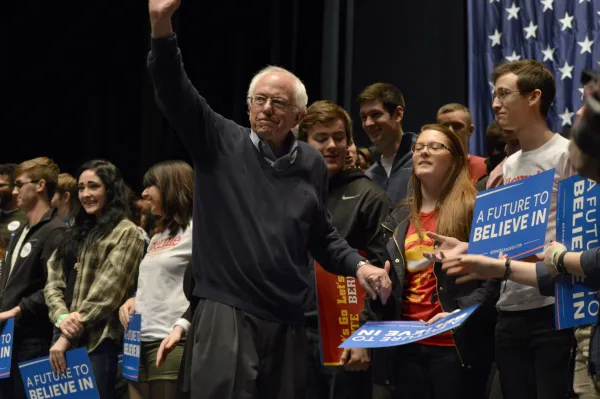
While journalists pick through the ashes of the Iowa caucuses meltdown, thousands of progressive activists are moving forward to make election history in New Hampshire. In sharp contrast to the prattle of mainstream punditry, the movements behind Bernie Sanders are propelled by people who engage with politics as a collective struggle because the future of humanity and the planet is at stake. As a result, the Granite State’s primary election on Feb. 11 could be a political earthquake.
Whether or not the Democratic Party’s corporate backers truly understand what progressive populism is all about, they’re determined to crush its strongest electoral manifestation in our lifetimes -- the Bernie 2020 campaign. And, since the bottom fell out of Iowa’s capacity for dramatic political impact, New Hampshire now looms larger than ever.
Monday night’s collapse of the caucus vote-counting process in Iowa has amped up the spotlight on -- and political consequences of -- what will happen in the New Hampshire primary. A clear Sanders victory would make him the frontrunner for the Democratic presidential nomination.

Fifty-two years after young people changed history with the New Hampshire primary election, a new generation is ready to do it again -- this time by mobilizing behind Bernie Sanders.
During early 1968, thousands of young people volunteered in New Hampshire to help the insurgent presidential campaign of Democratic Sen. Eugene McCarthy -- who went on to stun the party establishment by winning 42 percent of the state’s primary vote against President Lyndon Johnson’s 49 percent. Three weeks later, Johnson announced that he would not run for re-election.
What propelled McCarthy and his young supporters into the snows of New Hampshire was their opposition to the war in Vietnam. Five decades later, in effect, what’s propelling Bernie Sanders and his young supporters is the grim reality of class war in America.

From Noam Chomsky, Bill Fletcher, Barbara Ehrenreich, Kathy Kelly, Ron Daniels, Leslie Cagan, Norman Solomon, Cynthia Peters, and Michael Albert]
As the 2020 presidential election approaches the Green Party faces the challenge of settling on a platform, choosing a candidate for president, and deciding its campaign strategy. In that context, Howie Hawkins, a contender for Green Party presidential candidate, recently published a clear and cogent essay titled “The Green Party Is Not the Democrats’ Problem.” It represents a precedent Green Party stance which may guide Green campaign policy. We agree with much, but find some ideas very troubling.

To corporate media, Bernie Sanders is incorrigible. He won’t stop defying the standard assumptions about what’s possible in national politics. His 2020 campaign -- with feet on the ground and eyes on visionary horizons -- is a danger to corporate capitalism’s “natural” order that enables wealth to dominate the political process.

The dismal conflict that erupted this week between Bernie Sanders and Elizabeth Warren should never have happened. But now that it has, supporters must provide grassroots leadership to mitigate the dangerous mess.
The argument that broke out between Warren and Sanders last weekend and escalated in recent days is already history that threatens to foreshadow tragedy. Progressives cannot afford to give any more aid and comfort to the forces behind corporate contenders Joe Biden and Pete Buttigieg, or the plutocratic $54 billion man Michael Bloomberg waiting in the wings.
In a sense, this moment calls for Sanders and Warren supporters to be better than their candidates, who’ve descended into an avoidably harsh conflict that hugely benefits corporate power and corporate Democrats -- and will do so even more to the extent that it doesn’t subside.
So much is at stake that Sanders and Warren must be called upon to look beyond their own anger, no matter how justified. A demolition derby between the two -- or their supporters -- won’t resolve who’s right. But it will help the right wing.

Why has the hash tag #CNNisTrash been popular since this week’s presidential primary debate? There was nothing new about the corporate, militarist, anti-progressive slant of the debate “moderation.” What was new was the level of blatant bias so extreme that even viewers who knew nothing about the issues couldn’t miss it, plus the amount of time CNN focused on expressing its hostility toward a single candidate, Bernie Sanders.
First they ignore you, then they laugh at you, then they attack you, then you win . . . or so the saying goes. The Bernie Sanders campaign is well into stage 3 out of 4.

There's nothing like an illegal and utterly reckless U.S. act of war to illuminate the political character of presidential candidates. In the days since the assassination of Iran’s top military official, two of the highest-polling Democratic contenders have displayed the kind of moral cowardice that got the United States into -- and kept it in -- horrific wars from Vietnam to Afghanistan and Iraq.
Eager to hedge their bets, Joe Biden and Pete Buttigieg have offered merely tactical critiques of President Trump’s decision to kill Qassim Suleimani. In sharp contrast to Elizabeth Warren and especially Bernie Sanders, the gist of the responses from Biden and Buttigieg amounted to criticizing the absence of a game plan for an atrocious game that should never be played in the first place.
Many journalists have noted that only in recent days has foreign policy become prominent in the race for the 2020 nomination. But what remains to be addressed is the confluence of how Biden and Buttigieg approach the roles of the U.S. government in class war at home and military war abroad -- both for the benefit of corporate elites.

In a recent New Yorkerprofile of Pete Buttigieg, one sentence stands out: “Watch Buttigieg long enough and you notice that he uses abstraction as an escape hatch.” Evasive platitudes are also routine for Joe Biden, the other major Democratic presidential candidate running in what mainstream journalists call “the center lane.”
Jim Hightower has observed that “there’s nothing in the middle of the road except yellow lines and dead armadillos.” Or, we might say, party lines and deadening politics.
Like other so-called “moderate” politicians, Buttigieg and Biden dodge key questions by plunging into foggy rhetoric. They’re incapable of giving a coherent and truthful account of power in the United States because they’re beholden to corporate-aligned donors. Those donors want to hear doubletalk that protects their interests, not clear talk that could threaten them.