
No Kings, Just Kingmakers: The Irony of Democratic Control
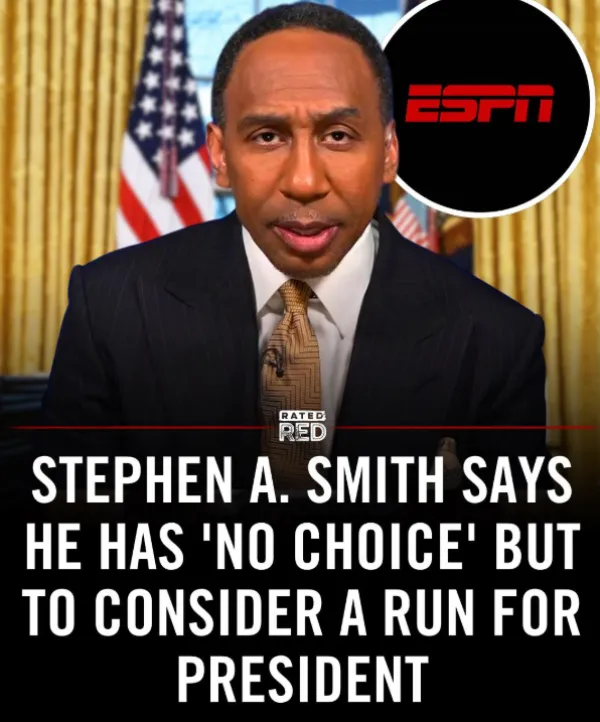
When Stephen A. Smith recently floated the idea of running for president, the reactions came right on cue. Some laughed. Some rolled their eyes. But the more interesting question isn’t whether Smith would be a good candidate. It’s whether the Democratic Party could ever allow someone like him to become one.
The Control Issue
For years now, Democrats have been telling themselves a story about democracy that they no longer quite believe. They still invoke “the voters” as a moral authority. But in practice, party leaders behave like a managerial elite that repeatedly narrows fields and coordinates outcomes in ways that limit how much real choice voters ever see. The result is a politics of containment: when insurgent choices gain traction, institutional tools redirect the outcome.
Stephen A. Smith is not a threat to Democratic ideology so much as he is a threat to Democratic management.
Smith’s appeal has nothing to do with policy white papers or carefully triangulated messaging. It’s presence. It’s voice. It’s the sense that he is not reading from a script written by consultants who workshop every sentence until it no longer sounds like anything a human being would actually say. He talks like someone you’ve argued with in a living room, like someone who expects to be disagreed with. In a culture dominated by focus-grouped language and careful non-answers, that kind of directness feels transgressive.
Modern party politics on the Democratic side is built to minimize that kind of unpredictability. The system is designed to reward candidates who can be trusted to stay within the lines and defer to the gatekeepers who decide when a moment is “their turn.” Disruption is tolerated only when it is tightly managed.
The Shock Hits: 2008
In some ways, this reflex was born in 2008. That year, the party establishment expected to nominate Hillary Clinton. Instead, Democratic voters chose Barack Obama. The process was open, competitive, and uncertain. The result surprised a lot of powerful people who felt the sting of a lesson learned: losing control of the process is dangerous.
The next three cycles show what they did with that lesson.
The Priority of Risk Management: 2016–2024
In 2016, Bernie Sanders built a movement that the party’s leadership regarded as an existential threat. The response was not simply to beat him in argument, but to close ranks institutionally—including a superdelegate structure that made the race look mathematically over before millions of voters had cast a ballot. The message was unmistakable: insurgency would not be allowed to take over the party.
In 2020, the pattern repeated in a more disciplined form. When Sanders again surged, the field suddenly consolidated around Joe Biden just before Super Tuesday. Pete Buttigieg and Amy Klobuchar exited within days and endorsed him in quick succession, followed by a rush of elite and donor support. Within forty-eight hours, the entire field collapsed. The effect was decisive: the race was transformed overnight into a one-on-one contest that Sanders could not win.
By 2024, the impulse had hardened into something even more explicit. Robert F. Kennedy Jr. was not merely defeated; he was effectively walled off from a real primary process altogether. Ballot access fights and procedural barriers ensured that Democratic voters would not be presented with a genuine choice. The field was protected in advance.
Then came the Biden succession drama, which revealed the same instinct in its starkest form. For as long as possible, the party insisted that everything was fine, that concerns about age and capacity were exaggerated. Only when the fiction collapsed did the conversation change. But even then, there was no serious attempt to trust voters with a genuinely open contest. No crash primary. No real competition. Just a hurried, carefully managed transition designed to preserve continuity and minimize uncertainty.
At every inflection point, the party apparatus makes the same choice: control over uncertainty.
This is not simply about protecting progressive ideology. It’s about protecting the machinery of power itself. Truly disruptive candidates don’t just threaten policy preferences. They threaten the system that manages succession itself.
Why Smith Doesn’t Fit
Stephen A. Smith would do exactly that.
Not because he’s a policy radical. He isn’t. But because he doesn’t come pre-approved. He doesn’t owe his rise to the party. He doesn’t speak in the party’s dialect. And he doesn’t instinctively defer to the priesthood of professional politics.
That makes him dangerous in a way the party cannot tolerate.
There’s a common explanation floating around that Democrats’ problem is age—their leadership is simply too old, too out of touch, too tired. But that’s a misdiagnosis. Bernie Sanders proved you can energize millions well into your seventies. The issue isn’t age—it’s stale ideas, stale language, a politics that feels less like leadership and more like risk management.
Smith represents the opposite of that: energy, directness, and a willingness to say things without checking whether they’ve been safely laundered through five layers of approval. That is exactly why he will never be allowed to emerge through a Democratic primary.
The same instinct that contained Sanders, consolidated against him, sidelined Kennedy, and managed the Biden transition will assert itself again. The levers will be pulled. The field will be shaped. The risks will be narrowed.
No Kings, Just Kingmakers
This is the irony of modern progressive politics: a movement that intones about democracy has grown uncomfortable with democratic unpredictability. It decries despotism in the abstract while tolerating remarkably little organized dissent in practice. The same culture that chants “No kings” in the streets increasingly reserves for itself the role of kingmaker behind closed doors. They applaud participation; they manage outcomes. They preach democracy; they fear real democracy.
To be fair, every institution gravitates toward self-preservation. But the Democratic Party has made a philosophy out of it. It has turned managerial control into a governing instinct. And like most instincts, it operates automatically.
The Verdict
Which is why Stephen A. Smith won’t be their nominee in 2028.
Not because he’s too loud. Not because he’s unconventional. Not because he’s insufficiently orthodox.
But because he’s insufficiently manageable.
Control over risk. Management over uncertainty.
The pattern is familiar. The conclusion is unmistakable.
They can’t help themselves.
Rowan Hale is a writer focused on American politics and institutional culture. He has written on party politics, democratic norms, and media culture.