
Politics
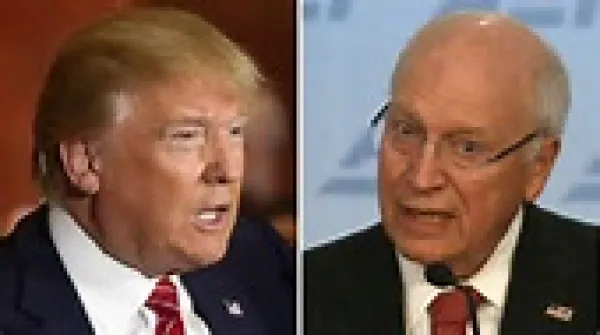
If your name is Donald Trump, or Dick Cheney, or George W Bush, then don’t bother reading this. This article is to help the rest of us to better understand how Donald Trump et al think. The psychiatric literature has long known that people with narcissistic personality disorder, also called the narcissistic sociopath, are far more common at the upper end of politics and business in the United States. About 1% of people in general show the criteria of the condition, yet 20% of CEOs in “Fortune 500” companies and many politicians in this country have these characteristics.
So it pays to know how these people think since it allows us to accurately predict their behavior. The cause of narcissistic personality condition can be summarized in three words: low self-esteem. The person’s thinking process is overwhelmed with the need to show them as powerful and important. It is much more common in men than women, and, thus, testosterone, one of the key driving forces of emotional behavior, powers this condition.

 hat is “Benghazi,” Washington’s long-running kabuki circus, really about?
Is it about dead diplomats and CIA mercenaries? Foreign service security? Terrorist attacks and Islamaphobic movies? Emails and Sidney Blumenthal? Whether Hillary Clinton cares, or whether she spends the night alone? Does the Benghazi committee, or anyone else, really know what “Benghazi” is about?

If you're into quaint, you can visit a historic village, restore some antique furniture, or for far less trouble pick up a mainstream analysis of the U.S. military from 40 years ago or so.
I just happened to read a 1973 book called Military Force and American Society, edited by Bruce M. Russett and Alfred Stepan -- both of whom have presumably updated their views somewhat, or -- more likely -- veered off into other interests. The problems and trends described in their book have been worsening ever since, while interest in them has been lessening. You could write a similar book now, with the numbers all larger and the analysis more definitive, but who would buy it?

Andrew Bard Schmookler's new book is called What We're Up Against: The Destructive Force at Work in Our World -- And How We Can Defeat It. I'll spare you some suspense; the evil force he has in mind is the Republican Party. Here's a video of a speech the author gave when he was running for Congress as a Democrat in a district gerrymandered Republican. As in the book, Schmookler calls out Republicans in the speech as promoting an unprecedented evil force in U.S. culture.
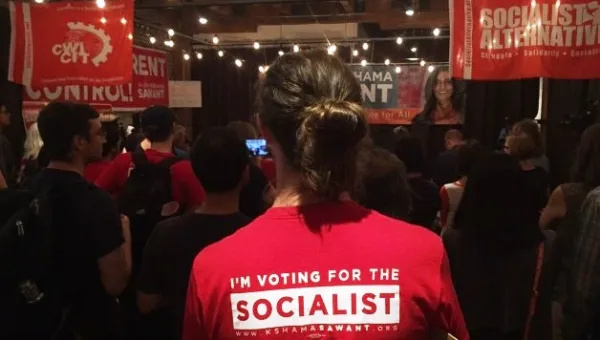
As Election Day draws near, a lot is at stake for working people in Seattle. But the outcome of Seattle’s City Council race will also reverberate in communities across the nation who want their city government to serve its constituents instead of corporate interests.
By making it the cornerstone of her platform in the 2013 City Council race, Kshama Sawant created the political will in a city controlled by the Democratic Party to raise the minimum wage to $15/hour. The Democratic establishment wouldn’t have got there on its own.
Sawant won the election for District 3, unseating a 16-year incumbent Democrat and making her the first independent Socialist in decades to be elected in a major U.S. city.
After years of stagnant wages and an ever-increasing cost of living, Sawant's minimum wage initiative was tremendously popular with working class voters. To maintain their image as the “progressive” party, Democratic mayor Ed Murray and the rest of City Council had no choice but to get on board with a city charter amendment to raise the wage to $15.

“Those who take oaths to politically powerful secret societies cannot be depended on for loyalty to a democratic republic.” -- John Quincy Adams
Most of us Americans have our own simplistic methods of evaluating candidates for political office during our uniquely perpetual, very costly, time-consuming, energy-wasting and exhausting campaign seasons. Increasingly, state and national politicians are out of reach for most voters. Local candidates for mayor, city council and school board are increasingly the only politicians that can be personally approached by average voters.

Ho hum, there was another mass shooting at another school a few days ago.
This one was at an Oregon junior college. It happens to be the 142nd school shooting since Sandy Hook (see: http://everytown.org/article/schoolshootings/ for the entire list), and no mainstream journalist is asking (or, if he knows, his editors are not allowing him to reveal the answer to) the pertinent question that people who truly want to understand the epidemic need to know: “What brain-damaging, addictive psych drug(s) was this brain-altered shooter taking or withdrawing from?”
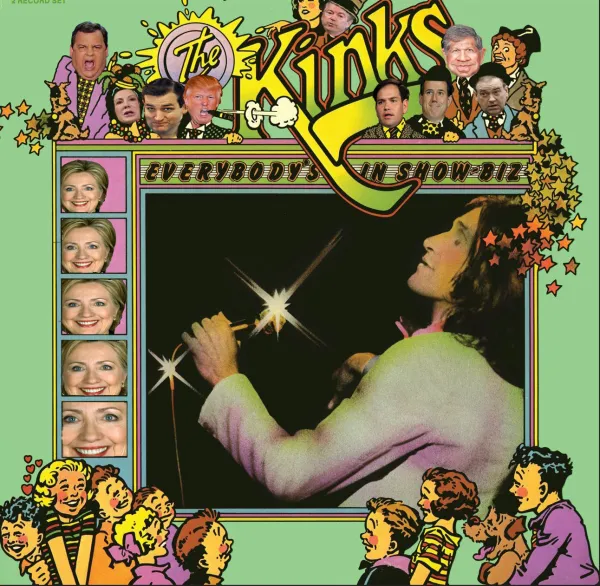
It's beginning to look like political season has finally arrived, and it isn't just that we have two debates under our belt and primaries about to begin. The telling statistic is that fully 85 percent of op-ed writers, most of whom ought to know better, have finally succumbed to the temptation of reacting to some piece of insane gibberish emanating from our dear friend Donald Trump. It's the journalistic equivalent of a weekend off, a “phone it in and come to bed honey” moment. More fool them – the man is plainly a Democratic plant, as is his friend Tom Brady.
But this is a music column, and we don't ask the easy questions here. If you want to know John Kasich’s stance on net neutrality, the Dispatch would be more than happy to oblige you. Here, however, we roll up our sleeves and get down to the ugly core of what makes someone deserving of the presidential office – if a candidate was a Kinks songs, which Kinks song would they be? Cue “The Contenders,” in alphabetical order:
That little smoke-filled room where our despair and paranoia incline us to imagine a small number of evil people run the world clearly forgot to keep an eye on the Republican Party.
A popular movement has struggled to stop such looming disasters as the NAFTA-on-steroids Trans-Pacific Partnership (TPP), but the ouster of John Boehner as Speaker of the House puts stopping anything into play. While scholarly studies deem the U.S. government to be an oligarchy, based on whom it actually serves, petty partisan squabbling just might come riding to the rescue of democracy -- accidentally of course.
Boehner wasn't insufficiently right-wing for the other Republicans in the House of Representatives, he was just insufficiently obstinate and insufficiently anti-Obama. The new Speaker's mandate will be to oppose to the death anything Obama supports. Obama could publicly throw himself behind keeping Guantanamo open, and the place would be shut by Thursday.

Get ready: the Republicans may not know it, but they’ve all but certified their ticket for 2016, and they will probably win.
The saturation bloviation that followed this week’s Republican presidential debates missed some monumental moments, including:
There was one (and ONLY one) candidate on the stage that had anything meaningful to say. It was Rand Paul. What he said about war and marijuana was of serious significance.
The GOP hard core on the stage and in the audience certified their obeisance to a free pass for the horrific presidency of George W. Bush, thereby opening the door for his brother, who can almost certainly win if he runs with the guy from Ohio.
Let’s deal first with Rand Paul. Like his father (and unlike virtually anyone else in the GOP) the Senator from Kentucky seems to have some actual principles. Both Pauls have been firmly committed to the legalization of marijuana for many years, and have not wavered.