
Politics

Forty-eight years ago, a serious insurrection jeopardized the power structure of the national Democratic Party for the first time in memory. Propelled by the movement against the Vietnam War, that grassroots uprising cast a big electoral shadow soon after Senator Eugene McCarthy dared to challenge the incumbent for the Democratic presidential nomination.
When 1968 got underway, the news media were scoffing at McCarthy’s antiwar campaign as quixotic and doomed. But in the nation’s leadoff New Hampshire primary, McCarthy received 42 percent of the vote while President Lyndon B. Johnson couldn’t quite get to 50 percent -- results that were shattering for LBJ. Suddenly emboldened, Senator Robert Kennedy quickly entered the race. Two weeks later, Johnson announced that he wouldn’t seek re-election.

I asked Green Party presidential candidate Jill Stein about her platform this week and came away believing it had a better chance of winning than Bernie Sanders'. I know that platforms don't run, people do, and they do so within a two-party dominated system. But this already crazy presidential election could turn into a crazier five-way race. And, even if it doesn't, or if it does but still nobody ever learns that Jill Stein exists, there is nonetheless much for us and for the other candidates to learn from her platform.
If you think free college is popular, you should see what young people think of free college and erasing all existing student debt.
If single-payer healthcare with raised taxes (but net savings, if you make it to that fine print) excites voters, how do you think they'd respond to single-payer healthcare with no raised taxes?

For a long time, as he campaigned for president, a wide spectrum of establishment media insisted that Bernie Sanders couldn’t win. Now they’re sounding the alarm that he might.
And, just in case you haven’t gotten the media message yet -- Sanders is “angry,” kind of like Donald Trump.
Elite media often blur distinctions between right-wing populism and progressive populism -- as though there’s not all that much difference between appealing to xenophobia and racism on the one hand and appealing for social justice and humanistic solidarity on the other.
Many journalists can’t resist lumping Trump and Sanders together as rabble-rousing outliers. But in the real world, the differences are vast.
Donald Trump is to Bernie Sanders as Archie Bunker is to Jon Stewart.
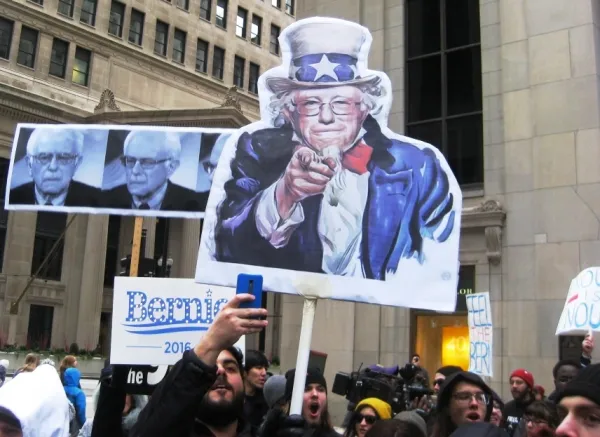
“The billionaire class and their representatives in Washington are so powerful that the best president in the world cannot defeat them alone,” said Bernie Sanders at a rally in Minneapolis last June. “We need a mass movement of millions of people.”
Taking their cue from the presidential candidate, on January 23 many thousands of supporters turned out for a #March4Bernie in more than 35 U.S. cities.
In Chicago, where much of the outrage against corporate-backed Democrats has been focused on Mayor Rahm Emanuel, more than 2,000 Sanders supporters marched from Daley Plaza to the Chicago Board of Trade. Many of the marchers carried signs demanding Emanuel's resignation. Activists have alleged a city-wide cover-up of the police killing of 17-year-old Laquan McDonald.
Major corporate media outlets in the United States are reporting on a new viability for Bernie Sanders' presidential campaign, based on his rise in the polls nationally and in Iowa and New Hampshire -- and possibly, though this goes largely unmentioned, based on his big new advertising purchases from major corporate media outlets.
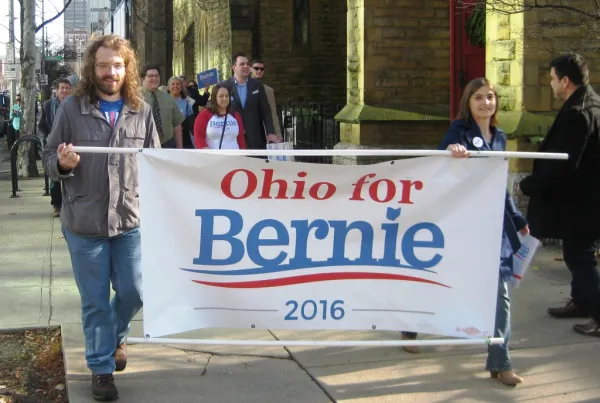
“Money doesn’t win. Pre-primary polls don’t win,” said Jason Edwards. “Votes win, and we have the people to go out and get them.”
Edwards was speaking on December 16 outside the Ohio Secretary of State’s office as nearly 6,000 petition signatures were delivered to put presidential candidate Bernie Sanders on the Ohio ballot for the May primary.
Sanders’ prospects for winning the Democratic primary in Ohio are “very good,” said Edwards, a member of Central Ohio Grassroots for Bernie Sanders and a delegate for the national campaign. For the general election, “We’ve got a lot of work to do as volunteers,” he said. “As long as we keep up our grass-roots effort around the country, we’re going to be fine.”
“I’m very confident that Bernie would win the general election,” said Bianca Davis, a graduate student in physics at Ohio State. “We need his policies. We need universal health care, we need maternity and paternity leave, we need infrastructure, and we need to address climate change. At the first Democratic debate, Bernie was the only one who said that climate change is the biggest security threat.”

Leaders provide vision. They help people understand where they are, how they got there and what they must do to go forward. They help calm nerves and strengthen courage. They are steady in times of trouble, inspiring in times of demoralization.
Donald Trump’s reaction to the terrorist acts in Egypt, Lebanon, Paris and San Bernardino, Calif., both divides and weakens us. And for the most part, his rivals for the Republican presidential nomination have allowed him to lead the Republican Party and its run to the White House to ignominy.
Americans are understandably worried. We have been fighting wars in the Middle East for over a decade. We lost thousands of lives and spent literally trillions of dollars in a wrong-headed war of choice in Iraq. We toppled the Taliban in Afghanistan, Saddam Hussein in Iraq, Muammar Qaddafi in Libya, producing failed states and generating more terrorists. Now we are trying to take out Assad in Syria even as his mortal enemy ISIS takes credit for terrorist horrors in Paris and Beirut. The violence keeps spreading; the terrorists keep reviving. And Americans grow more and more worried.

Thanks to Glenn Greenwald for pointing out that the U.S. media is acting as though Donald Trump just invented bigotry this week (one of those ugly details I'm happy to miss by never watching television). But not only is explicit bigotry toward Muslims not new, implicit bigotry toward Muslims has been the foundation of the largest public project in the United States for the past quarter century.

A 26 person delegation from the All Okinawa Council will be in Washington, DC November 19 and 20 to ask members of the U.S. Congress to use their power to stop the construction of runway for the U.S. Marine base at Henoko into the pristine waters of the South China Sea.
The delegation is concerned about the environmental impact of the new facilities, including a runway to be built into the coral areas and natural habitat of the marine mammal, the dugong and the continued militarization of their island. Over 90% of all U.S. military bases in Japan are located in Okinawa.
The Henoko construction plan faces substantial opposition from the people of Okinawa. Protests of 35,000 citizens, Including many senior citizens, against the construction of the base have rocked the island.
The issue of the Henoko relocation plan has taken a critical turn. On October 13th, 2015, Okinawa’s new Governor Takshi Onaga revoked the land reclamation approval for the Henoko base construction, which was granted by the previous governor in December 2013.

For many people, it is easier, safer and more comfortable to live in a world of delusion, particularly when this delusion requires no effort to seek out and understand truths that might prove unpalatable. If the delusion is one that is reinforced by the persistent promulgation of elite propaganda, then the idea of questioning the delusion might not even arise.
Since the publication of vast troves of official documents by Wikileaks, however, knowledge of deeper geopolitical realities has exited the select world of progressive academia, exemplified by scholars such as Noam Chomsky, with its enthusiastic but relatively limited audience in activist circles, to become more readily and widely available.