
Archeological surveys are a joke in this town, claim Anduril’s killer flying AI robots
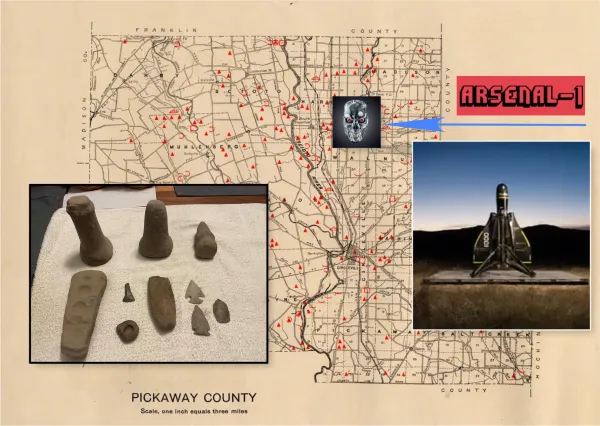
A longtime historian from Pickaway County revealed to the Free Press what many had surmised. That the archeological survey conducted at the future site of Arsenal-1 was completed by amateurs hired by Anduril’s construction company.
Arsenal-1 is the name of Anduril’s 5-million square foot autonomous killer flying robot manufacturing plant which will become the largest single-site job creation investment in Ohio history.
Building Arsenal-1 is CT Realty, and they hired Columbus-based Lawhon & Associates, an environmental and engineering consulting firm, to complete the archeological survey, which is mandated by the National Historic Preservation Act of 1966 due to the project’s use of federal funds and evidence of Native American occupancy at the site.
“They did a survey based on what they interpreted the state standards to require. But the way it went down is iffy,” said the Pickaway County historian who refused to offer his name for publication. “For example, they did the visual inspection in the summer in three-to-four feet tall soybeans. Kind of hard to see artifacts in those conditions.”
The non-profit Ohio Archeological Council went so far as to call Lawhon & Associates’ work at the site “fatally flawed.” On the flipside, CT Realty’s managing partner James Watson told local media this about the survey: “We’ve done everything, an exhaustive search.”
The unnamed Pickaway County historian forwarded the above picture of First Nation artifacts found by relic hunters at the site, which is adjacent to Rickenbacker International Airport, ten miles south of Columbus, but in Pickaway County. And like most of Central Ohio, the area was inhabited by Native Americans for thousands of years. This area’s last tribe before European invasion was the Shawnee, who claim ancestral stewardship to Serpent Mound, the Octagon, and many other earthworks.
“[Lawhon & Associates] found lots of ‘scatter flakes’ in shovel digs that to most people would indicate a settlement or semi-permanent hunting and fishing camp,” said the historian. “But their conclusion was that they were not significant or enough to warrant a more complete investigation which would use ground penetration methods such as geomagnetic or ground penetration radar. The real way to check for settlements in areas that have been plowed.”
Following the Lawhon & Associates survey, which we now know was completed in September, both the US Army Corps of Engineers and Ohio’s State Historic Preservation Office signed off on the survey’s conclusions meaning no more archeological research will be forthcoming at the site.
“There will be no historic properties affected by the proposed work,” stated the Corps in a public notice following the survey.
Whether a Tribal Historic Preservation Office concurred with the survey, as the National Historic Preservation Act demands, is unknown because The US Army Corps of Engineers (the Corps) never responded to the Free Press when asked.
The Corps is the engineering branch of the US Army and is one agency delegated by the federal government to uphold the National Historic Preservation Act. It should be noted that the State Historic Preservation Office, which was significantly marginalized by Trump’s axe last year, can disagree with the Corps but must accept their final ruling.
“The chances of a settlement along a major creek, especially on the high ridge where mounds have been indicated on old maps [pictured above] is likely, but without proper analysis they can’t say they don’t exist,” said the Pickaway County historian.
The State Historic Preservation Office, however, offered a caveat.
“If human remains are encountered during construction on a federal project, work must stop in the immediate area,” stated Diana Welling, a preservation officer in an email to the Free Press. “The US Army Corps of Engineers would ensure the site is secured and that the county coroner or appropriate authority is notified. If the remains are determined to be Native American, federal law requires the process to proceed under NAGPRA [Native American Graves Protection and Repatriation Act of 1990], including consultation with Tribal Nations before any further work occurs in the affected area.”
But can Anduril, CT Realty and the Corps be trusted if burials are uncovered? Initially, the Corps refused to answer the following questions asked via email by the Free Press:
Who conducted the survey? What were the survey’s findings? Will there be further archeological research conducted at the site? The Corps even demanded a Freedom of Information Request (FOIA) regarding the survey. Persistence paid off though, and the Free Press eventually received some answers. Nevertheless, are First Nations aware of how secretive this process is?
The decades-long effort to honor and promote Ohio’s earthworks such as the Octagon culminated in what is arguably Ohio’s greatest preservationist achievement. World Heritage designation in 2023 by UNESCO (The United Nations Educational, Scientific and Cultural Organization).
The State Historic Preservation Office, part of the Ohio History Connection, led the effort for World Heritage status. But juxtaposed to this is how most Native American sites and burials excavated in Ohio have more than likely been scoffed at and secretly disposed of. Ohio is one of three states which allows the owners of private property to do as they please with human remains and artifacts if dug up on their property.
The difference with Anduril is, they are a defense contractor supported by federal tax dollars. Thus, the National Historic Preservation Act (NHPA), the cornerstone of American historical protection, must be followed.
However, the Corps’ track record at protecting historical sites is poor at best, this according to a William Mitchell Law Review article published in 2014. In the 1980s the Corps “promulgated” (or officially declared) their own archeological survey rules and regulations, states the article.
“The Corps’ regulations are problematic, particularly for tribes,” states the article. “They significantly limit the scope of historic and cultural resource analysis under the NHPA, limit opportunities for tribal consultation, and conflict with the NHPA’s recognition of traditional cultural properties.”
Limiting “opportunities for tribal consultation” can perhaps be interpreted as, “Don’t let any local First Nation tribe know we may or have dug up their ancestors.”
The Corps’ core mission is “to strengthen our Nation’s security, energize the economy and reduce risks from disasters.” A core mission which has negatively influenced the way they comply with the NHPA, states the article.
“By promulgating and utilizing regulations that narrow its (archaeological) responsibilities, the Corps of Engineers has violated both the intent and the letter of the law.”
This may have occurred at the Arsenal-1 site, where autonomous killer flying robots will be flying training missions in just a few short years.