
Bad Energy: The AI Hucksters, Rogue Lithium Extractors, and Wind Industrialists Who Are Selling Off Our Future Book by Joshua Frank
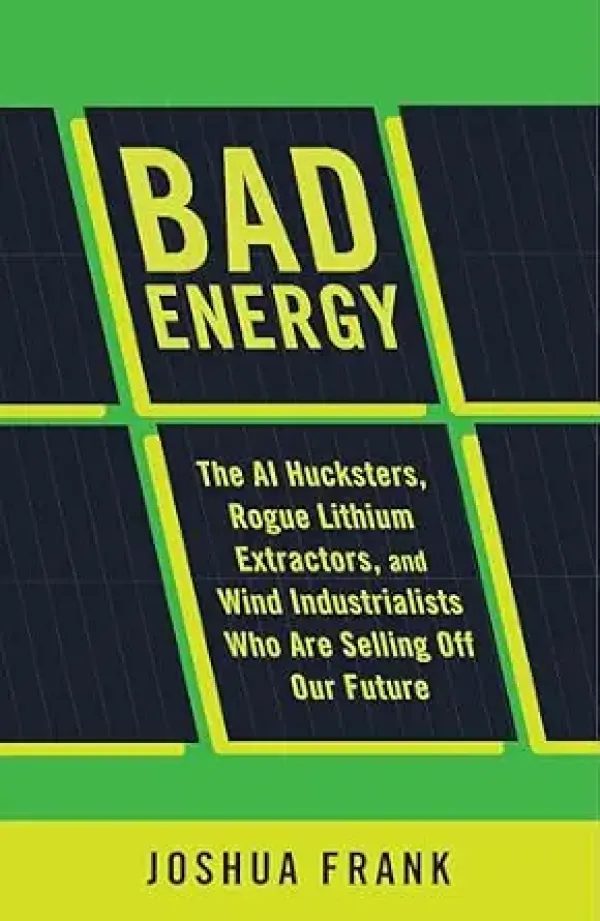
Bad Energy bookcover
The road to hell, they say, is paved with good intentions.
As we’ve learned from Donald Trump, bad ones will do every bit as well.
And when it comes to energy, that road is littered with toxic corpses.
The worst of all remains nuclear power, in which Trump is a major investor. He also runs the Nuclear Regulatory Commission, from which his pet Supreme Court says he can fire anyone without demonstrable cause.
That means, simply enough, that if an honest NRC whistleblower (there are certainly still a few) warns that a defect in an atomic reactor is about to lead to a major melt-down, Trump can have them fired even if he admits that the real reason is his psychotic impulse to protect his personal investments.
Even before Trump we experienced the tragedy of Dr. Michael Peck, an esteemed NRC site inspector who warned that California’s Diablo Canyon nukes could turn to radioactive rubble in the wake of a likely earthquake. Such a disaster could kill millions (I live downwind and take this VERY personally) where federal law has ruled (since 1957) that reactor owners need carry no private liability insurance.
Needless to say, the NRC trashed Peck’s findings, and he was soon gone from the Commission. Today, Trump might well have him prosecuted or deported.
It’s often hard to remember, but “Our Friend the Atom” was once viewed as a semi-divine savior by some who’ve treasured our ecological future. As a hyper-expensive, billionaire-owned alleged substitute for fossil fuels, there are STILL those who labor under the delusion that reactors burning the planet at 550 degrees Fahrenheit while emitting radioactive carbon and spewing thousands of tons of unmanageable atomic waste are somehow good for us.
Joshua Frank is not one of those. As Managing Editor of the staunchly anti-nuke CounterPunch website, Mr. Frank is one of America’s most impactful advocates for safe energy. His epic Atomic Days dissects in devastating detail the terrifying realties of the Hanford Nuclear Waste Reservation, whose catastrophic decades of Bomb production now threaten the future of the entire Pacific northwest, and with it the vital Columbia River, an irreplaceable artery in the global ecology.
So when we encounter in Bad Energy Joshua’s core questioning of various incarnations of renewable energy, we need to take special notice.
Such critiques are often viewed as akin to treason in certain green circles.
But Mr. Frank here reminds us that no technology can ever be perfect. And that the last thing we want to do is to cover the earth with “solutions” that could make things worse.
Solar panels, for example, on balance can generate massive quantities of cheap, clean, fast-to-build, job producing alternatives to the failed insanity of atomic energy. They are essential to the future of our species.
But if done wrong, they will bite us, and not just in the ass.
In many current incarnations, they can be toxic and resistant to recycling. That needs to change.
They can also be installed where they absolutely don’t belong.
In one case, Joshua recounts a generally reasonable Los Angeles Times reporter justifying an insane plan to chop down rare, critically endangered Joshua Trees in order to install a massive solar farm.
As a fellow Angeleno, I clearly recall reading that story in the original, with pure native horror. After all, what greater solar collector has ever been created than an actual tree, let alone an endangered Joshua Tree?
In a truly invaluable analysis, author Joshua Frank does the math, not the meth. He points out that thousands of square yards of un-encumbered rooftops in and around LA could do very well being covered to deflect the hot sun, as well as hosting panels for generating electricity. Author Frank has the brilliance, indeed, to compare the available rooftop square footage with that of the actual forestland to be destroyed to host panels that should instead be serving a dual purpose on hyper-hot rooftops.
“If residential solar has succeeded exceptionally well and has so much possibility,” Frank asks, “why are we intent on destroying desert ecology with massive industrial-scale solar farms?”
Even with rural-sited solar farms we have the creative possibility of doing agri-voltaics, where power installations serve both the eco-system and food supply.
The question takes a proverbial swim when we further remember that solar panels can cover aqueducts, canals and reservoirs, saving countless gallons of precious water from avoidable evaporation while cooling panels that gain efficiency with diminished heat
Real damage can also be done by carelessly sited wind turbines, which unnecessarily kill birds. Or with corporations that make a mess of the Earth’s heat by siting geothermal facilities in ecologically inappropriate locations and even in spots (especially in Hawaii) sacred to native peoples.
Frank reaffirms the case for advancing Solartopian production and storage in a post fossil-nuke world.
But along the way he makes the absolutely critical point that it will make no sense for us to go there in a sloppy rush, closing our eyes to the inconvenient truths demanding that even our most seductive green technologies be handled with care.
The transition to a global renewable energy base also demands social justice. “The average person in Bangladesh consumes less electricity every year than the refrigerator in your kitchen during the same period of time,” Frank writes.
There are thus technical, ethical, moral and ecological problems with solar, wind, geothermal, batteries and more that demand we keep our eyes open and our monitors in place.
Joshua Frank performs a serious service with Bad Energy. The last things we want poisoning the transition to our necessary Solartopian future are glib illusions that might mirror a “Peaceful Atom,” which turned so lethal in so many greedy, blind, careless ways. Nuke power today is more dangerous than ever, being rammed down our throats without insurance, by utterly incompetent KeyStone Kop perps, for the sole benefit of uncaring billionaires and their oligarchic AI data centers.
But we still face clear imperatives to engineer photovoltaics, wind turbines, geothermal wells, solid state post-lithium batteries with serious care, in ways we can be sure will serve our heath, economy and planet imperfectly...but well enough to yield us a truly sound, sustainable future.
Joshua Frank has done well here to expose the really Bad Energies we need to leave behind, no matter how green some of them might seem for the unexamined moment. Capitalism, he warns, is a virus that feeds on both the human body and the Earth. Some of its most benign-seeming technologies could, in fact, kill us if we don’t take proper green precautions.
We can thus remain 100% certain of the dire need to make this post-fossil/nuke Solartopian transition happen as soon as possible.
But this book reminds us that doing it right demands humble, organic, big-picture care.
Harvey “Sunny” Wasserman wrote Solartopia! Our Green-Powered Earth, and The People’s Spiral of US History. He co-convenes the GREEP zooms (https://grassrootsep.org) most Mondays, & Pacifica’s weekly Solartopia Show.