
The Beginning of the End of American Primacy: Is the World Witnessing a Historic Transfer of Global Power?
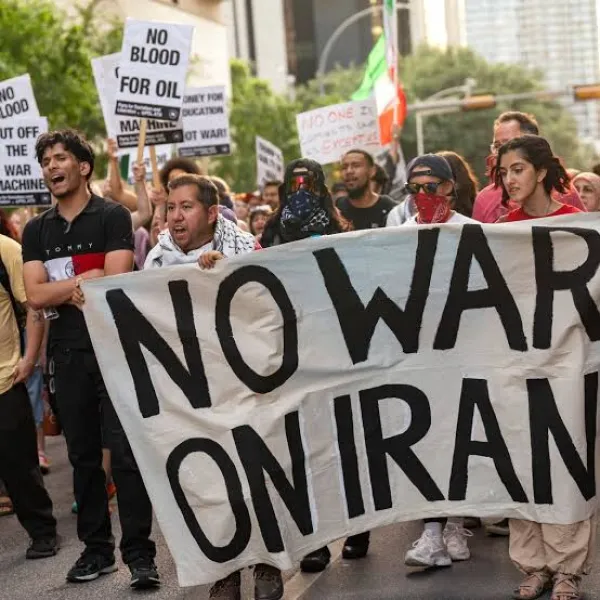
Creative commons image via the Independent
Wars do not always produce the outcomes anticipated by those who initiate them. Sometimes their most consequential effects are not measured by territory gained, military targets destroyed, or enemies defeated, but by the political and strategic transformations they set in motion. The war with Iran may prove to be one of those historic turning points. Its consequences could extend far beyond the Middle East, accelerating the erosion of American global primacy and ushering in a new international order in which the United States is no longer the unquestioned superpower.
The Iran war has fundamentally altered the nature of the Iranian regime. Rather than producing a weakened and politically discredited government ready to compromise with the West, the conflict created a more militant, militarized, repressive, and deeply anti-American state. The experience of war, external attack, and perceived existential threat may reinforce the regime's conviction that its survival depends on greater military capabilities, stronger internal repression, and ultimately the acquisition of nuclear weapons.
There is a profound strategic irony here. A war intended, among other things, to eliminate Iran's nuclear ambitions may have strengthened the political and ideological motivations for pursuing a nuclear deterrent. The Iranian leadership may conclude that the only reliable guarantee against future American or Israeli military intervention is to possess the ultimate weapon of deterrence. If that calculation prevails, the war may have made the prospect of a nuclear-armed Iran more likely, not less.
But perhaps the most consequential damage of the war has been inflicted on America's relationships with its traditional partners in the Persian Gulf. For decades, the security architecture of the Gulf rested on the American security arrangement: America provided military protection and strategic stability, while Gulf countries offered military bases and access to energy resources particularly gas and oil, and geopolitical alliances under the American led world order. That bargain is now under unprecedented strain. The war has exposed an uncomfortable contradiction at the heart of the American security presence in the region. The very military bases and strategic installations intended to protect America's Gulf partners have also made them potential targets in a confrontation with Iran.
For these countries, the question now is whether an American security partnership actually makes them safer. When decisions made in Washington can expose their cities, energy infrastructure, shipping routes, and economic ambitions to retaliation, the American security umbrella can begin to look less like protection and more like vulnerability. The war has already shaken the foundations of trust. These countries are diversifying their strategic relationships, develop greater independent defense capabilities such as Macca agreement between Saudi Arabia and Turkey, and pursue a more pragmatic foreign policy that gives them room to maneuver between Washington, Beijing, and other global and regional powers.
The consequences extend beyond the Middle East. Perhaps the greatest casualty of the war is the perception of American military supremacy. For decades, American power rested not only on its extraordinary military capabilities but also on the belief that those capabilities could be translated into decisive political outcomes. The United States was widely regarded as a military superpower that could project force anywhere in the world, defeat its adversaries, and shape the political consequences of conflict. That perception was itself an instrument of American power. It deterred adversaries, reassured allies, and reinforced Washington's authority in international affairs.
The Iran war has challenged that assumption. Military superiority and strategic success are not the same thing. A country can destroy military installations, degrade an adversary's capabilities, and demonstrate overwhelming technological superiority while still failing to achieve its fundamental political objectives. If an adversary survives, retains the capacity to inflict substantial damage, and emerges more determined to resist, the meaning of military victory becomes considerably less clear.
The myth of American military invincibility has suffered a serious blow. Its technological advantages, global military reach, and economic resources remain formidable. But the world may increasingly distinguish between American military strength and American strategic effectiveness. That distinction could prove more consequential than the immediate military outcome of the war.
It is against this background that President Trump's recent visit to China and his meetings with Chinese President Xi Jinping and Russian President Vladimir Putin acquire a significance that extends beyond conventional diplomacy. The image of the American president meeting the Chinese and Russian leaders in China, under the diplomatic auspices of Beijing, is itself revealing. For the first time, the three leaders of the world's major nuclear powers have appeared together in a setting that places China at the center of the diplomatic stage. The symbolism is difficult to ignore. China is no longer simply a rising power seeking recognition within an American-led international system. It is increasingly positioning itself as a power capable of shaping that system.
The summit may ultimately produce few substantive agreements. But its symbolism could prove more important than its immediate diplomatic results. The United States is no longer operating in a world in which it can unilaterally establish the rules, define the agenda, and expect other major powers to follow. Washington increasingly has to negotiate with competitors that possess their own strategic ambitions, economic leverage, and visions of the international order.
There is perhaps an even deeper message in Trump's willingness to participate in this diplomatic configuration. Does it reflect a tacit recognition that the era of unquestioned American dominance is coming to an end? Is Washington beginning to acknowledge, even if indirectly, that it must accommodate a world in which power is more widely distributed and American leadership can no longer be taken for granted? If so, the moment invites an extraordinary historical comparison.
After the Second World War, Britain gradually relinquished its position as the world's leading power. The British Empire had emerged victorious, but the war had exhausted its economic resources, weakened its global reach, and undermined the foundations of its imperial system. The United States, meanwhile, emerged with an enormous industrial advantage, unmatched financial resources, and a military presence spanning the globe. The transfer of global leadership from London to Washington was not simply the consequence of British military defeat. It was the result of a deeper structural transformation in the distribution of economic, military, and political power.
Could America now be approaching a comparable historical transition?
The analogy is not exact. America is not a defeated empire, nor is China in a position to assume all the responsibilities of global leadership that the United States inherited from Britain. China faces serious economic, demographic, political, and strategic constraints of its own. Russia, despite its military capabilities and geopolitical ambitions, lacks the economic foundation to become a comprehensive global superpower.
But the emergence of a multipolar international system does not require a single successor to American power. It may instead produce a world in which China becomes the principal economic and technological competitor, Russia retains significant geopolitical and military influence, and regional powers acquire greater freedom to pursue independent strategies. The real historical question, therefore, is not whether America will suddenly cease to be a superpower. It is whether it is losing the capacity and willingness to sustain the international order it has led since 1945.
Great powers rarely recognize the end of their primacy while it is happening. They tend to interpret setbacks as temporary, military disappointments as isolated events, and the erosion of alliances as manageable diplomatic problems. Yet historical transitions often become visible only in retrospect, when a series of seemingly unrelated events is understood as part of a much larger transformation. The war with Iran, the growing doubts among America's Gulf partners, the erosion of the perception of American military invincibility, and the emerging diplomatic prominence of China may ultimately be remembered as interconnected elements of such a transformation.
Perhaps Trump's visit to China will be remembered not as the moment America surrendered its global leadership, but as a moment when the changing balance of power became impossible to ignore. Like Britain after the Second World War, America may be approaching a period in which it must reconcile itself to a world where it is no longer the indispensable center of international affairs.
The danger is that America may be losing its primacy without yet having developed a coherent strategy for life after primacy. A peaceful transition to a more limited role in the international system would require strategic restraint, diplomatic sophistication, and an acceptance that American interests cannot always be imposed through military power. The alternative could be considerably more dangerous: a declining superpower attempting to preserve its dominance through increasingly unpredictable uses of force, while its allies hedge, its adversaries become more assertive, and the international order fragments.
History may eventually judge the Iran war not simply as a Middle Eastern conflict, but as one of the events that marked the beginning of the end of the American-led international order. The most consequential question may no longer be whether America can still win wars. It may be whether America can recognize that the world in which it became a superpower is disappearing—and manage its transition to a different place in the international order without plunging the world into another era of instability.