
Bill to Effectively Ban Ranked-Choice Voting moves to DeWine’s Desk
Well, the statehouse is once again attacking our right in Ohio to local democracy. Senate Bill 63, which has passed the Ohio House and Senate, is now on Governor DeWine’s desk.
SB 63, which would make any county or municipality that has approved the use of ranked-choice voting ineligible to receive local government funds from the state. This bullying bill would effectively ban ranked-choice voting in Ohio. It is in violation of the principle of home rule and local self-government which was enacted into our Ohio Constitution in 1912. This principle recognizes that government works best where it is closest to the people. Also, it allows communities to experiment with laws and policies that meet their local needs. Furthermore, in a democracy, the people in a community should be able to enact and enforce local laws for their health, safety, and welfare as long as those laws do not conflict with constitutional rights granted to natural persons.
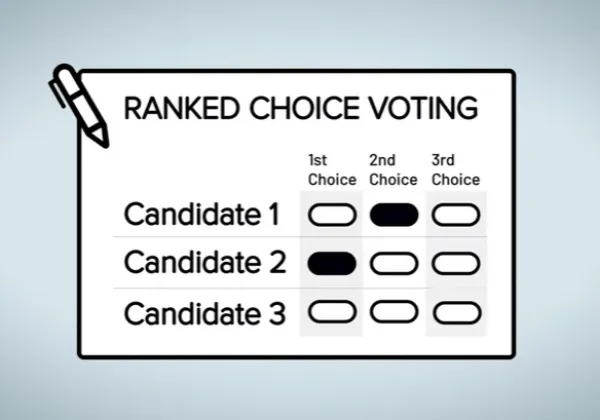
Ranked-choice voting (RCV) is a system whereby voters rank candidates on a ballot in order of preference. Once the first-place votes are tabulated, if no candidate receives a majority (more than 50 percent) of the votes then the last place candidate is eliminated. Any voter whose first choice was the eliminated candidate will now have their second choice count and then the votes are retabulated. The process continues until a candidate receives a majority. RCV is used in nearly 50 jurisdictions across the country including Maine, Alaska, New York, and San Francisco.
One benefit of RCV is that voters no longer have to choose the lesser of two evils. They can vote for who they really want as a first choice and not worry about their choice being a spoiler. Also, candidates will have to appeal to a wider range of voters and not just to a strong base if they wish to be elected. RCV will help with polarization, make primaries more meaningful, and more easily allow for alternative choices to the two-party duopoly. In addition, RCV has been shown to increase voter turnout.
There is no overriding state interest – as if often used to justify preempting local authority - in banning ranked-choice voting in Ohio, only antidemocratic, mainstream party interests who want to control the choices of candidates and results of elections.
Regarding ranked-choice voting (RCV), Walter Olson of the Cato Institute stated, “RCV improves elections by letting voters communicate much richer data about their preferences. It probably also tends to help the sorts of candidates who appeal to many kinds of voters, not just a narrow, super-committed base. That’s good news, not bad, for both Republicans and Democrats in search of high-quality candidates.”
SB 63 has two primary sponsors, Republican Senator Theresa Gavarone and Democratic Senator Bill DeMora. When SB 63 was voted on in the Ohio House and Senate, several Democrats voted for it, but when the Ohio Senate finally concurred with House amendments to the bill on March 4 of 2026, Bill DeMora was the only Democrat voting for it.
Recently, DeMora stated, concerning a data center project in Hilliard where Amazon is installing a natural gas power system over objections of local residents and officials, “We have to let local people decide what’s best for their local communities, instead of the state cramming things down their throats.” Most residents would agree. Hypocritically, DeMora does not want to let local people decide if they wish to adopt RCV and now he is for the state cramming a ban of RCV down our throats!
The practice of statehouse overreach in infringing on home rule and local self-governance is called state preemption. In Ohio so far, the state has preempted local legislation on minimum wage, rent control, banning plastic bags, pesticide use, sensible gun restrictions, puppy mill bans, fracking and its waste, and many others. SB 63 is attempting to add RCV to the growing list.
A local group, Columbus Community Bill of Rights, of which I am a co-organizer, is collecting signatures for a Columbus Charter Amendment ballot initiative that will challenge this unconstitutional encroachment upon our rights. The initiative will clearly define our local self-governing rights and declare their immunity to state lawmakers’ unconstitutional preemptive bans. We have worked cooperatively with the Central Ohio Chapter of Rank The Vote Ohio to oppose SB 63. Our goal is for the initiative to appear on the November 2027 ballot.
Please consider signing our initiative if you encounter one of our volunteer at various events. We will have a booth at Comfest and Hot Times Festival this year. Also, you can contact DeWine and demand that he veto SB 63.
State officials have to let democracy and local self-government rule, allow communities to experiment to make their lives better, and trust them to alter or repeal local laws if they do not meet their needs. If we don’t have democracy where we live, then we don’t have democracy.
Let the people decide!
--
Bill Lyons is the Co-organizer of the Columbus Community Bill of Rights and President of the Ohio Community Rights Network.