
Blockades and the Logic of Collective Punishment
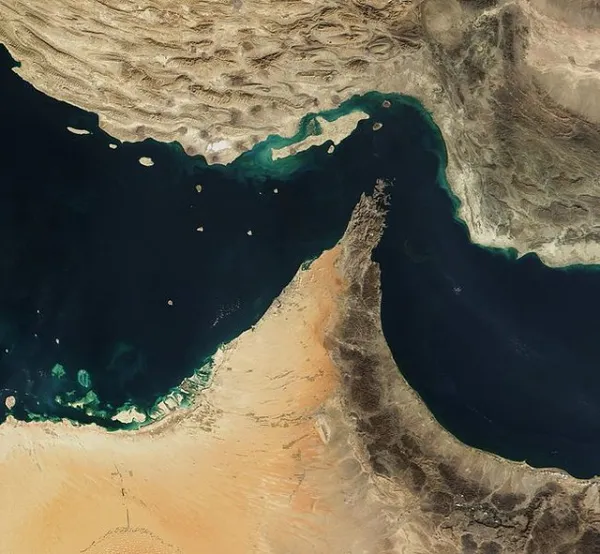
Strait of Hormuz Creative commons image via Flickr
The naval blockade around Iran exposes something modern war talk tries to hide: coercion no longer needs to look like war to function as war. It only needs to control the systems people depend on to live.
The Strait of Hormuz is not a symbolic chokepoint. It is one of the most important energy arteries on the planet. The current U.S.-enforced blockade operates through inspections, interdictions, and the constant threat of force against shipping tied to Iranian ports. In practice, this means delays to tankers, rising insurance premiums, rerouted vessels, and heightened risk for even third-party shipping. What this produces is not clean “pressure” on a state. It is friction injected into global systems—fuel flows, insurance markets, shipping routes, and civilian supply chains that extend far beyond any military target.
This is the first myth that needs to go: that blockades are a restrained alternative to violence. They are not. They are violence administered through systems instead of explosions.
The blockade of Iran makes that impossible to ignore. When maritime movement is restricted in the Strait of Hormuz, nothing stays contained within “military impact.” Energy prices shift. Shipping patterns adjust. Costs propagate across interconnected markets. Civilian infrastructure absorbs the shock first and longest. That is not collateral damage. That is how the mechanism functions.
And Iran does not respond in the way blockade theory predicts.
It does not simply absorb pressure and move toward compliance. It adapts within constraint. It reroutes trade, leans on alternative networks, escalates threats against shipping in return, and folds external coercion into domestic political justification. The message becomes simple: the country is under siege, and siege conditions demand consolidation, not concession.
This is the failure at the center of modern coercive strategy. It assumes pressure travels in a straight line—from economic constraint to political submission. That assumption is not just wrong. It is dangerously simplistic.
Societies under sustained pressure do not behave like equations. They reorganize around constraint. They generate black markets. They shift costs downward. They harden internal control. And crucially, they redirect blame outward. What is meant to fracture a regime often strengthens its narrative of external hostility.
This is not an implementation flaw. It is built into the structure of blockade warfare.
Historically, blockades have operated by exposing civilian systems to sustained deprivation. From Napoleon’s continental system to the American Civil War to the Allied blockade of Germany in World War I, the objective was not simply battlefield victory. It was economic suffocation—restricting food, fuel, and trade until political pressure emerged from within society itself.
The language has changed since then. The logic has not.
Today’s “smart sanctions” and “targeted restrictions” repeat the same pattern under more technical terms. They promise precision. They promise restraint. But in integrated economies, there is no clean separation between military and civilian systems. Restrict energy flows and hospitals suffer. Disrupt finance and food distribution falters. Interfere with shipping and civilian markets carry the cost.
The idea of a surgical blockade is a fiction sustained by distance—from consequences, and from the people forced to live inside them.
What makes this worse is the moral laundering embedded in modern strategic language. Blockades are described as less violent than war, as if slow disruption is preferable to visible destruction. But the violence is not reduced. It is dispersed. It is stretched across time and embedded in infrastructure, making it harder to identify and easier to ignore.
Whether intended or not, this is how blockades function. They make harm administratively diffuse.
And that brings us back to Iran.
The Strait of Hormuz blockade is not just a military posture. It is a mechanism that entangles civilian life in geopolitical confrontation. It turns everyday economic dependence into an instrument of pressure while preserving the fiction that what is being applied is restraint rather than force.
This is where the logic begins to collapse.
Because the core assumption behind coercive strategy—visible in recent U.S. policy and articulated most explicitly by figures like Donald Trump—is that material pressure produces predictable political compliance. It does not. It produces adaptation, fragmentation, resistance, and often consolidation of the very systems it is meant to weaken.
The result is a strategy that mistakes suffering for leverage.
When a strategy predictably imposes widespread civilian harm in order to influence political outcomes, it begins to resemble what international law defines as collective punishment—regardless of how it is labeled.
And that is the central failure in how the blockade of Iran is understood. It treats disruption as control. It treats pressure as obedience. It treats civilian exposure as an acceptable cost of geopolitical design.
But blockades do not isolate states cleanly. They redistribute harm through populations who did not choose the conflict and cannot opt out of its effects. They turn infrastructure into a battlefield and survival into a pressure point.
“Collective punishment” is not rhetorical excess here. It is a structural description.
This is the quiet failure at the center of Donald Trump’s coercive strategy—from Cuba to Venezuela to Iran: it mistakes suffering for leverage and calls the outcome strategy.