
Book Review - The Afterlife of Malcolm X: An Outcast Turned Icon’s Enduring Impact on America by Mark Whitaker
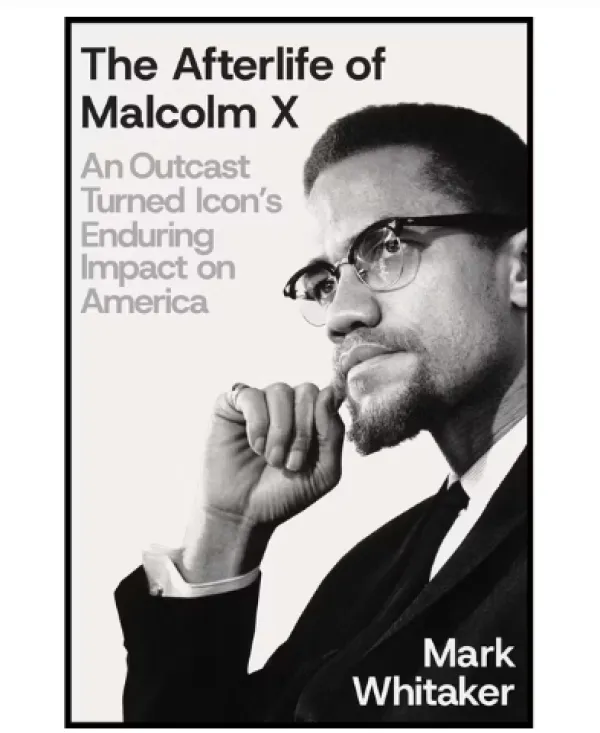
Malcolm X was one of the most dynamic and misunderstood leaders in the United States in the middle of the twentieth century. He was tall, handsome, extraordinarily charismatic, and a spell bounding, fiery orator. While he never received mainstream acceptance during his lifetime, his impact on the country and in black America is undeniable.
Born Malcolm Little in 1925 in Omaha, Nebraska, he was the fourth of seven children of Louise Langdon Little of Grenada and Earl Little. His mother was an educated woman of mixed heritage. Her father was white, and so she was light-skinned. She “looked like a white woman,” Malcolm recalled in his autobiography. “She had straight black hair, and her accent did not sound like a Negro’s.” His parents were both admirers of Marcus Garvey, the Jamaican Pan African activist who started the Universal Negro Improvement Association (UNIA), and both worked for the organization. As such, the Little children were instilled with the UNIA values of black pride and self-reliance. The local Ku Klux Klan targeted Earl because of his beliefs and activities on behalf of the UNIA and so the Little family moved to Milwaukee in 1926. There they found themselves harassed by a white supremacist group known as the Black Legion and their home was set afire. In 1931 Earl Little was killed in a street car accident, although his family always thought the Black Legion had been responsible for his murder.
Malcolm’s mother struggled to rear seven children and slid into despair. /diagnosed with what is euphemistically referred to as a nervous breakdown, she was institutionalized and the Little children were pretty much left on their own.
Malcolm was a good student, but was discouraged by white teachers who telegraphed their low expectations of him–indeed, of all black students. Leaving school in the eighth grade, he moved to Boston to live with his sister Ella Collins; he later moved to Harlem. It was there he was sucked into a life of petty crime and drug use, and by the age of twenty-one he was in prison. Several of his siblings told him of their conversion to the Nation of Islam (NOI) which he began to study while still incarcerated. His interest piqued, he wrote to Elijah Muhammad, the leader of the NOI, and upon his parole joined the organization. Muhammad preached racial separatism, personal responsibility, and the theory that whites were “blue-eyed devils.” Muhammad welcomed Malcolm into the organization where he changed his name to Malcolm X and was posted to a series of mosques in Philadelphia, Detroit and Harlem.
At Mosque No. 7 in Harlem, Malcolm gained great fame for his dynamic speaking style and castigation of blacks who supported integration. He was often compared–and not in a positive way–to the Rev. Dr. Martin Luther King, Jr., who preached nonviolence and racial integration. Malcolm was openly critical of King and the concept of non-violent direct action supported by him and other civil rights organizations. The irony was that the two men met only once and very briefly when they were both in Washington, D.C. during the time Congress was debating the bill that became the 1964 Civil Rights Act. Each man was aware of the other and Malcolm had written at least one letter to Dr. King in 1963 and once shared a platform with Coretta Scott King. Two years later, Malcolm was dead.
The Afterlife of Malcolm X coincides with the one hundredth anniversary of Malcolm’s birth. It is really two stories: an overview of Malcolm’s extraordinary life and his impact on disparate groups and individuals and an investigation into his murder. Whitaker’s book begins with Malcolm’s death. The first section covers the assassination, how the crime was reported, and the trial and conviction of three men charged. Subsequent sections cover how Malcolm X inspired Black America through the early 1970s, his rediscovery and importance to popular culture, his travels to Europe, Africa and the Middle East, his conversion to Sunni Muslim belief, the reinvestigation of his death, and the exoneration of the men imprisoned for it.
Mark Whitaker is a long-time journalist; in 1979 while a student at Harvard, he served on the editorial board of the Harvard Crimson. He authored the Newsweek cover story on the release of Nelson Mandela from prison. From 1998 to 2006 Whittaker was the first Black editor of Newsweek magazine. During that time Newsweek won several National Magazine Awards for General Excellence for its coverage of the terrorists attacks of September 11 and the Iraq War. He also served as the Washington Bureau Chief and Senior Vice President at NBC. As managing editor and senior vice president at CNN, he developed CNN Films. A prolific writer, he is the author of four other books, including the critically acclaimed Saying It Loud: 1966 – The Year Black Power Challenged the Civil Rights Movement. His CBS Sunday Morning segment about is great grandfather who had been born in slave in Texas before Juneteenth won an Emmy.
One of the fascinating things about Malcolm X is his wide ranging influence across the political, social, and historical spectrums. His admirers include the Black Panthers, Barack Obama, Maya Angelou, Kareem Abdul-Jabar, and–at least for a time–Clarence Thomas. More than sixty years after his murder, he continues to inspire conversations and movements about race, racism, black pride, and liberalism.
Right up to this death, Malcolm X–El Hajj Malik El-Shabazz–continued to grow, question, and change. Whittaker shows us that his iconic status is secure.