
Book Review: Art and Activism: Jazz Artists and Writers in the Civil Rights Vanguard by Jack Marchbanks
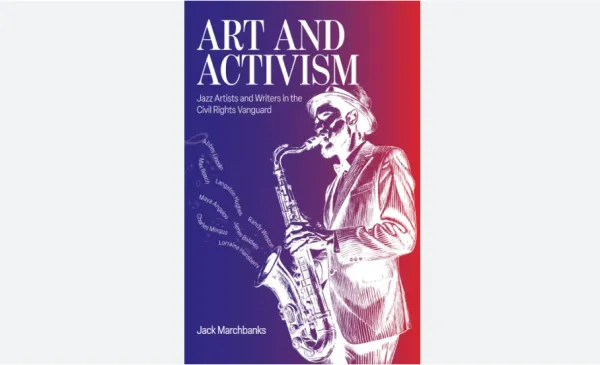
When crafting a book review, each author is faced with the unenviable task of writing just enough to pique the reader’s interest while resisting the temptation to delve too deeply for fear that doing so will quench the reader’s thirst and dampen any enthusiasm one might have had to purchase the book or check it out at the local library.
An original piece of scholarship, Jack Marchbanks has produced a tour de force. In this seven-chapter book of more than 300 pages readers learn about the intersection between the world of jazz, literature, and the modern civil rights movement.
The book’s first sentence sets the stage for all that follows. Marchbanks writes, “this book tells the story of how a select group of jazz musicians and jazz-admiring writers used their creative gifts to raise their audiences’ awareness of the social, economic, and political forces affecting African Americans” (p. 1).
The book’s period of investigation begins in 1955 the year that fourteen-year-old Emmett Till was murdered in Money, Mississippi and Rosa Parks refused to move from her seat thus sparking the Montgomery Bus Boycott to 1965 the year of Sam Cooke’s “A Change Is Gonna Come” and the passage of the Voting Rights Act.
The book’s introduction, as it should, does a terrific job of laying the much-needed groundwork for those who may not be jazz aficionados yet are students of Black peoples’ struggle for freedom, justice and equality. Marchbanks argues that the jazz artists and writers in this book can be said to have acted as public intellectuals. In Chapter 2 Marchbanks offers a fascinating examination of Big Band leader Duke Ellington and the literary giant John Mercer Langston Hughes aka Langston Hughes. One of the things readers will find most interesting in this chapter is the influence Hughes had on writers such as Gwendolyn Brooks, Ralph Ellison and James Baldwin and the ways they came to view Hughes over time and vice versa. Aside from these well-known characters readers will encounter lesser known yet important figures such as Lionel Trilling, Richard Gibson, Melvin Tolson and the anti-apartheid author Peter Abrahams.
Chapter 3 is equally captivating. Marchbanks places the modern civil rights movement, namely the fight to desegregate Central High School in a context that few writers have successfully accomplished. Marchbanks points out there was and has been some debate regarding the extent of Daisey Bates’s role in the Central High School crisis. While that may be true any history of Black peoples’ struggles for freedom, justice and equality in the city of Little Rock specifically, and Arkansas generally, without discussion of this important National Association for the Advancement of Colored People (NAACP) leader is merely a work in progress. Speaking of the NAACP, the organization was founded in 1909 not 1911, an error that most likely occurred during the editing process.
Chapters 4-7, not unlike the previous chapters, are chock full of interesting nuggets about some of the most widely known jazz artists and writers as well as those whose names are not as frequently mentioned as those cited in chapter two. Be that as it may, readers will take note of the ways that both jazz artists and writers contributed to the modern civil rights movement.
Readers will greatly appreciate chapter 5 and the time and attention Marchbanks devotes to women writers and jazz artists of the early 1960s. Giants such as Melba Liston, Nina Simone, Lorraine Hansberry and Mary Lou Williams are featured prominently.
In chapters 6 and 7 Marchbanks paints a vivid portrait of the year 1963, which he considers a pivotal, and arguably the most violent year of the modern civil rights movement. One of the more interesting stories in chapter 6 revolves around actress Lena Horne who initially was hesitant to involve herself in the movement, but by 1963 had thrown herself full force into the fray. “The Evers assassination and grisly bombing murder of the Birmingham girls galvanized Horne into action” writes Marchbanks (p. 217).
Two months after Medgar Evers was murdered, approximately 250,000 people converged on the nation’s capital for the March on Washington for Jobs and Freedom. Among the approximately 250,000 attendees were numerous celebrities including Lena Horne. Perhaps the most controversial attendee was Nation of Islam’s Minister Malcolm X of Temple No. 7 in Harlem. On page 218 Marchbanks notes that Malcolm X considered the March a farce, which is true (at least, those were Malcolm’s sentiments) and thus boycotted the March which is false. When Malcolm X still a member of the Nation of Islam at the time sought Elijah Muhammad’s permission to attend the March on Washington Muhammad made clear that should Malcolm attend the March it would be as a private citizen not as a representative of the Nation of Islam. Farce or no farce, Malcolm was not about to miss out on being a part of such an historic event no matter what he may have said publicly.
As for other celebrities, namely Black performers and entertainers, some like Lena Horne came to understand that celebrities’ willingness to headline fundraisers was vital to the success of the modern civil rights movement. Horne’s year-end 1963 civil rights concert with Frank Sinatra at Carnegie Hall is indicative of that. Contrary to what some may believe several of the major organizations that comprised the modern civil rights movement (such as the NAACP, the Congress of Racial Equality, the Student Nonviolent Coordinating Committee and the Southern Christian Leadership Conference) were not flush with cash. Proceeds from celebrities’ performances were well-received.
The eighteen-page chapter 7 provides readers with among other things a rich and robust discussion of the Minister Malcolm X’s impact on many of the jazz artists and writers mentioned in the book. Marchbanks writes, “while they supported the Black church-anchored civil rights movement with their fundraising efforts, these artists found cathartic satisfaction in his searing condemnation of American hypocrisy at home and abroad. Marchbanks continues, “their embrace of the combative el-Shabazz in the late 1950s and very early 1960s is another example of how the political thought circulating among this cadre of jazz artists and writers was an early indicator of a more confrontational, militant activism that would come to the fore” (p. 229). “In this case, it augured how the civil rights movement would evolve into an angrier, more urban, and more confrontational phenomenon, starting with the Los Angeles Watts riots in 1965” (p. 229). By more confrontational phenomenon Marchbanks is undoubtedly referring to the Black Power Movement, and by riots Marchbanks is referencing the well-known rebellion that occurred in August of that year and is considered one of the most destructive uprisings of that era.
Finally, the list of sixteen significant jazz albums released during the modern civil rights movement and the struggle for African Independence that appears at the end of this book is a must have for any budding or seasoned record collector.
Art and Activism warrants a prominent place on bookshelves alongside Frank Kofsky’s 1970 Black Nationalism and the Revolution in Music, Walton M. Muyumba’s 2009 The Shadow and the Act: Black Intellectual Practice, Jazz Improvisation, and Philosophical Pragmatism, and Jeremy Lane’s 2014 Jazz and Machine-Age Imperialism: Music, “Race,” and Intellectuals in France, 1918-1945. The major difference is that Art and Activism is not only an excellent read but a time traveling experience that readers won’t soon forget. For students of both jazz and the modern civil rights movement Art and Activism is a must read that will stand the test of time. I highly recommend this book.
Art and Activism: Jazz Artists and Writers in the Civil Rights Vanguard. Athens, Ohio: Ohio University Press, 2026. X + 311 pp. ISBN 9780821426876. Paperback
Judson L. Jeffries PhD, MPH, is Professor of African American and African Studies at The Ohio State University