
Book Review: A Dream Deferred: Jesse Jackson and the Fight for Black Political Power by Abby Phillip
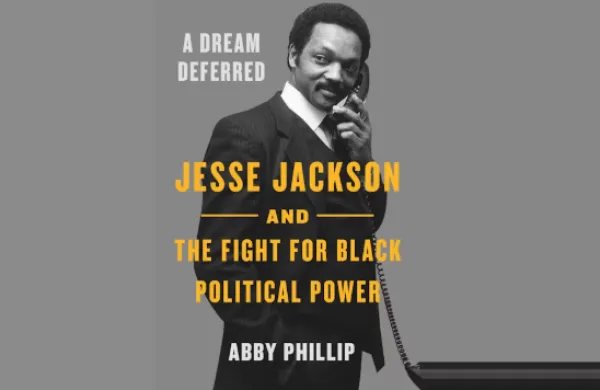
When the Reverend Jesse Jackson died on February 17, it was very nearly the end of an era. Watching his funeral was surreal. Now only the Reverend Andrew Young remains from that group of African American preachers who fought so doggedly for civil rights in the 1960s.
I had the pleasure of meeting Jackson when he was running for president in 1988. I was the secretary to the director of Traffic and Parking at The Ohio State University and he was going to speak on campus at Mershon Auditorium. There was some coordination about parking and safety issues for his campaign. I cannot remember how I ended up backstage before he went on, but a group of us were introduced to him. I told him I was very proud of him and he hugged me and said–in that great southern drawl–”Aw, thank you darlin’.” I felt like a groupie and I have never forgotten it.
Jackson came to national prominence as one of the men who was at the Lorraine Hotel in Memphis, Tennessee when the Reverend Dr. Martin Luther King, Jr. was assassinated on April 4, 1968. Jackson had participated in the Selma voting rights march and had been King’s point man in Chicago as King and the Southern Christian Leadership Conference (SCLC) began to expand its civil rights work outside the South. King was standing on the balcony with Reverend Ralph Abernathy and Reverend Billy Kyles; Jackson and Andy Young were standing below. Jackson said King had pointed out he was late for dinner and not wearing a tie, and they exchanged some lighthearted banter. After the shot, Jackson and Young rushed up to join the other men standing with King as they tried to render aid.
Jackson was born Jesse Louis Burns on October 8, 1941 in Greenville, South Carolina, to the teenaged high school student Helen Burns and her married neighbor, Noah Louis Robinson. The next year his mother married a post office maintenance worker named Charles Henry Jackson, and he later adopted Jesse. Even though he took his stepfather’s last name, he had a relationship with his birth father. Growing up, he was regularly taunted for having been born out of wedlock. He felt that sting the rest of his life, sometimes referred to it in speeches, and often said it strengthened his will to succeed. During his lifetime he used the circumstances of his conception and birth as an example of how young people, especially young black people, could transcend their origin circumstances and build a meaningful and successful life.
Jackson attended segregated schools and chafed under the daily humiliations of southern segregation. He graduated tenth in his class from Sterling High School in 1959 and lettered in basketball, football, and baseball. Turning down a contract to play minor league baseball, he entered the predominately white University of Illinois on a football scholarship–one can imagine the tremendous culture shock!–but left after two semesters, transferring to the historically black North Carolina A & T in Greensboro. Jackson, a popular student, was elected student body president and was quarterback of the football team. While at North Carolina he participated in demonstrations against segregated public accommodations. In 1962, he met Jacqueline Lavinia Davis, a fellow student at North Carolina who was also active in civil rights demonstrations, and they married in December of that year. Jackson earned a B. S. degree in sociology in 1964, and then entered the Chicago Theological Seminary as a scholarship student. He left the seminary in 1966 to devote himself to full time civil rights work.
Phillip posits that it was the Gary Declaration, which came out of the National Black Political Convention in March 1972, held in Gary, Indiana that put Jackson on the path to thinking he could be president. More than three thousand black Americans from across America met seeking to harness the political interests and power of the black community nationwide, to work to ensure more blacks were elected to political offices, and to develop a unified program to uplift black Americans and solidify the gains made during the civil rights movement. According to Phillip, “It was a proving ground for Jackson’s theory that when Black voters were united and activated, their political power would be impossible to ignore.”
In A Dream Deferred we see the names and life work of the first generation of blacks elected to city councils and mayor’s offices across the country. The late Shirley Chisholm, the New York Congresswoman who was the first black woman elected to that body, influenced Jackson in ways perhaps not seen to him at the time. She threw her hat in the ring as a Democratic candidate for the presidency in 1972 and ran into a buzz saw of resistance from men–many of them black–who thought a woman had no business running for the presidency. By the time Jackson ran in 1984, he openly championed the rights of women.
Jackson also battled the powerful and somewhat despotic Richard Daley, the long-time Democratic mayor of Chicago, at the Democratic National Convention in 1972. Daly was still smarting from the chaos of the 1968 presidential convention that saw thousands of disaffected young people, women, and racial and ethnic minorities in open rebellion against the establishment. In the wake of that, new rules to diversify the delegates to the convention had been adopted. In a surprising twist of fate, it was those new rules that allowed the Jackson forces to oust those delegates loyal to Daley. Mayor Daley never forgot it.
Jackson’s role at the 1972 convention gave a tremendous boost to his national stature. It also showed black voters that it was possible for them to become insiders within the Democratic party thereby affecting the way the party was structured and run.
In June 1983, Jackson spoke in Memphis to about 4,000 black ministers pointing out that blacks were twelve percent of the population, but only one percent of the elected officials. This underscored how the party’s rules handicapped non-traditional candidates. In the fall of that year, he announced his candidacy for the presidency. His announcement shook the Democratic party at its core. While many black elected officials supported his right to run, they remained reluctant to endorse him in part because they believed no black candidate could be elected to the presidency. Nonetheless, Jackson participated in the first Democratic debate held in New Hampshire in January 1984 and a debate sponsored by the League of Women Voters the next month. Jackson claimed he received twenty-one percent of the popular vote in primaries, but only nine percent of the delegates. He came in third behind former Vice President and eventual Democratic nominee Walter Mondale, and United States Senator Gary Hart.
Jackson spoke at the 1984 Democratic National Convention in July where he delivered what came to be called the Rainbow Coalition speech. He also apologized for a derogatory comment that he had made about Jewish people–in part he referred to New York as “Hymie town.” He reiterated that even though he had visited the Middle East and embraced Yasar Arafat, the leader of the Palestine Liberation Organization, he was neither anti-Semitic nor anti-Israel. He urged the Jewish community to join the Rainbow Coalition and reminded the audience that “all of us count and all of us fit somewhere.”
After former Democratic Vice President Walter Mondale’s nomination, the two met. Although dismayed by what he saw as an unfair delegate distribution process, Jackson eventually campaigned for the Democratic ticket. He assured the audience that he would be loyal to the Democratic party during the campaign, and he introduced Mondale to key black organizations and constituencies. The Democrats were crushed by former Republican governor Ronald Reagan in the general election.
Jackson’s 1988 campaign was more focused, better organized, better financed, and every bit as exciting. When he announced on October 11, 1987, the polls in the twelve southern states that would hold primaries showed he led in nine of them. Jackson’s platform called for, among other things, cuts in defense spending, higher taxes on the wealthy, the ratification of the Equal Rights Amendment and suspending the development of new nuclear weapons. One of his most interesting ideas was what he called the American Investment Bank, that would be a domestic version of the World Bank. The organization as Jackson envisioned it would have the authority to sell government bonds to in part rebuild America’s infrastructure.
On all important Super Tuesday, Jackson won primaries in Alabama, Georgia, Mississippi, Virginia and Louisiana. His most surprising win, however, was the Michigan caucus held on March 26, in which he beat former governor and Democratic favorite Michael Dukakis in a landslide. In total he won four caucuses and seven primaries. He also exponentially increased his appeal among white voters, particularly farmers and the working class who had been hit hard by the recession.
Jesse Jackson inspired two generations of Blacks, working class whites, women, and Latino citizens to engage in politics and activism at the highest level through his campaigns, and the founding of the Rainbow/PUSH Coalition. He forced the Democratic Party to become more inclusive with his historic runs for the presidency in the 1980s. Jackson was clearly one of the most influential Americans of the late twentieth century.