
Book Review - Freedom Lost, Freedom Won: A Personal History of America by Eugene Robinson
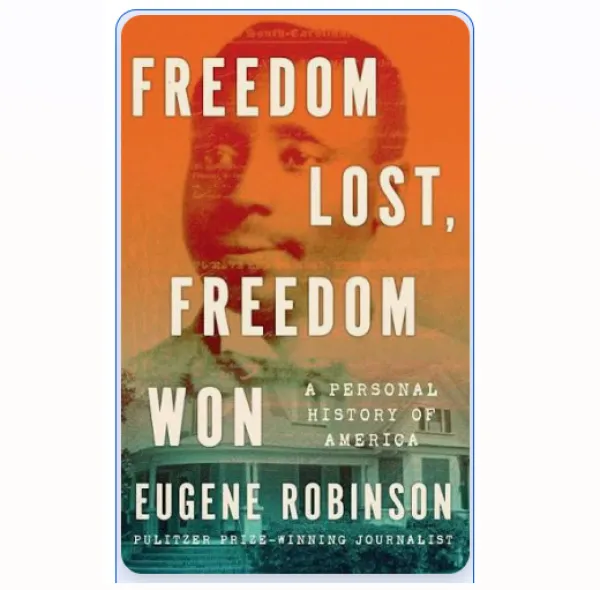
I have never been particularly interested in tracing my family tree. I’ve always enjoyed hearing family stories, but not enough to do the detailed detective work needed to trace back any further than my grandparents on either side. At one time my cousin Lawrence had done some digging and found that on my mother’s side of the family–our mothers were sisters–we are descendants of an enslaved man named Moses Grandy, who three times had to purchase his freedom. I have even read the short narrative that was written by him. Yet reading Freedom Lost, Freedom Found made me wonder if I have missed something by not following up with Lawrence.
Eugene Robinson joined the highly esteemed, influential, and liberal leaning Washington Post in 1980 and became a columnist in 2005, the position from which he earned a Pulitzer Prize for commentary in 2009. The Post was purchased in 2013 by Jeff Bezos, and in 2025 Bezos directed the opinion section to focus on stories about personal liberties and the free market. Many think the move was intended to curry favor with President Donald Trump who has made it a point to harass journalists and the papers for their lack of fealty to him. Robinson saw that as a “significant shift” in the section’s mission and decided it was time to leave the venerable publication.
Robinson has been able to trace his maternal family back to 1829 when a boy named Harry was born to Isabella Perlman, an enslaved black woman purchased by the rich white planter Richard Ford in Charleston, South Carolina. Harry was Robinson’s great-great-grandfather. Harry was renamed Henry Fordham and worked as a blacksmith. He bought his freedom ten years before the Civil War and saw Union troops march through Charleston in 1865.
The Fordhams were Robinson’s maternal ancestors, and among them were land owners, business people, lawyers, members of the military, and civic leaders. Not only did they pass down their family history orally, his ancestors saved letters, postcards, photographs, and deeds. Robinson is more fortunate than many people who endeavor to trace their family histories because of this treasure.
Unlike the Fordhams, the Robinson ancestors were more typical of the black population in America. They joined the 1.9 million African Americans who left the rural south for the urban industrial north. Robinson’s paternal grandfather, K. W. Robinson settled in Columbus, Ohio where he was a minister. He is buried in Greenlawn Cemetery. (When I was growing up, it was known as the black cemetery.)
Several members of the Robinson family ended up in Detroit, where they worked at Henry Ford’s massive River Rouge plant. These factory jobs were instrumental in undergirding the black working class. Yet even though blacks could work at River Rouge, they were relegated to the worst, lowest paying, and most dangerous positions in the plant with no chance for advancement.
Robinson’s father had migrated north but returned to the Jim Crow south, married and had three children. Robinson graduated from Orangeburg High School in Orangeburg, South Carolina. The school had only recently been desegregated, but even so, there were fewer than a dozen black students in attendance there. He was a sophomore at the time of the infamous Orangeburg Massacre of February 8, 1968, when highway patrolmen and city police fired on a crowd of black students on the campus of South Carolina State College who were protesting against de facto segregation at a local bowling alley. Three students were killed and twenty-eight were injured.
Even after the passage of the Civil Rights Act of 1964, the South and its institutions tenaciously clung to the long-discredited myth of the Lost Cause, white superiority and black inferiority. Robinson experienced the sting of segregation firsthand; when he was in high school there were still restaurants and amusement establishments black people could not patronize in spite of federal law forbidding discrimination in public establishments. He left South Carolina to attend college at the University of Michigan and after writing an essay about the Orangeburg Massacre for a class assignment, decided to study journalism.
A running theme through Freedom Lost, Freedom Found is that the story of the African American quest for freedom and equality is often one of two steps forward and one step back. In five generations over two hundred years, Robinson demonstrates how his ancestors worked diligently for freedom and equality against what was sometimes virulent opposition, and how once successful, could find themselves spending an inordinate amount of time and tenacious effort holding onto their hard won gains.
Racism, violence, political maneuvering, economic downturns, and the circumstances of everyday life reinforced the fragility of their progress. The Fordham ancestors also knew that unlike whites, there was a limit to how high they could rise regardless of educational attainment or effort.
Robinson readily admits that he was the beneficiary of the three federal laws passed in the 1960s designed to end systemic discrimination in the United States and provide equal opportunity to black Americans when he landed his first job at the San Francisco Chronicle although he didn’t know it at the time.
“When I handed in my first story, one of the editors came over to my desk. “You can write!” he announced with an air of surprise.” Bubbling barely under the surface of that comment was the automatic assumption that because he was black, his work would not measure up to the standard demanded by the paper nor be as good as that of his white colleagues. Robinson refrained from retorting–barely, I sensed–that he had written front-page stories for the Detroit Free Press and the Washington Star, was the editor for the highly regarded daily student paper at the University of Michigan, and a graduate of that same university. Indeed, his work was of such high caliber that his nine-month probationary period ended after a mere thirty days.
We are now a quarter of the way through the twenty-first century, and Robinson says we are seeing the usual backlash against black progress. Barack Obama, the first black president of the United States, won forty-three percent of the white vote in 2008, yet was dogged by rumors that he was a closet Muslim–his middle name is Hussein–and that he was not born in Hawaii but in Kenya like his African father. Millions of Americans saw his presidency as illegitimate.
The esteemed African American scholar and Harvard professor Henry Louis Gates, Jr., was arrested in Cambridge for breaking into his own house even after providing evidence that it was his. A young white man entered Mother Emanuel African Methodist Episcopal Church and was invited to join the Bible study class in session. He took out a handgun and murdered nine black worshipers and smiled about it at his arraignment. The killing of unarmed black men by white police officers continues; the only difference is that some of them have been videotaped by private citizens. Donald Trump has been elected twice, in part on the basis of convincing white voters that ensuring and protecting the constitutional rights of people of color means denying those same rights to white people, and that white people are being very badly treated.
On the last page of Freedom Lost, Freedom Found, Robinson recalls how his family, including his father who was ninety-two years old at the time, discussed the improbability that a black man would be chosen as the Democratic Party’s nominee for president, much less win the coveted prize. They all agreed it was nigh impossible.
No doubt Henry Fordham would be astonished.