
Book Review: Tits Up: What Sex Workers, Milk Bankers, Plastic Surgeons, Bra Designers, and Witches Tell Us About Breasts by Sarah Thorton
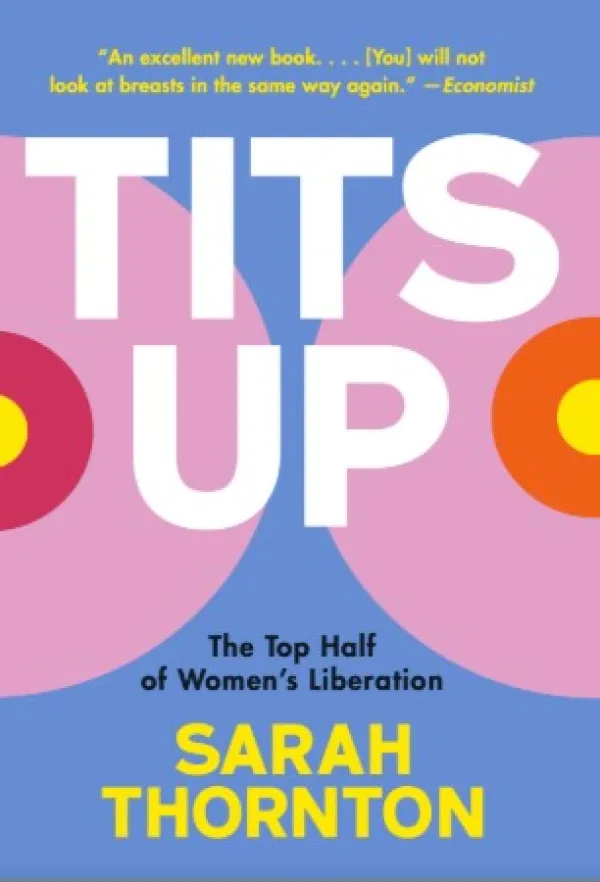
Perhaps nowhere other than American is there such a prurient fascination with women’s breasts. In the cultural landscape, they are stared out, celebrated, deified, legislated against, and commodified in a way no other female body part is.
Moreover, is there a woman who is satisfied with her breasts? They are either too big or too small, not symmetrical, too droopy, or lumpy. They are seldom as attractive as they are pictured in fashion magazines, and not nearly as comically mesmerizing as they are shown in so called men’s magazines. And of course, most women spend several minutes every morning thinking what they will do to hide them.
Enter the bra. Good bras–ones that lift, separate, support and are attractive–are expensive and finding the perfect fit can be a lot like looking for a needle in a haystack. From puberty on girls and taught to focus on the breast itself, ignoring the rib cage, shoulders, chest plate, and so there is the frustrating and time consuming quest for the “right” size bra. Indeed, numerous studies suggest that more than two-thirds of women who wear bras are wearing an incorrect size. Throw in the number of bra manufacturers, the endless types of bras–strapless, demi-cup, wireless, balconette, racer back, etc.–the worry over whether the nipples are showing–God forbid!–and you can easily see why shopping for a bra is not a favorite activity for most women.
Thornton’s acquired prosthetic breast after a peremptory double mastectomy. They are mismatched in size, and she calls them Bert and Ernie. The mastectomy and the subsequent experiences since then prompted her desire “to shift the definition of breasts away from the dominant patriarchal version of them as passive erotic playthings.” Tits Up consists of five chapters entitled Hardworking Tits, Lifesaving Jugs, Treasured Chests, Active Apexes, and Holy Mammaries; each of those chapters discusses a different aspect of breasts and how they are viewed and experienced by women, men, and society in general.
I found the chapter on milk banks the most fascinating. As Thornton says, “In a capitalist society where women’s breasts are commodified like no other body part, here their jugs are the key players in an economy that is not about money.” Let’s face it: the most important thing that breasts can do is nurture life; that is their raison d’etre. But just as we assume that every woman who enters a hospital to give birth will walk out with a healthy baby, we take for granted that those same women will be able to breast feed–if they so desire–with no trouble at all. And yet, that is not always the case. Milk banks exist for several reasons: to assist women who cannot breast-feed because they cannot produce enough milk, to help women whose milk is too plentiful to share it with women and babies who need it, to help poor women who cannot afford formula and so on. One woman who lost her own baby within minutes after his birth had so much milk, her breast “felt like volcanoes.” Donating that milk not only helped other women and infants, it helped her heal from the death of her child. It reduced her risk for a host of ailments, including diabetes, osteoporosis and cardiovascular diseases, and contributed to other improvements in her overall wellness.
Thornton’s book also debunks the standard societal view of sex workers and how they feel about their bodies. The women she interviewed were surprisingly candid about and unashamed of their work and saw their breasts in much the same way I as a writer and professor see my pen and keyboard. They spoke of the utilitarianism of their breasts and the pleasure they imparted to the people who paid for their services.
Tits Up takes the reader on a fascinating journey through the history, cultural significance, and social value of breasts. It is also a unique, primarily female perspective of how woman have taken ownership of their bodies since the middle of the twentieth century. The woman who reads Tits Up will think about her breasts in ways she no doubt ever imagined.