
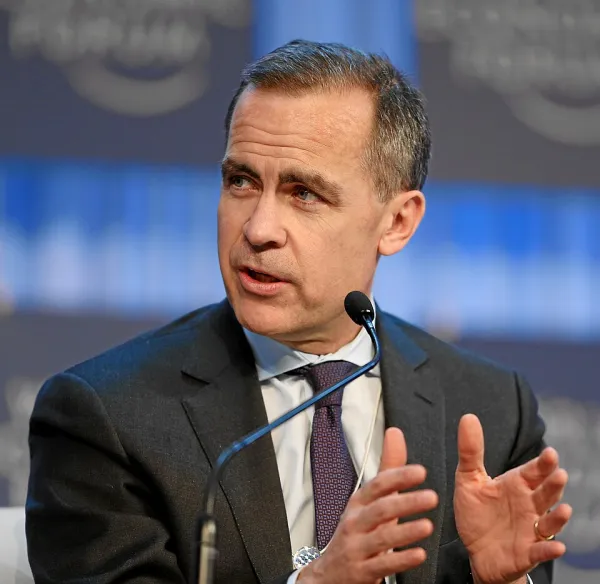
World Economic Forum from Cologny, Switzerland
A year and a half ago, I developed a documentary web series with the support of the online magazine Canadian Affairs. The series centered on an immigrant who had, as the logline put it, “fled a country torn by political strife.” I was approaching my first Canadian election with no party loyalty and a commitment to learning the politics, issues, and history of my new country. My top issue would have seemed quaint, even naïve, to anyone still living through what I had left—don't elect someone who will divide the people. The series was called Undecided Voter.
I was born in the United States, moved to Canada for graduate school in 2011, and became a dual citizen in 2023. Those intervening years were not good ones south of the border. From where I stood, both the political right and left had become extreme, even irrational, hell-bent on taking the country in different directions, neither of which the majority wanted.
Canada felt different. I arrived during the final years of Stephen Harper’s Conservative government and watched the campaign that brought Justin Trudeau to power. It was by no means a lovefest, but it was a political culture where “loyal opposition” seemed to be taken literally. The runners-up questioned and pushed the party in power. They didn’t claim they lacked legitimacy.
Over Trudeau’s years as Prime Minister, things began changing. “F🍁ck Trudeau” yard signs and bumper stickers pained me, not because I had an allegiance with the Liberal Party, but because it revealed the opposite of what I thought of as the Canadian character. In many ways, it felt just like the backlash against Obama, a cultural spillover from my homeland to the south.
But the candidates running against him didn’t take the bait. During the 2019 campaign, the crowd at a rally for Conservative candidate Andrew Scheer began chanting “Lock him up! Lock him up!” Scheer quickly changed the chant to “Vote him out! Vote him out!”
Then in 2021, after Trudeau called a “snap election” that could fairly be described as an opportunistic power grab, the Conservatives did something unthinkable in the US, they nominated a true centrist, Erin O’Toole. He also lost to Trudeau. Nevertheless, his final speech in Parliament was conciliatory, “I see unfair and wild language branding Justin Trudeau a ‘traitor’ for some of his actions,” he said, “These claims are ridiculous.”
I wasn’t a voter then, but I would have voted for O’Toole. He struck me as a chance to interrupt that cycle—a candidate who might restore a measure of equilibrium. My liberal Canadian friends reacted to him with a derision not dissimilar to American liberals’ feelings for Trump.
After O’Toole’s defeat, Pierre Poilievre, a more overtly populist figure, won the Conservative Party leadership in a landslide. His platform was in the Reagan tradition, but populism is not about a policy program. It is a posture: the corrupt elite has captured power and governs in its own interest; the people are its victims.
The next election was slated for 2025. Both candidates felt divisive to me: in the case of Poilievre, division as strategy; in the case of Trudeau, division through character—his blind spots reflected a man who believed that his values were everyone's values.
An American immigrant, recently naturalized, genuinely curious, looking for a leader who wouldn't divide his adopted country—this felt like a story worth telling.
However, a week after Canadian Affairs committed to Undecided Voter, Trudeau’s government began to unravel. At risk of losing the parliamentary support required to govern, he resigned and his party selected a new leader to face Poilievre.
That leader was Mark Carney.
Carney appears to have been designed for me. He is a remarkably intelligent centrist with a record of exceptional competence, most notably during the 2008 financial crisis. His book, Value(s) takes as a baseline that capitalism is the only economic system that has produced sustained broad-based prosperity, acknowledges its failures, and offers a blueprint of how it can become a better version of itself. Call my politics niche, but this is precisely what I want in a government leader.
I was no longer an undecided voter and, at that point, I dropped the project.
Carney’s candidacy immediately altered the trajectory of the election. With an assist from Donald Trump’s “51st state” rhetoric—which Poilievre had no idea how to react to—he led a party that had been trailing by 26 points (!) with Trudeau to a comfortable victory.
A year and a half later, Carney’s approval ratings are very strong. Through wins in by-elections and defections from other parties, he has deftly secured a majority government. He delivered a speech-heard-round-the-world in Davos that cast him as a spokesperson for the countries that are wealthy enough to matter, but not powerful enough to dictate terms.
By any conventional measure, the candidate “designed for me” is succeeding.
But being on the winning side is when questioning disappears. I watched Democrats fall into complacency in 2016. Carney appears designed for voters like me, but that hardly meant that he could sustainably unite the country.
Canada and the US are deeply connected. Perhaps the strongest indication of the countries’ differences are their founding mottos: “peace, order, and good government,” stands in stark contrast to “life, liberty, and the pursuit of happiness.”
When US politics went haywire and indeed started threatening Canada’s sovereignty, the pull of order and good government was that much stronger. Historically, conservatives emphasize those qualities. Trump broke that alignment. Pierre Poilievre had tried to absorb Trump’s energy, adopting slogans, social media populism, and a rhetoric of the people vs. the elites. Carney arrived at the opposite pole: not as rupture, but as restoration.
Despite his association with the Trudeau government, he was able to paint himself as the change Canadians wanted. The core critique of Trudeau is that he prioritized signaling over substance—performing liberal virtue rather than addressing material problems. Years of economic underperformance, combined with housing shortages, created an affordability crisis that makes the American version look mild. By the end of his leadership, he’d lost approval of half of his own party’s voters. Carney, in contrast, projects a serious, steady presence. He has also aggressively launched initiatives to reposition Canada during this uncertain era.
To test what aspects of Carney's record had penetrated public perception, I prompted Claude, ChatGPT, and Gemini to each list his ten most significant actions as Prime Minister. Across the three models, 19 distinct items emerged.
All the models chose the Davos address, a sweeping national electricity strategy, the One Canadian Economy Act, and approval of a pipeline from Alberta to the Pacific. Three of the four are non-partisan; the pipeline is a clear move to the right.
Four more appeared in two of the three lists: winning the election itself, an unprecedented expansion of global trade partnerships, abolishing the consumer carbon tax, and cutting immigration. The latter two are issues that previously belonged to the Conservative Party.
The remaining eleven—each appearing in only one list—fill out the story. One is a technical fiscal restructuring with no clear political valence. Four lean right: tax cuts, a large increase in defense spending, 40,000 government jobs cut, and electric vehicle mandates replaced with incentives. Four are doctrinal shifts that are also right-leaning—law and order, productivity over redistribution, an industrial-positive climate strategy, and away from Trudeau-era cultural liberalism. Tallying the results, I could dub only one action of all 19 that is predominantly embraced by the left: recognition of Palestinian statehood.
My personal take on Israel/Palestine is that I respect the conclusion of anyone who recognizes that there are legitimate arguments for and against both sides. That's probably a pretty small minority of people at this point, but I'd be willing to bet that Carney is one of them. But I have to note that as a leader who is managing a coalition that includes voters well to his left as he moves firmly to the right, recognizing Palestinian statehood is remarkably efficient politics. It signaled something important to people who needed to hear it, cost Canada almost nothing, and left him free to focus on the difficult and consequential work in front of him.
The most vivid example of that consequential work is also the one that surprised me most. As an outsider with a fairly strong understanding of economics, the fact that the provincial trade barriers that were eliminated by the One Canadian Economy Act even existed was shocking. Eliminating this drag on the economy seemed to be fruit hanging so low as to be resting on the ground. The story behind it, though, reveals a lot about Carney. He designated the unprecedented trade war with the US as an Extraordinary Systemic Risk, allowing the federal government to circumvent objections from the provinces. The bill that implemented the changes forced the federal government to drop its own internal barriers.
Carney governed transactionally from the start. On economic legislation, he worked with Conservatives; on labor or social policy, he assembled support from the New Democratic Party or Bloc Québécois. At the same time, he aggressively and successfully courted Members of Parliament from other parties to join the Liberal Party. Combined with off-year election gains, the strategy succeeded and he had a majority government.
The man is playing Machiavellian chess on behalf of a moderate agenda and, in the process, clearing institutional underbrush to make government more efficient and effective. Be still my beating heart.
That’s the public record, but are critics seeing something not reflected in those actions? Digging into conservative and populist chat rooms and speaking to a few friends who actively dislike him, I found objections that fell into three categories.
First, that Carney stole the Conservative agenda. A leader governing with policies that attract support across partisan lines is the sort of politics I hoped Canada might preserve.
Second, a conviction that the Liberal Party hasn’t changed—that Carney is just a continuation of Trudeau. “He’s Just Like Justin” was one of Poilievre’s core slogans in the campaign. The son of a Prime Minister who was a fixture of the international jet set, Trudeau was out of touch even by the standards of politicians. When a reporter asked him a question about the future of mankind, he corrected her: “We like to say peoplekind...because it's more inclusive." Less ridiculously, but much more critically, he described Canada as having “no core identity” and as “the world’s first post-national state.”
Carney was an undersized Division I hockey goalie and is the first Prime Minister born in the northern half of the country. He made patriotism the center of his campaign to great effect. Sixteen months into his tenure, the comparison with Trudeau has largely collapsed under the weight of the record.
The third category of complaint, tied to but distinct from “another Trudeau,” is an accusation of elitism. Carney, the thinking goes, is a globalist who will continue and even accelerate the trends that have led to upheaval in western countries today. This concern deserves close scrutiny.
Mark Carney represents the pre-Trump order's ideal candidate: a globally-minded leader who believes that well-designed institutions, properly governed markets, and technocratic competence are the best ways to address what ails the world. That’s more or less my political comfort zone. I am, in the Steven Pinker sense, an optimist, which is to say that I recognize that, by most measurable indicators, things are better than they have ever been.
I hold this optimism with open eyes. I'm implicitly defending imperfect institutions. They are widely sclerotic, often captured, and sometimes contemptuous of the people they serve. I’m drawn to “move fast and break things,” but not when it doesn’t recognize that the things that need breaking are real. Imperfection is the condition of every human institution, full stop. There is a meaningful difference between clearing the underbrush and burning the forest. The first requires competent leadership willing to do unglamorous work. The second just requires a match.
I benefited from the status quo. I was shaped by a system made for highly educated people who want to live in cities; a system that rewards managing things over making them. There is no separating one’s own political instincts from the system that has impacted them for good or for bad. The worldview that produced Mark Carney also produced me.
And yet, even from inside that worldview, the hard reality of public dissatisfaction is obvious. It’s stunning how few of the people who built and benefited from that order are trying to address it. On a recent The Good Fight podcast interview, Yascha Mounk pressed Klaus Schwab—the founder of the World Economic Forum (i.e. “Davos”) and as pure a distillation of that order as exists—on the deep dissatisfaction driving populism. Schwab simply could not register the argument. For him, the data settled the question. If things are measurably better, then dissatisfaction is a problem of communication, ignorance, or manipulation—not a signal worth taking seriously on its own terms.
Populism—left and right; Pierre Poilievre, Bernie Sanders, Donald Trump, upstart leaders in virtually every European country—is telling us something that data alone cannot refute. You cannot govern people by telling them things are fine. You have to make them feel that their specific desires and concerns are being addressed.
Mark Carney was on the Board of Davos, and this year, he became its breakout star. If he tracks as the avatar of what I want in a politician, is that bode well or poorly for the future? Does he grasp what Klaus Schwab cannot? If he does, he may be the global influencer building bridges to a better future that so many hope him to be. If he doesn’t, then he will likely be a temporary (and local) reversal in the broad trend of division, a modest reprieve in the coming reckoning.
The global rise of populism has many causes: high immigration, wage stagnation, social media ecosystems that reward outrage and punish nuance, the collapse of trust in institutions that once arbitrated shared reality, the 2008 financial crisis, and policy that has inflated the values of the “haves”—including myself—and locked out most of a generation from owning their own homes. They all produce the same feeling: that the system is working for someone, but not for you, and that the people running it don't care.
Canada has not been immune, but the Canadian expression of populism is distinct from its American and European counterparts.
In 2021 and 2025, respectively, 5% and 1.6% of Canadian voters chose the explicitly populist People's Party of Canada. The attitudinal data tells a different story. 34% of Canadians hold a coherent populist outlook: belief in a corrupt elite, desire to return power to the people, and a desire to restore a lost social order. Meanwhile, the same survey reported that only 22% of Canadians feel positive about politicians described as "populist"—lower than "socialist," "left-wing," or even "woke."
The Freedom Convoy of 2022, when truckers staged a massive protest in the capital, is the most vivid illustration of this gap. Nearly half of Canadians said the truckers' frustration was legitimate and worthy of sympathy, yet 68% said they had very little in common with how the protesters saw things, and 72% said it was time for them to go home. These are not contradictory findings. They describe a population that feels grievance but recoils from the populist aesthetic when it arrives in concrete form—flags, blockades, American funding, the faint smell of insurrection. The dissatisfaction is real; the vehicle is rejected.
The immigration data confirms the pattern and adds a crucial dimension. From 2022 to 2024, the percentage of Canadians who agreed there was too much immigration grew from 27% to 58%. The shift was driven by young urban Canadians—locked out of housing and watching international student populations skyrocket in their cities while their rent climbed. Canadians overwhelmingly point to issues like housing, healthcare, and social services, not cultural grievances, not race or ethnicity. The question is: can Canada’s famous kind-heartedness hold against both high immigration and the rhetoric coming from both south of the border and across the Atlantic?
My own threshold for immigration comes from my belief that the wisdom of crowds is real. When a politician can make immigration the center of their campaign and have a realistic chance of winning, that means there is too much immigration.
Trudeau’s government tested that threshold aggressively. Immigration levels in his final four years are difficult to grasp without living in the country. As a percentage of population, it was almost 50% higher than Germany’s during the four-year peak of Europe’s refugee crisis and double that of the United States under Joe Biden. The far right draws considerable energy from the bogeyman of globalists engineering open borders. For several years, many Canadians felt the country had moved uncomfortably close to that model.
What emerges from this data is a portrait of a country with a large reservoir of unaddressed dissatisfaction that has not yet—or not yet fully—found its populist vehicle. The electoral results dramatically understate the underlying feeling. A politician who can address that feeling without the aesthetic, who can give people the substance of what populism promises without the theater of it has a much larger addressable audience than previous elections suggest.
Is that how Carney sees it? His immigration cuts were substantial but still leave annual intake higher than any pre-Trudeau year—a reduction, not a reversal.
The core political problem of the last decades is that globalization created a tension between what was good for “the world” and what democratic citizens experienced within their own countries. Over the past several decades, more than a billion people moved out of extreme deprivation. This was not theoretical progress. It was measurable, material, and historically extraordinary.
The same basic logic applies to climate change. Carney’s bona fides on the subject are inarguable[i], yet he approved a pipeline, reversed an EV mandate, and reframed Canada's climate posture as industrial strategy rather than environmental obligation. You cannot read Value(s) without knowing he cares about the future of our ecology, but he also clearly understands that Canada cannot save it alone.
What we need in our leaders is the ability to make the right decisions by not ignoring that these tensions exist. Carney is a globalist in the sense that he cares about the entire world, present and future. But he seems to understand that governments do not answer to humanity in the abstract. They answer to voters. One person, one vote may be an imperfect system, but it is the least bad system that humanity has discovered. It’s also the morally correct one.
In sixteen months, he has governed as if a government's first obligation is to its own citizens—not as a retreat from the world, but as a precondition for greater engagement. That is a meaningful departure from a governing class that has too often treated democratic dissent as a problem to be managed rather than a signal to be heeded. And because Carney is so deeply connected to that governing class, his approach is unlikely to go unnoticed. For the first time in years, I find myself wondering whether the post-2016 political era might produce not just backlash, but adaptation—a world designed for all of us.
[i] UN Special Envoy on Climate Action and Finance; Founder and Co-Chair of the Glasgow Financial Alliance for Net Zero (GFANZ); Head of ESG and Transition Investing at Brookfield Asset Management; ordered British banks to undergo climate stress tests as Governor of the Bank of England