
Clintonville Area Commissioner taking legal action to force City to reveal “Zone In” research findings and other details
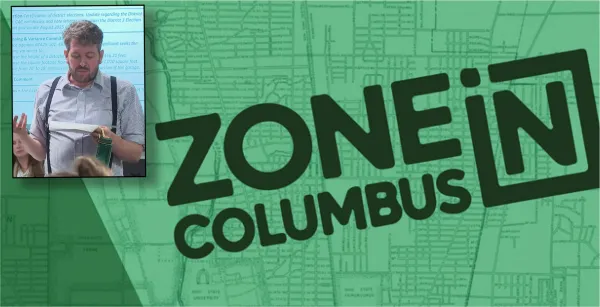
Three months ago on April 7, 2026, Will Klatt, who sits on the Clintonville Area Commission, made a public records request to the City of Columbus regarding the “Zone In” initiative. The first substantive response was not provided until July 6, 2026 – approximately 90 days later. That delay is well beyond what Ohio’s Public Records Act requires. Ohio law requires public offices to make records available within a reasonable period of time, and a delay of this length, absent a compelling explanation, appears inconsistent with those statutory obligations. Klatt intends to pursue legal action on Monday (7/20) against the City of Columbus.
After more than three months without receiving the requested records, I believe the City has failed to comply with its obligations under Ohio’s Public Records Act (ORC 149.43). The request relates to records connected to the Zone In Columbus zoning code update, including materials, data, and communications used in the development of that process.
Specifically, I requested access to and copies of the following public records related to the “Zone In Columbus” initiative:
- Any and all versions of surveys conducted in connection with Zone In Columbus, including but not limited to any “push-polling” or message-testing surveys.
- All results, data, summaries, analyses, reports, or presentations generated from those surveys.
- Records reflecting expenditures on communications, including but not limited to spending on Facebook, Instagram, X (Twitter), or other social media platforms, related to development policy, zoning reform, or the Zone In Columbus initiative.
- Any contracts, invoices, purchase orders, or agreements with vendors, consultants, or firms related to the creation, distribution, or analysis of the above-referenced surveys or social media advertising.
At its core, this request concerns transparency in how the City develops major policy decisions, how taxpayer-funded resources are utilized, and how public input and research are incorporated into government decision-making and public stakeholder validation.
I am particularly concerned about the public’s right to understand the process behind the zoning update, including questions surrounding the use of public resources, outside influence by the Columbus Partnership, and other Ginther and Hardin Republican donors, stakeholder involvement, and communications between city leadership, departments under the Mayor’s administration, and interested parties.
My concern is not simply that the request has taken time. I understand that some public records requests require review, organization, and legal analysis. The issue is that Ohio law requires public offices to provide records within a reasonable period of time, and Ohio courts have repeatedly held that public offices cannot indefinitely delay access due to internal administrative challenges.
Relevant Ohio Supreme Court decisions include:
- State ex rel. Wadd v. Cleveland, 81 Ohio St.3d 50 (1998) — establishing that public records must be made available for inspection and emphasizing the importance of prompt access.
- State ex rel. Warren Newspapers, Inc. v. Hutson, 70 Ohio St.3d 619 (1994) — holding that whether a delay is reasonable depends on factors such as the volume of records, difficulty locating records, and necessary review, rather than government convenience alone.
- State ex rel. Morgan v. Strickland, 121 Ohio St.3d 600 (2009) — recognizing that unreasonable delay can constitute a denial of access, even if records are eventually produced.
- State ex rel. Cincinnati Enquirer v. Deters, 148 Ohio St.3d 595 (2016) — reaffirming that the Public Records Act requires prompt inspection of public records.
- State ex rel. Consumer News Services, Inc. v. Worthington City Schools, 97 Ohio St.3d 58 (2002) — recognizing that delays must be justified by legitimate processing needs.
The City has recently indicated that the delay is related to the departure of a staff member who handled technical aspects of the zoning update and the need to restore system permissions. While I understand that staffing transitions can create challenges, Ohio law evaluates the actions of the public office as a whole – not whether a particular employee remains available. I also believe any other observer of the sequence of events would find this hard to believe. The City attempted either through negligence or intent, to deny the public critical information requested through the legal process afforded under the law.
A staffing change does not suspend a public office’s obligation under ORC 149.43 to process and provide public records within a reasonable timeframe.
I believe this matter raises broader questions about transparency, accountability, and the public’s ability to oversee how significant policy decisions are developed and implemented.
I am sharing this information because public access to government records is a fundamental part of democratic accountability. I will provide updates as this matter proceeds.
Will Klatt represents District 3 for the Clintonville Area Commission (CAC).