
CRINK: Should we be concerned?
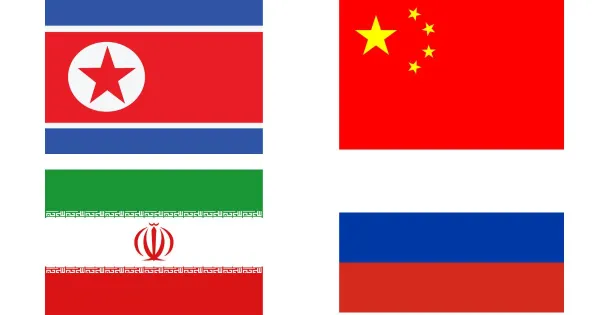
Image by Gornos
What does an alliance between China, Russia, Iran and North Korea mean for the West, especially America and the rest of the world? Is this cabal as Peter Van Praagh, president of the Halifax International Security Forum, believes in cahoots with the express purpose of disrupting the global status quo? If so, what’s new about that? Far from strangers the relationship between these four nations dates back as early as the Cold War. While the four nations were never best friends, so to speak, the relationship between the four has taken on greater meaning and substance since the war in Ukraine and the West’s reaction, namely the United States’s response by way of economic sanctions and military support of Ukraine.
There are students of international relations and comparative politics who believe that Russia, China and Iran see the United States as their biggest obstacle. Their biggest obstacle to what is the question. CRINK actors are noted for their opposition to the West, codeword for America, their authoritarian regimes and being embroiled in military conflicts. It is said that collectively, they are on one accord when it comes to creating a multipolar world order with the express purpose of undercutting U.S. global dominance. Some believe this alliance may go a long way in deterring external meddling in their nation’s affairs, the expansion of U.S. alliances, the installation of American nuclear weapons on military bases and secure government-operated facilities around the world and the implementation of sanctions purely for political rather than humanitarian purposes.
Reports indicate that at least two of the four nations have conducted military drills together and at least three of the nations have shared resources such as munitions. Another example is Russia’s willingness to “provide Iran with satellite imagery on the locations and movements of American troops, ships and aircraft.” And of course, Iran and China’s relationship is well documented as it is grounded in a “25-year cooperation agreement with Beijing, securing $400 billion of oil at below-market prices in exchange for Chinese investment and security cooperation.” Will the friendship between these four nations last? Is CRINK committed to pooling its resources over the long haul with the intention of adversely impacting:
a) America’s economic arrangements, both domestically and internationally
b) America’s military global reach
c) U.S. diplomatic relations with other countries and
d) America’s standing on the world stage?
Is CRINK this era’s version of President George W. Bush’s Axis of Evil-Iraq, Iran and North Korea or does it represent something less sinister? Some claim that news of the development of CRINK has given other anti-western nations a heightened but false sense of confidence and security, thus making for an even more precarious global body politic.
At the end of the day does CRINK represent a credible threat to the West, namely America’s domestic and foreign interests or is it nothing more than a paper tiger?
Judson L. Jeffries, PhD, MPH, is Professor of African American and African Studies at the Ohio State University.