“Don’t go looking for Tecumseh” – but we did, so to honor the greatest Native American
“Don’t go looking for Tecumseh.”
This warning from Native Americans has echoed across Ohio, Michigan, Canada and beyond, over the two centuries since Tecumseh died in battle on October 5, 1813, in southern Ontario during the War of 1812.
What is not a mystery is how the Shawnee chief and warrior is regarded as the greatest Native American.
And as America celebrates its 250th anniversary, Tecumseh has never been more revered. Especially in “Ohi:yo” (the great river) where he was born and reared and fought desperately to reclaim for all Native peoples.
Whether its social media or the recent World Heritage recognition of Ohio’s Native-built earthworks – the sacred geometric structures connecting the earth to the celestial heavens and which Tecumseh grew up near – there is no easy explanation why the Shawnee chief continues to amaze and inspire.
All of this recognition, however, makes some wonder why it took the “white man” so long to appreciate the contributions of the First Nations to America.
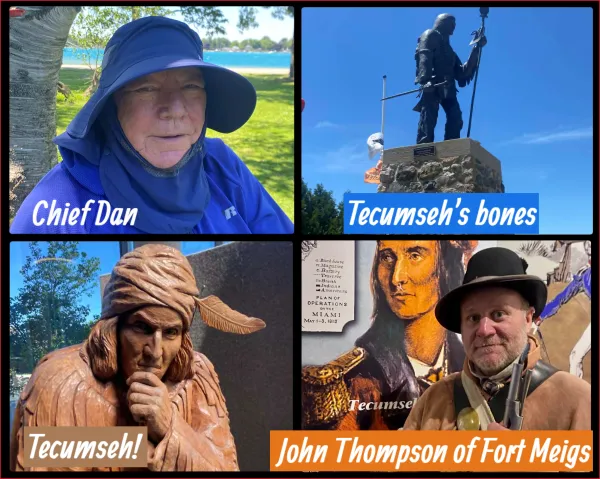
“It’s long overdue,” says Dan Miskokomon, former Chief of Bkejwanong First Nation, an Anishnaabe alliance, or “Council of Three Fires” community on Walpole Island in southwestern Ontario, and roughly 40 miles from where Tecumseh was killed.
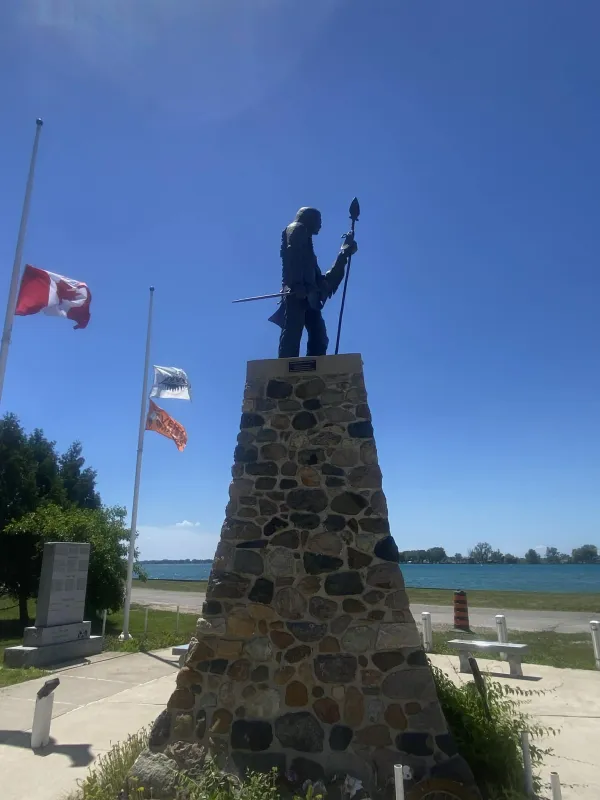
When the Free Press recently spoke with Chief Dan on Walpole Island it was a windy sun-splashed day and he was tending to his front yard. About a mile down the road from his home is a tall stone monument crowned with an impressive seven-foot-tall statue of Tecumseh holding a spear and a tomahawk and warily gazing across the St. Clair River into America.
The monument is actually a “cairn” or a burial mound, because encased within are Tecumseh’s bones, says Chief Dan. And as we begin our conversation in his front yard a loud cracking sound can be heard. Suddenly, a long branch in a nearby tree is torn by the wind and comes crashing down.
“Yep, that’s a sign,” says Chief Dan in the calm voice of a Native elder. He was first elected chief in 1988 and served on and off until the early part of this decade.
Walpole Island is sovereign and is neither Canada nor America. Nevertheless, the island’s Natives have fought and died in each nation’s major wars, including the Civil War fighting for the Union to end slavery. Surrounding Tecumseh’s cairn are monuments honoring these veterans.
And while a two-century debate endures about how Tecumseh died and where exactly he is buried, the oral history of Walpole Island’s Native veterans should never be dismissed.
According to this oral history, as told by the Walpole Island Soldiers’ Club, after Tecumseh fell, he was taken by his warriors and buried in a nearby woods. One of those warriors, Chief Shah-noo, came to reside on Walpole Island. Years later he retrieved Tecumseh’s bones so he could someday be buried near his chief.
During the 1930s, says Chief Dan, First Nation communities in both Canada and United States raised funds to erect the stone cairn. Tecumseh’s bones were retrieved a second time and placed within the cairn in 1941. Chief Dan’s great grandfather, a WWI veteran, was part of this mission.
“Our elders got a hold of that sacred bundle, and unfortunately the white man was looking for that too. So they could desecrate or to further conquer Tecumseh. Wanting to further eradicate us and assimilate us,” he says, thus explaining one reason why you should “never go looking for Tecumseh.”
“Our elders, the veterans, built the monument, and only got as far as building the cairn. That’s all they could afford,” he said.
In 2015, with help from Canadian federal dollars secured by Chief Dan, Tecumseh’s statue was unveiled on October 5, two centuries and two years to the day of his last breath.
“It brought closure for our veterans,” said Chief Dan.
What all Americans and Natives can agree upon, is they never want to abandon their ethnic heritage. In the Shawnee language Tecumseh means “celestial panther leaping the sky.” He stands as a symbol of defending a people’s way of life and traditions.
And in Tecumseh’s own words, “Listen to the voice of duty, of honor, of nature and of your endangered country. Let us form one body, one heart, and defend to the last warrior our country, our homes, our liberty, and the graves of our fathers.”
The nobility he showed
Tecumseh is celebrated and memorialized in Ontario even more so than Ohio. Numerous statues, historical markers, coins, and towns and roads bearing his name can be witnessed from Walpole Island to Toronto.
There is a simple answer as to why, claim many Canadians. If not for Tecumseh, they could very well be Americans.
But to tell the story of Tecumseh’s death, the story begins in America – just south of present-day Toledo at Fort Meigs, which was impressively rebuilt by the Ohio History Connection. To this day, on a plateau high above the Maumee River, the cannons of this American fort’s artillery batteries take aim at a long-ago enemy.
How the War of 1812 started has several explanations. But it could be described this way: America and its insatiable appetite desired the fertile farmlands of Ontario, while Britain desired its former colonies under the Crown again. Whatever the reasons, Tecumseh and his warriors sided with whom they believed to be the lesser of two evils, the British, who promised Ohio would be returned if victorious.
Six months before he died, during the spring of 1813, Tecumseh and a thousand of his warriors were on the march up the Maumee River to help the British destroy Fort Meigs. On May 5, Tecumseh’s actions would forever become an extraordinary moment in American history.
Outside the walls of Fort Meigs across the Maumee River a group of American militia are captured by the British, and Tecumseh’s warriors sought to massacre the doomed lot.
“Killing and scalping us as fast as their own crowded ranks would admit,” one of the American militia would later write. “Just then, suddenly as the lightning’s flash, the yelling ceased.”
Tecumseh had arrived, and put “a stop to the massacre, shaming his warriors for behaving like squaws.”
“It’s one of the reasons that Tecumseh is so revered in our culture, some of the nobility he showed on May 5 in the treatment of unarmed American prisoners,” says John Thompson, manager for historic programming at Fort Meigs, and on this day giving a tour dressed and armed as an American militiaman of that time.
“Tecumseh is a strange character in American history,” continues Thompson, “because his name will appear in every textbook from Maine to Arizona. Yet, he is an enemy to the United States, and it’s very odd to revere one of your enemies. But we have to believe that the ideals that Tecumseh stood for, the nobility he had, the magnetism, and his powerful nature as a leader, these are all human qualities that transcend battle lines and country boundaries.”
Death of Tecumseh and the end of a dream
Several months after Tecumseh saved the lives of Americans, the winds of victory had turned. A large American force is chasing a haggard and depleted group of British soldiers and Native warriors across southern Ontario.
Unable to outpace the Americans, the British and Tecumseh make a stand near the Thames River on October 5. Before the battle, the Shawnee chief had told a British general, “Our lives are in the hands of the Great Spirit. We are determined to defend our lands, and if it be his will, we wish to leave our bones upon them.”
How Tecumseh was killed has remained a 200-year-old mystery. The fog of battle and the political ambitions of a future American Vice President forever hindering any chance at a definitive answer.
Ohio author Allan W. Eckert, a master at writing dramatic historical nonfiction, found there are “no less than forty-five (perhaps considerably more!) accounts, all of them differing in various points, of the death of Tecumseh, who killed him and under what circumstances.” Eckert died in 2011 and one of his notable works is the outdoor drama “Tecumseh!” in its 54th season and performed in Chillicothe.
The account of Tecumseh’s death which has garnered the most attention is the one with the least veracity of truth, as suggested by Eckert’s research. Col. Richard Mentor Johnson, a Kentucky native, charged his troops directly at Tecumseh’s warriors and was immediately wounded and carried off by his own men. Johnson would later claim he shot and killed Tecumseh, mockingly using the falsehood to win a US Senator seat and become Vice President under President Martin Van Buren.
As America celebrated Tecumseh’s demise, an onslaught of white settlement flooded into Ohio. In many aspects it’s taken two centuries for America to find the moral clarity to fully respect Tecumseh for trying to unite Natives to save Ohio where his ancestors had built marvels such as Serpent Mound and the Octagon.
“There is something very romantic in the story of Tecumseh,” says Thompson of Fort Meigs. “And if you were telling this as a story, Tecumseh dies at the perfect point to make a legend. He dies in battle, for one. He dies fighting with his troops, for two. And he dies in the last battle of this campaign. So, he’s never really defeated. He never goes on to be a beaten person as he ages. From a story telling standpoint, it’s perfect for a romantic hero. You couldn’t write a more dramatic story.”
Tecumseh is never really defeated. A mission the Native veterans of Walpole Island were a part of and refused to fail at.
“If the white people would have found Tecumseh’s bones, they would have had power over us,” says Chief Dan.