
Dr. Mohammad Tawfiq: The Egyptian Doctor Who Went to Gaza Twice
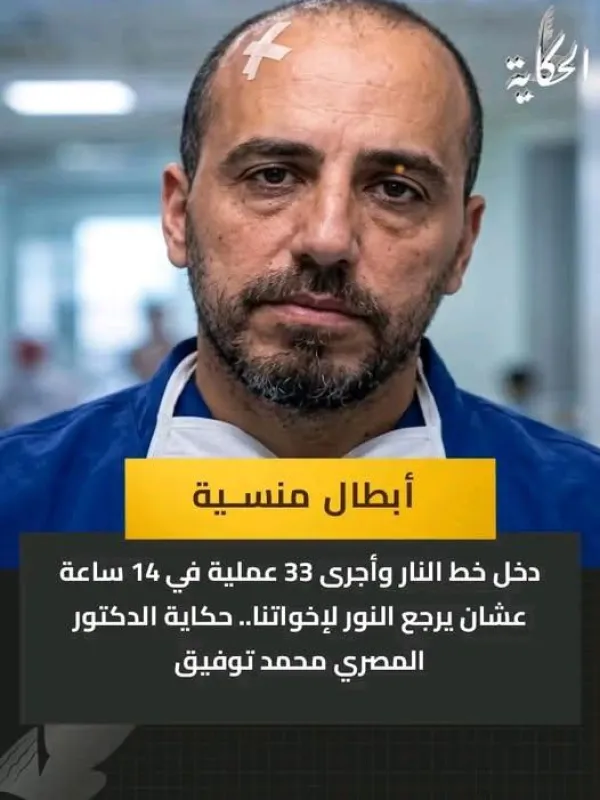
Egyptian doctor Mahammad Twafiq went to Gaza twice to help people see again, and in in the process, Gaza opened his eyes to a world he could no longer see the same way. Photo credit: alhekaya.com
When Dr. Mohammad Tawfiq left his medical practice in Egypt and traveled to Gaza in the middle of a devastating war, he knew he was entering a place where even the most basic medical care had become a struggle.
What he may not have known was that Gaza would change him forever.
Tawfiq, an Egyptian ophthalmologist, entered the Gaza Strip on May 1, 2024, before the Rafah crossing was closed. He stayed for 20 days, working under conditions few doctors would ever encounter.
There was an immediate problem: there was no operating room properly equipped for eye surgery.
So, he and the medical team did what they could. They searched for the necessary equipment, secured what was available, and worked to establish a functioning operating room so that patients could receive the surgeries they desperately needed.
Then, despite everything he had already witnessed, Tawfiq returned to Gaza for a second time.
By then, conditions had become even more difficult. Hospitals were facing sieges and destruction, medical supplies were scarce, and doctors were being forced to work with equipment and medications that were nowhere near sufficient for the number and severity of cases arriving at their doors.
Still, they continued.
One day in particular remained etched in Tawfiq's memory.
He and his team performed 33 cataract surgeries in a single day.
From 8:00 AM until 10:00 PM, they operated on patients who had been waiting for treatment since the beginning of the war. For approximately 14 hours, the operating room remained busy as one patient after another came in, hoping to regain something many of us take for granted: the ability to see.
Thirty-three surgeries in one day is an extraordinary number.
But for Tawfiq, the numbers were not what mattered most.
It was the people behind them.
One patient told him that he had been only meters away from reaching the Rafah crossing in an attempt to travel to Egypt when his car was targeted. The man's companions were killed, and he suffered a devastating injury to his eye.
He had begun to believe that he would never see again.
Then Tawfiq operated on him.
The surgery was successful.
In another case, a child suffered a serious eye injury after the explosion of a suspicious object. It became one of the most difficult cases Tawfiq encountered during his time in Gaza.
These were not simply medical cases. Each one was a person whose life had been violently interrupted by the war.
And for the doctors treating them, there was an agonizing reality: knowing that a patient needed help while having only a fraction of the equipment, medication, and resources normally required to provide it.
Tawfiq later explained that this was among the hardest parts of his experience.
But he and his colleagues kept working.
Perhaps the clearest expression of what Gaza meant to him came after he left.
"I am not the same person after leaving Gaza as I was before entering it."
Those words say more than any number of surgeries ever could.
Dr. Mohammad Tawfiq entered Gaza as an ophthalmologist. He went there to restore sight—to repair damaged eyes and give patients a chance to see again.
But he left having seen something himself.
He saw patients waiting for help in circumstances that should be unimaginable. He saw families carrying the wounds of war. He saw fear, loss, exhaustion—and, somehow, hope.
And perhaps that is what makes his story worth remembering.
There are countless names connected to this war. Some are known around the world; many will never be. Some stories become headlines, while others disappear almost as quickly as they emerge.
I don't want this one to disappear.
Because when I think about Dr. Tawfiq, I don't think first about the 33 surgeries he performed in one day. I think about the man who had almost reached the border and thought he might never see again—and the doctor who gave him that possibility back.
I think about the child whose injury demanded everything a doctor could give with almost nothing at his disposal.
And I think about a physician who could have remained safely in Egypt, but chose to enter Gaza—not once, but twice.
Maybe heroes are not always the people whose names fill the history books. Sometimes they are simply the people who walk toward suffering when they could have walked away.
Dr. Mohammad Tawfiq did that.
He went to Gaza to help people see again.
And in the process, Gaza opened his eyes to a world he could no longer see the same way.
That is a story worth remembering.
Mahmoud El-Yousseph is a Palestinian freelance writer and retired U.S. Air Force veteran. He writes about U.S. foreign policy, Middle Eastern affairs and justice.
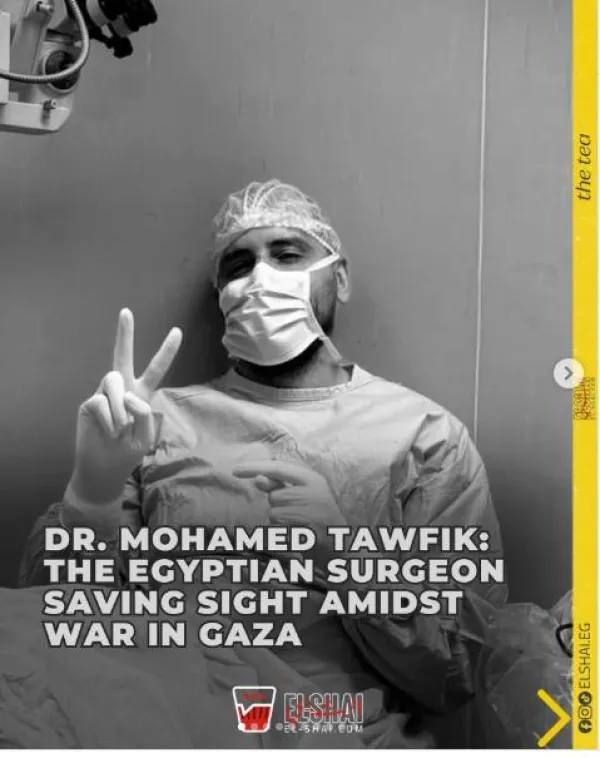
Egyptian doctor Mohammad Tawiq and his team performed 33 cataract surgeries in a single day in Gaza. Photo credit: ElShAI.EG