
The Egyptian Man Who Risked His Life to Save a Family from a Sinking Car
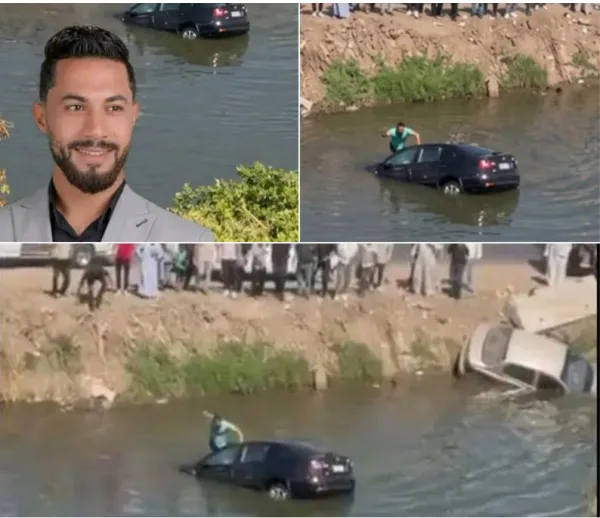
Ahmed Magdy Nada El-Banna did not stand by and watch. He jumped into the water and risked his own life to help save the family as he saw their car sinking in the Canal in Tanta last July 19. Photos credit: Social media.
Sometimes, an ordinary person is placed in an extraordinary situation, and what he does in those few critical moments reveals more about his character than a lifetime of words ever could.
That is what happened in Gharbia Governorate, Egypt, on July 19, 2026, when a car plunged into the Al-Qased Canal in Tanta with an entire family trapped inside. As the vehicle sank, Ahmed Magdy Nada El-Banna did not stand by and watch. He jumped into the water and risked his own life to help save the family.
The dramatic rescue was captured on video and widely shared on social media, prompting many Egyptians to call for the rescuers to be recognized for their courage and selflessness. The incident also became a powerful example of shahama—the Egyptian ideal of courage, generosity, and coming to the aid of someone in danger.
What Exactly Happened?
Ahmed was on his way to work when he witnessed a private car veer off the road and plunge into the Al-Qased Canal in Gharbia Governorate. Inside the vehicle were a father, a mother, and their young daughter, all suddenly fighting for their lives as the car began to sink.
Ahmed, a plumber from the village of Ibshway El-Malaq in the Qutur district, was heading to work in Tanta. At that moment, however, his plans no longer mattered. He saw a family in desperate need of help and immediately decided to act.
He got out of the vehicle, grabbed a brick, and jumped into the canal.
Swimming toward the sinking car, Ahmed climbed onto its roof and began striking the glass with the brick. As he struggled to reach the trapped family, he reportedly tried to reassure them, telling them not to be afraid and that he would not abandon them.
Every second mattered
Ahmed eventually managed to break the glass and reach the people trapped inside. His hand was badly cut by the broken glass, but he continued despite his injuries.
He pulled the young girl from the vehicle first, followed by her father. Another rescuer, Ragab Abdel Hamid Abdel Aal, then joined the effort, helping Ahmed rescue the mother. Together, the two men succeeded in getting the entire family out of the sinking vehicle.
The family was taken by ambulance to Tanta General Hospital for treatment and, according to reports, survived the ordeal and eventually returned home safely.
A Heroic Act of Courage
What makes Ahmed's actions so remarkable is that he was not a firefighter, police officer, or emergency responder. He was an ordinary working man who happened to be in the right place at the wrong time—and chose to put himself in danger to save people he did not know.
He had a family of his own waiting for him at home, including his wife and their young daughter. Yet when he saw another family facing death, he did not stop to calculate the personal risk.
He acted.
That instinct to help someone in mortal danger is what many Egyptians describe as shahama—a form of courage and chivalry deeply associated with coming to another person's aid when it matters most.
The story quickly resonated with people on social media. Many called for Ahmed and the other rescuer, Ragab Abdel Hamid Abdel Aal, to receive official recognition for their bravery.
The Governor Honors the Rescuers
Their courage did not go unnoticed.
Gharbia Governor Alaa Abdel Moaty formally honored Ahmed and Ragab for their role in rescuing the family. During the ceremony, the governor praised their courage, selflessness, and willingness to rush to the aid of people in danger.
The recognition went beyond a ceremony. According to reports, Gharbia authorities also arranged a private-sector employment opportunity for Ahmed as a gesture of appreciation for his actions.
The recognition is significant because stories like this remind us that heroes are not always famous people. They are often ordinary individuals who find themselves facing an extraordinary moment and choose to do the right thing.
Ahmed did not rescue the family because he wanted fame, followers, or recognition. He acted because three human lives were in danger.
What Makes Someone a Hero?
People are often judged by their titles, careers, wealth, public positions, or number of followers on social media. But moments of crisis can reveal something far more important: character.
A person's true worth is not necessarily measured by the position he holds or the fame he achieves, but by what he contributes during his lifetime and the positive impact he leaves on others.
Ahmed's story is a reminder that courage does not always announce itself. Sometimes it is simply a decision made in a few seconds: to step forward when everyone else is afraid to move.
We may never know when we ourselves—or someone we love—will be in desperate need of help. But when that moment comes, perhaps the greatest measure of who we are will be what we choose to do.
Ahmed El-Banna chose to help.
And because he did, a family went home alive.
Mahmoud El-Yousseph is a Palestinian freelance writer and retired U.S. Air Force veteran. He writes about U.S. foreign policy, Middle Eastern affairs, and justice.