
Election could bring more change to Linden: for better or for worse
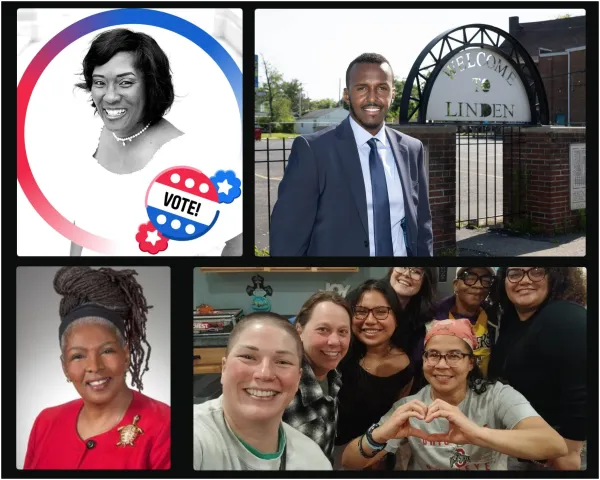
A Black MAGA candidate is running against a state representative incumbent who was accused of not even living in Linden, that currently has a white realtor as its city councilmember, even though it is predominantly Black.
This is the current state of political leadership in Linden. And while this upcoming vote is crucial for Columbus it is equally important to Linden because there is an ongoing effort to rehabilitate and rebrand the area during a time when young people, mostly white, are seeking affordable housing there.
This raises a serious question about Linden’s future: Is this effort to revive Linden meant for longtime community members, or was it prompted by “development pressure” to support new residents as this The 614 for Linden white paper suggests? The 614 for Linden was a group of nonprofits and financial institutions backed in part by JPMorgan Chase and ended operations in 2022.
Linden’s downslide began in the 1960s after I-71 cutoff Linden from Italian Village to Clintonville. Before this it was a bustling and vibrant group of neighborhoods but then the crack epidemic hit in the 1980s and Linden was officially split into two parts – South and North with Hudson Avenue being the divider. The South was overwhelmed by crime, addiction and degradation, and it remains in hard times.
But all is not lost to reunite Linden which is something Columbus leadership has actively tried to make happen with the “OneLinden” initiative. Focusing on “10 Big Ideas” the plan is to “expand housing options, support student success, reimagine Cleveland Avenue, connect the community, connect residents to employment, reduce crime and improve perception,” among others.
Some noteworthy infrastructure projects have been completed such as making Hudson Avenue more pedestrian friendly with expanded sidewalks. There’s also the “Linden Green Line” a 7-mile linear park and pedestrian corridor utilizing an abandoned rail corridor connecting South and North Linden with a 2030 expected completion.
The Free Press reached out to several Linden sources for this story such as Dr. Ralph Carter who leads the nonprofit, We Are Linden, but he and others never responded. We Are Linden is well connected to City Council and thus probably the reason Dr. Carter did not want to participate.
The better source for an unfiltered Linden story would be an activist, such as Adrienne Hood, who was propelled into activism in 2016 after her son was shot and killed in Linden by the Columbus police “jump out boys.” In 2023 she unsuccessfully ran against the white realtor, City Councilmember Emmanuel Remy, for City Council District 4 which encompasses all of Linden.
Hood continues to keep a close eye on Linden and is part of the Our City, Our Say leadership pushing for true-district representation which will be on November’s ballot as Issue 8. If it wins each city district would have candidates running who live in the district and only the people living in that district can vote for them. Currently the district vote is at-large or across the entire city.
Hood is fully aware of the changes Linden has experienced over the previous two decades. For starters, especially in North Linden, young white working class and young white professionals have moved in and more will come.
“There are a lot of white people who have moved in. But it’s the same as on the Near East Side. All the areas that can be gentrified are being gentrified,” she says. “Some of the individuals who have come in are sincere with the community, but some are trying to make it their community. That’s not how we do things in Linden.”
Reinventing a community to your liking has always been a prickly American subject but there is a far more pressing issue, says Hood. The “extraction” of resources from Linden.
“The unfortunate thing is, anybody who has been in Linden for any amount of time knows that resources were extracted from the community and the community went down, and property values went down,” she says.
Some of the missing resource dollars, says Hood, were for after school programming to “give our youth something to do,” for our elderly, and to those organizations and nonprofits “doing real work.”
Private investment abandoned Linden too. There’s not a single major grocery store and pharmacies have also shuttered. “This has been an ongoing thing since I was an early adult. It’s continued to get worse. And once the property values went down you had investors buying houses,” said Hood.
But in recent times private investment has returned. For example, the $5 million JPMorgan Chase gave to The 614 for Linden helped pay for 500 units of affordable housing, consult and assist 120 small businesses, and open the Linden Fresh Market and Charitable Pharmacy on Cleveland Avenue.
But these questions now hang over Linden: Does the current private investment and the OneLinden initiative have a duplicitous end result? Is it meant to help current Linden residents or to further gentrification, or both?
Lurking in Linden’s future
As improbable as this sounds a MAGA takeover is threatening Linden at the state level.
Bernadine Kennedy Kent, a “Black Voices for Trump” Republican candidate, is running for Ohio House State District 3 which includes most of Linden. The Democrat incumbent is Rep. Ismail Mohamed who is Ohio’s first-ever Somali American to win an office in the State Legislature. Kent is trying to make a political comeback as she once held an office within the Ohio House of Representatives as a Democrat but was expelled from the party in 2020 after endorsing Trump.
Besides young white people, Linden has experienced growth in new Americans, mostly from African and Arabic nations. The Somali migration to Linden began in the 1990s after those refugees fled that nation’s civil war. This led to some predicable pushback and Islamophobia from white and Black Linden residents. To this day tensions remain in Linden schools between Africans and Black American students.
And while the Free Press did not reach out to Kent due to her alignment with MAGA, she is no doubt tapping into this resentment. Hood is hoping Linden doesn’t end up being duped.
“I would venture to say Kennedy Kent is probably banking on the fact she is Black, and people won’t do their research. I would hope and encourage as many people as I can to not vote for her because she is not safe,” she said.
Rep. Mohamed makes amends with Esther Flores
As first reported by KIN media, Bernadine Kennedy Kent in September filed a residency challenge with the Franklin County Board of Elections against Rep. Mohamed. She alleged Mohamed no longer lived in Linden and instead was residing in a $600,000 suburban Delaware County home.
The evidence against Mohamed was compelling. For instance, records showed the power at his Linden home had been shut off this past winter when at times the temperature dipped below zero. The Franklin County Board of Elections voted to deny Kent’s challenge, however.
Responding to KIN media social media posts about Kent’s residency challenge was Esther Flores who is seeking to expand her “street sister” anti-addiction advocacy across the city. She stated when she sought Mohamed’s support she was told “he was too busy.”
“I was applying for a capital grant to get some of our properties renovated, especially our Linden safe house, and after leaving multiple messages, that’s the response I got,” said Flores. “I have met with several Ohio senators and representatives. They all made time for me, including Michele Reynolds, a Republican [Ohio State Senator District 3, which is Linden].”
Flores continued, “Ismail Mohamed needs to make time for his constituents, especially women since Linden has a large population of African American women being trafficked.”
The Free Press asked Mohamed to respond to Flores’s account.
“Representative Mohamed values the opportunity to support constituents and community organizations, and our office strives to remain accessible and responsive to those we serve. We sincerely apologize for not following up with Ms. Flores regarding her request for a letter of endorsement,” stated his office in an email.
Following this Rep. Mohamed met with Flores “and included her project on our capital budget request list for a significant amount of funding.” He also noted his participation in furthering several domestic violence and human trafficking bills at the Statehouse.
Will Adrienne Hood run for District 4 again?
As mentioned earlier, Columbus City Council’s District 4 encompasses both North and South Linden, a District in which Hood ran for in 2023 but lost to Councilmember Emmanuel Remy who needed the Ohio Realtors Political Advocacy Fund, lobbyists at the Statehouse for landlords, to fund his campaign.
If Issue 8 wins, or City Council’s Issue 9 wins for that matter, Hood could have a better chance at unseating Remy. Issue 9 will also establish true-district representation but will add 4 at-large seats.
“A lot of people keep asking me this question, but to be honest, I don’t know. I do think there is a lot of work that needs to be done in the community as far as civic engagement and civic education is concerned before I would put my name back in the hat.”
The Free Press asked Hood how she thinks City Council member Emmanuel Remy has done running District 4.
“If there is something somebody has a concern about, or if I have a concern about something, Remy has been accessible. Probably a lot of that is because he doesn’t want to see my name on the ballot again. But he has been accessible,” she responded. “When we had a conversation about Issue 8 it wasn’t something he was against. He knows and every one of them knows that is something the community has been fighting for a very long time.”
Hood’s mission is clear in the meantime.
“Because people have become so discouraged with voting period I feel like I need to do the work to galvanize and build the community that is actually going to go out and vote for me. Right now I just want people to be educated what this civic process is and the responsibilities that come with it.”