
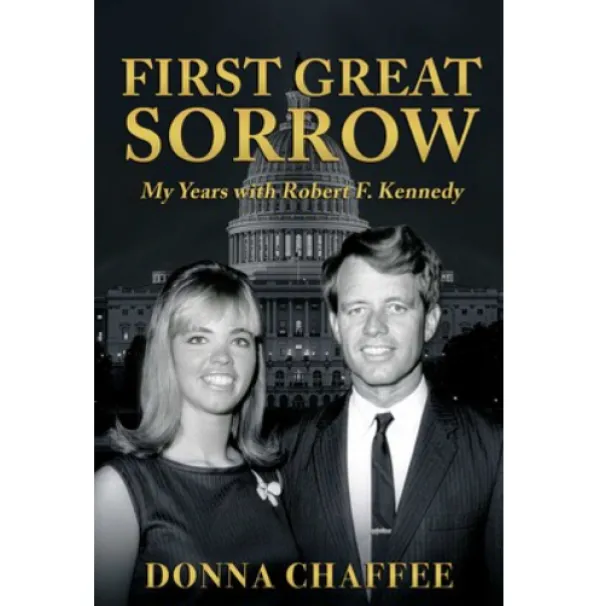
First Great Sorrow: My Years With Robert F. Kennedy by Donna Chaffee
It was the last week of my sixth grade year when Robert Kennedy was assassinated in 1968. It was just two months earlier that Martin Luther King, Jr., had been murdered, and I remember all the magazines my mother got–Life, Look, Ebony, Jet–and reading about both assassinations over and over.
We had a swing set in our back yard, and my friend Shielda Miller and sat in the swings talking about Kennedy’s shooting. She was adamant that he was going to die; I was just as adamant that he was not. I remember the news coverage on television and how one New York television station broadcast the word SHAME in bold black giant letters for almost three hours rather than running regularly scheduled programs.
The funeral train carrying Kennedy’s casket from New York to Washington, D.C. was hours late, so it was past our bedtime when the casket arrived at Arlington National Cemetery. Yet for some reason, my mother had left the television in my parent’s bedroom on, and I remember sneaking out into the hallway to watch–half holding my breath and ready to jump back into bed in case she headed upstairs. I have always thought she knew I was watching.
Looking back on that terrible year that also included–among other events–the seizure of the USS Pueblo by North Korea; Tet and Lyndon Johnson’s subsequent withdrawal from the presidential race; the Memphis sanitation workers’ strike; the release of the Kerner Commission report about the race riots that had rocked American cities every summer from 1964 through 1968; King’s assassination; the shootout between the Black Panthers and the police in Oakland, California; and leaving elementary school for junior high, I can now see that was when I became really interested in politics, history and what was going on in the world around me.
The title of the book comes from the Victorian era poet and novelist George Eliot’s book Adam Bede. The phrase tells us that the most terrible feelings come immediately after an individual’s first enormous loss and before s/he is aware that suffering, recovery, and hope are a cycle that will occur many times in life. “She had no tears this morning. She had wept them all away last night. . .For there is no despair so absolute as that which comes with the first moments of our first great sorrow, when we have not yet known what it is to have suffered and be healed, to have despaired and to have recovered hope.” As an American historian, I have studied how this era was lived, remembered and written about. The quote seems apropos.
Although Chaffee didn’t grow up in a family as immersed in politics and current affairs as the Kennedys, she did have a grandfather who was an adviser to Robert La Follette, Jr. and parents who were supporters of Adlai Stevenson. The 1960 convention was held in Los Angeles, her hometown, and she managed to get into the convention hall–where she was seated just a few rows from former First Lady Eleanor Roosevelt–to see John F. Kennedy nominated on the first ballot. Chaffee describes it as “electric and intoxicating.” Hooked, she volunteered for Kennedy’s campaign, addressing and stuffing envelopes, doing literature drops and knocking on the doors of potential voters. In the fall of that year–she was in the ninth grade–she chose Kennedy’s presidential campaign as the subject of her social studies assignment.
Chaffee was in her current events class when the teacher announced that JFK had been shot. She wrote a condolence letter to Robert F. Kennedy, who was his brother’s attorney general, and received a reply in which he stated his hope that her interest in politics and government would continue to grow. Those two things led her to enter George Washington University in Washington, D.C. She later completed a summer program at Oxford University and then transferred to the University of California at Berkeley. When RFK was elected to the United States Senate in 1964, she showed up in his Capitol Hill office and volunteered to help in the mail room, opening, distributing, and assisting with answering the tremendous volume of mail Kennedy received–more than 400,000 letters a year. She was quickly hired as a paid staffer.
Chaffee witnessed up close how Senator Kennedy responded to the seismic issues roiling America during the 1960s, including President Lyndon B. Johnson’s dispatching of U. S. troops to the Dominican Republic to counter what he claimed was a Communist attempt to overthrow their government; Kennedy’s subsequent tour of Latin America; his concerns about nuclear proliferation, which he addressed in his maiden speech in the United States Senate; the passage of the Voting Rights Act of 1965; the dismal conditions of schools for the “mentally retarded” in his home state of New York; his meeting of and developing support for Cesar Chavez and the United Farm Workers union; his growing concern over racial inequality and what became the yearly summer urban unrest in some of America’s largest cities in response to it; and his ever growing concerns over the Vietnam War and Johnson’s conduct of it. She was also aware of the escalating dislike between the two men, noting that Kennedy could not understand the president’s fixation on him since he was merely a junior senator and the president was the leader of the free world.
Chaffee admits she was in love with Kennedy and did everything possible to be in contact with him, including hand delivering his mail. She became friends with Providencia “Provi” Parades, the former assistant to Jacqueline Kennedy during her White House years who subsequently worked for Senator Kennedy and was thereby pulled into the personal orbit of the Kennedy family. Kennedy sometimes hosted staffers at his home for picnics and swimming in his pool and occasionally gave Chaffee rides home from the office, kissing her on the cheek when they departed. She admits this sounds very inappropriate if not downright scandalous in the days of Me Too, but insists it was part of her friendly, outgoing nature.
The last time she saw Kennedy was on June 2, 1968, when he was campaigning in California for the presidency. “He looked more tired” than when she had seen him two months earlier in San Francisco. Chaffee said that his hands were scratched and swollen from the interaction with the crowds, but she was left with the impression that he was energized by the campaign and the mostly positive reception he had received in the state. Just days later she was helping to coordinate plans for his funeral. She traveled on the funeral train from New York to Arlington National Cemetery and attended the burial. Afterward, Chaffee fell into a depression that lasted for a number of years and rushed headlong into marriage even though she knew it was a bad decision.
For several years after the assassination, Chaffee and other staffers gathered at meetings, symposia and the Kennedy compound in Hyannisport to discuss Kennedy’s work, legacy and relive old times. In 2018 she attended a service marking the fiftieth anniversary of his death held at Arlington National Cemetery and the reception following it, where she was able to visit with former staffers and campaign workers. She also became involved with the RFK Human Rights organization and went to dinners highlighting its Ripple of Hope Awards.
First Great Sorrow is not a scholarly study of Robert Kennedy’s life and work, but a sentimental, wistful, and affectionate account of someone who worked with him as a senator and presidential candidate. She summed up her experience by quoting Charles Dickens, “It was the best of times, it was the worst of times. . .” and William Wordsworth, “Though nothing can bring back the hour of splendour [sic] in the grass, of glory in the flower. . .”
Breezy and affable, First Great Sorrow is a highly readable account of one of one of the most complex, controversial, and significant politicians of the twentieth century.