
Georgia: the “Cracker State” No More?
Decades ago, while at an academic conference, a well-known African American political scientist who died in 2023 referred to Georgia in off-handed fashion as the “Cracker State” – a year or so before Andrew Young had launched a 1990 campaign for governor of Georgia that was doomed from the start. In my conversations with former Governor Douglas Wilder, Young committed a serious error in judgment. “He picked the wrong time to run for governor,” said Wilder. Wilder encouraged Young to run for Lt. governor and use that post as a steppingstone to the governor’s mansion eight years later, advice that Young ignored. Instead, Young chose to square off against Zell Miller, the state’s popular incumbent Lt. governor. Young advanced to the runoff only to lose badly to Miller who garnered approximately two-thirds of the vote and went on to win the governorship and serve eight years.
Twenty-eight years later the very enterprising and politically savvy Stacey Abrams, a veteran of the Georgia House of Representatives and former House Minority Leader, tossed her hat in the gubernatorial ring and lost a close race. Four years later she ran again, and put up a good showing, but by that time her opponent was an incumbent with all the trappings and advantages accorded such. Again, Abrams lost. In the end however I would argue that Abrams two losses altered Georgia’s political landscape.
If only the venerable political scientist referenced earlier was alive to see what unfolded last Tuesday night as Black woman after Black woman after Black woman after Black woman after Black woman after Black woman after Black woman after Black woman was elected to offices that were historically reserved for whites, namely white men. Would the good professor take the position that no longer is Georgia the “cracker state” but now the state “too busy to hate?” Obviously, there is no way to know. But here’s what we do know.
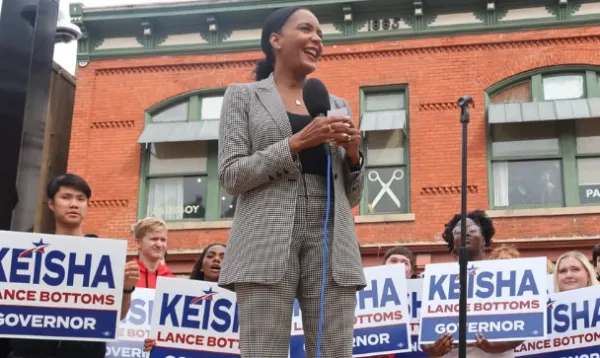
We know that not only was Keisha Lance Bottoms elected governor of a state whose history of race relations has historically been vitriolic at worst and ignominious at best, her election was just one of several history making events last Tuesday. That they occurred in Georgia makes what happened even more mindboggling.
To put things in perspective for those who are not easily moved: from 1882 to 1968, Georgia was among the states with the highest number of recorded lynchings. Yet last week Georgia voters elected Penny Brown Reynolds as secretary of state; Tanya Miller as attorney general, Katherine Juhan-Arnold as agriculture commissioner; Keisha Waites as insurance commissioner; Nikki Porcher as labor commissioner; Sheila Edwards as public service commissioner; and Lydia Powell as state school superintendent. More than thirty American states have never in their history elected an African American woman to a statewide office, yet Georgia ushered in eight in one night.
Who would have believed that such a thing could happen in a deep south state? Is Keisha Lance Bottoms’ election a sign to come? Lance Bottoms’ election in Georgia is about as mind-blowing as the likelihood of Mississippi voters electing a Black man to the United States Senate. Not in a million years could that ever happen, or could it?
Judson L. Jeffries, PhD, MPH, is Professor of African American and African Studies at The Ohio State University.