
A Hollow Song for a Hollow President: Reclaiming the Real Patriotic Ballads
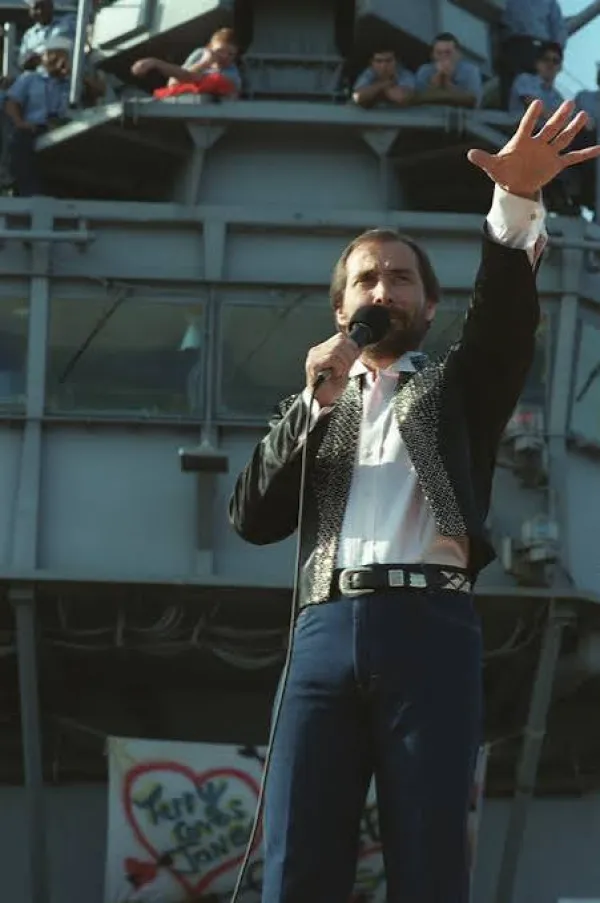
Lee Greenwood, creative commons image Released to Public Combined Military Service Digital Photographic Files
After musician after musician pulled out from Trump’s “Freedom 250” concert, he was left with Lee Greenwood, an opera tenor, a couple of military bands, and Kash Patel’s girlfriend. The anthem that made Greenwood a star, “God Bless the USA,” was written in 1985 during the height of the Cold War. It begins with the specter of loss— “If tomorrow—all the things were gone, I’d worked for all my life/ And I had to start all over with my children and my wife.” Then the wounds disappear before they’re felt: “I’d thank my lucky stars to be living here today/ Because the flag still stands for freedom and they can’t take that away.”
Ronald Reagan made the song his campaign theme while launching a new age of American inequality by systematically busting unions and cutting taxes for the wealthiest. Trump calls it Greenwood treats layoffs and the resulting toll on ordinary lives as a mere inconvenience. As the refrain shifts from violins and a church organ to a military march, he repeats, “I’m proud to be an American, where at least I know I’m free/ And I won’t forget the men who died who gave that right to me.”
Honoring those who died resonates powerfully. Those who risk taking bullets to defend our country deserve respect for their service and sacrifice. Yet this gives us no special grace over citizens of other lands. And doesn’t answer the question of whether or not it was necessary to put them in harms way to begin with. Because Greenwood says nothing about what freedom might demand of us, it becomes just an empty phrase, blessing all that our leaders may do, no matter how arrogant or destructive.
We were defending freedom in this view, when supporting dictators from Chile’s Augusto Pinochet to the Iranian Shah whose brutal rule laid the groundwork for the current theocracy and the war of choice that we hope has now finally ended. We’re supposedly defending freedom now as Trump cozies up to dictators like Vladimir Putin, Turkey’s Recep Erdoğan, and Saudi Arabia’s Mohammed bin Salman, and while ICE agents grab innocent people off America’s streets. When Greenwood sings, “There ain’t no doubt I love this land. God Bless the USA,” he never suggests what qualities of justice would redeem the love he declaims.
Greenwood wrote the song after we invaded the 95,000-person country of Grenada, wanting to reflect “the spirit of America being proud.” Reagan made it his campaign theme, and Greenwood has been singing it at Republican rallies and conventions ever since. Trump calls it “the greatest hit of all time” and sold a “God Bless the USA Bible,” (printed in China) that contains the song. Because Greenwood says that just living in America makes us free, his version of patriotism gets reduced to signing a blank check for whatever our leaders choose to do. It’s a perfect match for this or any president who seeks to erase all limits on their power.
But Greenwood’s isn’t the sole patriotic ballad to choose from. The late Waylon Jennings’ “America” reached number six on the charts the year “God Bless the USA” first came out. Written by Sammy Johns, the song affirms connection to native soil, as Jennings repeats, “America, America,” slowly and tenderly as if to a woman he loves; then admits, softly, “You’ve become a habit to me.” But he also makes tough demands—recounting his own history as an Anglo yeoman “from down round Tennessee,” then continuing, “But my brothers/ Are all black and white/ Yellow too/ And the red man is right/ To expect a little from you/ Promise and then follow through/ America.”
In a similar vein, “America the Beautiful” writer Katherine Lee Bates celebrated “purple mountain majesties,” but actively opposed America’s imperial adventures, so added lines like “God mend thine every flaw/Confirm thy soul in self-control/Thy liberty in law!” Bruce Springsteen’s whole career has been about honoring the courage and dignity of ordinary Americans, from “The Promised Land” celebrating those with “dreams that break your heart,” to “The Rising’s” portrait of 9/11 firefighters, to the “Streets of Minneapolis” chorus, “Singing through the bloody mist, we’ll take our stand for this land.”
Hard as it is, we’re stronger for engaging the difficult questions about who we’ve been as a country and who we want to be. Patriotic ballads don’t have to be political manifestos. But the best celebrate our diverse and contradictory land and acknowledge that true greatness does not flow like automatic grace. Rather, it’s fulfilled through honoring common responsibility and connection.
With democracy profoundly threatened, we need true patriotism more than ever. We can choose a patriotism of blind adulation. Or we can embrace the songs that demand the most of us.
Paul Rogat Loeb is the author of Soul of a Citizen and The Impossible Will Take a Little While, with 300,000 copies in print between them and a new edition of The Impossible out in October and available for preorder. See paulloeb.org An earlier version appeared in The Fulcrum.
PS—Speaking of real patriots, Jonathan Kozol is someone who’s done as much as anyone I can think of to fight for the lives of the children that our society, particularly black and brown children, too often defines as expendable and disposable. He has his own updated edition of We Shall Not Bow Down: Children of Color Under Siege: An Invocation to Resistance, which challenges the agenda that denies Black and Latino children the right to question their education and a system that rewards compliance instead of creativity. Creativity and critical thought is essential, Kozol writes, in the face of an administration that’s threatening the core of democracy. And he portrays dozens of warm and courageous teachers who stand up for a more democratic learning. I’ve just picked the book up and hope you will too.
Also please do follow me on social, since it’s another way to distribute these posts: Facebook, LinkedIn, Twitter (if you can stomach it), and Bluesky.
[Here’s subscribe and unsubscribe info]
To receive my postings directly, if you're not already receiving them, please subscribe on my new Substack, where I’ll be migrating my posts and lists
To unsubscribe from this list, including if you’re now confirmed as following me on Substack and have been receiving messages, please email sympa@npogroups.org with the subject line:
unsubscribe paulloeb-articlesedu