
How to Stop Trump’s Coup: Lessons from South Korea
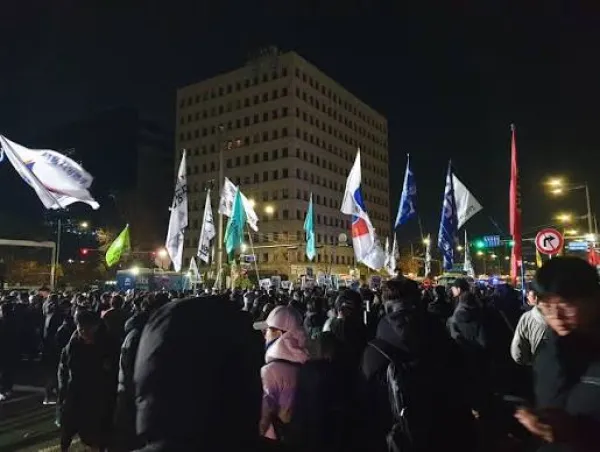
Flags in the protests against 2024 South Korean martial law, Hashflu, CC BY-SA 4.0 <https://creativecommons.org/licenses/by-sa/4.0>, via Wikimedia Commons
How do you stop a would-be dictator? The first lesson is knowing that it’s possible, as South Korea showed a month after Donald Trump’s reelection. Their example should hearten those of us worried that Trump and his allies will disrupt or defy the results of November’s midterms—whether by obstructing voting or trying to block ballot counting and certification.
After escalating conflicts with South Korea’s National Assembly and bribery accusations against his wife, President Yoon Suk Yeol abruptly declared martial law on December 3, 2024, at 10:23 P.M. Like Trump, Yoon had already appointed loyalists to key military posts, and his state prosecutor used libel laws to attack political opponents and journalists. Yoon now banned all political activity, protests, and strikes, and claimed the right to detain anyone he chose. He ordered the military to enter the National Assembly by force to remove the members, “including the use of firearms if necessary.”
But 16,000 protesters rushed to the building to protect the legislature, helping National Assembly members and staffers push past the arriving soldiers and climb the walls to get in. As Korea’s opposition leader and others headed to the parliament, they live-streamed calls for people to join them. Citizens outside nonviolently blocked armored vehicles and buses. When military helicopters landed inside the assembly grounds, parliamentary aides defended the main building against the troops they carried, building barricades from furniture and using fire extinguishers to slow soldiers breaking through the windows. In the end, resistance from citizens, the Assembly’s security forces, and legislative staff kept the troops from occupying the main chamber.
By 1 A.M. enough members had reached the chamber for a quorum, and unanimously exercised their constitutional right to revoke Yoon’s martial law. For the next ten days, citizens surrounded the parliamentary complex in freezing temperatures—chanting, singing K-pop songs, waving lightsticks, and calling for Yoon’s impeachment. The protests grew to over a million people by December 14, when the assembly, including a dozen members of Yoon’s own party, impeached him. Four months later, Korea’s Constitutional Court upheld the impeachment, and Yoon’s party lost the presidential election that summer. Yoon is now serving a life sentence for insurrection, and his Defense Minister, Prime Minister, and Interior Minister are serving lengthy terms.
Here are five key lessons for America from South Korea:
1. Elections matter all the more under a would-be dictator.
Nonviolent movements have overthrown seemingly entrenched dictators. But authoritarian power is far easier to challenge when the opposition also holds institutional power. Because South Korea’s opposition party had won major gains in the April 2024’s election, they were already blocking some of Yoon’s initiatives. Party leaders defied attempts to silence them, and their leadership on the night of the attempted coup was critical. Because broad, decisive margins are our best guarantee of securing our elections, we can’t let fear of Trump’s interference deter us from doing all we can to get people to vote.
2. Act quickly to confront attempted seizures of power.
As soon as Yoon declared martial law, activists and opposition party leaders called on people to assemble. The crowds arrived before the military’s armored vehicles and helicopters, and helped assembly members and staff enter the building despite the military troops. Had they waited, martial law would have become the status quo, making protest much harder.
In America’s upcoming midterms, some points of contestation are national, like the successful Supreme Court battle over mail voting. But most are and will be local, which means citizens and local governments need to prepare to protect polling places and vote-counting centers if disruptions occur, including having police protect them from potential attacks by Trump supporters. The 2,000 election is a cautionary tale. A mob of Republican congressional staffers helped hand Florida and the presidency to George Bush by shutting down the Miami-Dade County recount, while the Gore/Lieberman campaign placed its trust solely in the courts and discouraged the citizen mobilization that might have pressured them.
It matters that US courts have blocked many of Trump’s anti-voting initiatives and that groups like LULAC are suing in advance to block ICE from polling places, legal scholars are circulating arguments for why judges must reject requests to seize ballots, and state Attorney Generals and Secretaries of State are pre-creating emergency legal briefs. Protect Democracy and the Brennan Center have published detailed checklists for election officials, and for citizen groups refuting potential administration arguments. But massive and immediate nonviolent protest will be also essential if Trump tries to shut down voting or disrupt the count.
3. Encourage security forces to stay loyal to the Constitution, not to any particular leader.
Citizens who confronted the martial law forces said many soldiers showed open or subtle resistance to the coup. They didn’t actively repel the crowds in front of the building or forcibly remove the aides resisting inside. Officers commanding two military buses ordered their troops to stay aboard rather than fully deploy. A sergeant refused flight approval for a Special Forces transport helicopter. A major and a sergeant, ordered to prepare ammunition, refused to issue it, saying replenishing it would take too long. When one unit was ordered to seize computer servers to prevent a parliamentary vote, they delayed by stopping to eat ramen noodles at a nearby convenience store.
Assembly members with military and National Intelligence backgrounds played crucial roles in the resistance. They’d watched the president appoint loyalists to key military posts and attack opposition journalists. They’d proposed amendments to make martial law harder to declare and made specific plans to assemble if Yoon instituted it. This helped them respond immediately.
Ordinary citizens also urged soldiers to defect or refuse unlawful orders. Outside the assembly building, they both blocked the troops trying to enter and tearfully pleaded with them to stop their assault on democracy. Former special forces members invoked their shared unit backgrounds. Protesters explicitly asked the soldiers to remember the 1980 Gwangju massacre and not support a dictatorship.
In our own context, it mattered enormously that six US senators and House members with military and national security backgrounds created last November’s video on the duty to refuse illegal orders. That’s why the Trump administration attacked them so virulently, and why it was a major victory when a Washington, DC, grand jury refused to indict them. We need to keep highlighting this duty to service members, while reminding fellow citizens how Trump and his cohorts break the law daily. We hope we never reach a moment like South Korea’s, but if we do, we shouldn’t assume the American military will fully do Trump’s bidding.
4. Prevent the coup’s initiators from consolidating power.
The day after the attempted coup, civil society organizations nationwide held press conferences demanding the president’s resignation, impeachment, and arrest, and the arrest of his ally, the defense minister. Daily protests outside the Assembly pressured members to swiftly impeach Yoon, culminating in the demonstration of over a million people. After the assembly impeached Yoon, including members of his own party, protests shifted to the presidential residence and the Constitutional Court, demanding Yoon’s arrest.
Meanwhile, a coalition of 1,550 civil society groups held weekend demonstrations in front of the Constitutional Court. Metal, railway, and transport workers’ unions led strikes and demonstrated at local ruling-party offices and at the offices of assembly members who refused to support impeachment. History teachers explained the relevant precedents. A widely circulated PowerPoint debunked Yoon’s arguments and offered slogans to use. The Korean Confederation of Trade Unions created a website to send text messages to anti-impeachment assembly members—swamping their phones.
The lesson for the US is that power gets consolidated in stages, and that every stage we block makes the next easier to prevent. It also shows how much countervailing power matters, particularly when state and local governments resist election interference. Legal challenges are essential to this, but so are the actions of ordinary citizens. It’s important that Indivisible and No Kings have been conducting Hands off the Vote trainings with the ACLU and recruiting poll monitors, and that the long-standing 866-ourvote national hotline is expanding its presence. Whether or not people cast challenged ballots often depends on whether trained observers are there to stand up for their rights,
Will it be enough? Veteran nonviolent organizers the Freedom Trainers have mapped out how people can respond to multiple scenarios from pre-election attempts to suppress the vote to attempts to block vote certification. Were far more people trained and trained thoroughly it would help. But although South Korea has had more experience challenging dictators, most who confronted the soldiers and protected the Assembly members acted intuitively without formal training. So we need to hope that lessons in resistance, like Minnesota’s ICE resistance, have rippled out sufficiently.
5. Create festive, diverse forms of resistance.
As South Korea’s demonstrations kept growing, K-pop lightsticks replaced the traditional candles as the protest symbol. They gave the rallies the feel of a concert, as protesters turned K-pop hits into chants. Musicians and artists added to the festival atmosphere. Supporters prepaid for hundreds of cups of coffee, snacks, and meals at nearby cafés, restaurants, and food trucks. This atmosphere was crucial in drawing younger Koreans, the core K-pop fan base.
America’s major rallies, like No Kings, already combine festivity with defiance, a combination key to helping people keep going. Let’s embody that in our final election push!
Have pro-democracy organizers across the US engaged enough people to prevent Trump from overturning election results he doesn’t like? We won’t know until Election Day and the days immediately after. Meanwhile, South Korea’s example can inspire and instruct us as Americans defend our own beleaguered democracy.
Paul Loeb is the editor of The Impossible Will Take a Little While: Perseverance and Hope in Troubled Times, whose wholly updated new edition has just been released after 128,000 copies in print. Jungmin Choi is a campaigner at World Without War, a South Korean antimilitarist organization based in Seoul. Adapted from Choi’s essay in The Impossible and an earlier version at WagingNonviolence.org. A shorter version appeared in The Nation.
Please forward, link to this, repost, or quote, but if you forward or repost, keep the end credit about it being from The Nation and The Impossible Will Take a Little While.
Thanks for reading Paul Loeb--Soul of a Citizen! Subscribe for free to receive new posts and support