
If Azaria Is Pardoned, Why Not Amir?
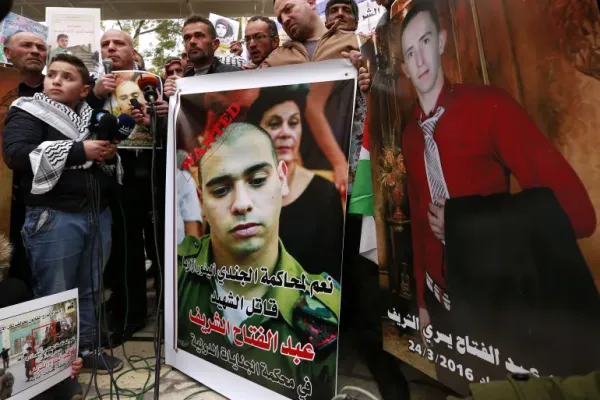
Palestinian protesters hold images of Abed al-Fattah al-Sharif and Elor Azaria, the Israeli soldier who shot and killed al-Sharif in Hebron in 2016 while he was wounded and lying incapacitated on the ground. Protesters also hold a “wanted” poster of Azaria in Arabic calling for him to stand trial before the International Criminal Court.
President Isaac Herzog recently granted Elor Azaria clemency, shortening the period before the remainder of his criminal record could be erased. He did so despite opposition from the military's chief of staff.
In March 2016, Azaria shot and killed 21-year-old Palestinian Abdulfattah al-Sharif in Hebron while al-Sharif was wounded and lying incapacitated on the ground.
Azaria, who was serving as an IDF medic, approached the wounded al-Sharif and fatally shot him in the head from a few feet away. A video of the shooting was published by B'Tselem and went viral on Israeli social media, sparking widespread controversy and renewed debate over Israel's characterization of the IDF as "the most moral army in the world."
Azaria was subsequently convicted of manslaughter and served nine months of an 18-month prison sentence. He was also sentenced to 12 months of probation and demoted in rank. Following his conviction, Prime Minister Benjamin Netanyahu and then-Defense Minister Avigdor Lieberman said that the soldier should be pardoned. The Palestinian Authority criticized the trial, while al-Sharif's family called for a life sentence and argued that the Israeli military has imposed harsher sentences on Palestinian children convicted of stone-throwing.
Herzog has now shortened the remaining period of Azaria's criminal record, allowing him to move forward without that record. According to the President's Office, Herzog said he considered the passage of time, the sentence Azaria had served, his changed personal and family circumstances, and the remorse he had expressed.
The President's decision raises serious questions about how presidential clemency is applied and what principles should distinguish one case from another.
I should also note that Israel held al-Sharif's body for approximately two months before returning it to his family in Hebron. The circumstances surrounding the withholding of Palestinian bodies have been the subject of international controversy.
For the al-Sharif family, the delay meant an additional period of uncertainty and grief following their son's death.
So, what comes next—would he pardon Yigal Amir, too?
Circled in red: Elor Azaria, holding a gun moments before firing at Palestinian Abd al-Fattah al-Sharif, who was lying wounded and incapacitated on the ground. (Emad Abu-Shamsiyah/B’Tselem)
Mahmoud El-Yousseph is a Palestinian freelance writer and retired U.S. Air Force veteran. He writes about U.S. foreign policy, Middle Eastern affairs and justice.