If They Were Israeli Jews, Would the World Care?
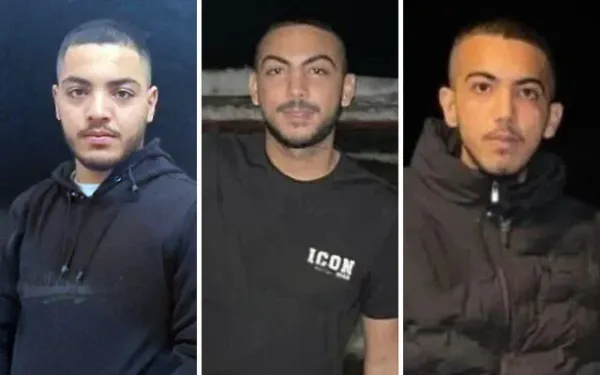
Three men have been found dead in a burning car near an Arab town south-east of the Israeli port city of Haifa, police reported on Sunday. Police said the incident was believed to have been the result of a crime.The victims were identified as: brothers Zain Odeh, 16, and Qassem Odeh, 20, and their relative Yahya Bassimi, 20. Photo credit: X
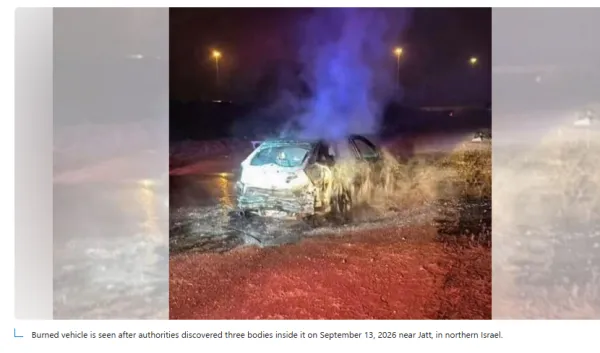
The bodies of three young Palestinian men were found Sunday, September 14, inside a burned vehicle in an open area between the occupied Palestinian towns of Baqa al-Gharbiya and Jatt.
They were not foreigners. They were not people who had crossed a border illegally. They were Israeli citizens.
The victims were brothers Zain Odeh, 16, and Qassem Odeh, 20, and their relative Yahya Bassimi, 20.
Three young men. Three lives. Three families left to grieve.
Israeli police believe the killings were criminal in nature.
And then what?
Silence.
One year ago today, Police Commissioner Danny Levy declared that Israel was in a “state of national emergency” after five Arab citizens were killed within just 12 hours.
Yet Levy insisted that the police were doing everything they could to combat violent crime.
Forgive me, but that is difficult to swallow.
During a situational assessment with senior officers that day, Levy reportedly said that the problem could not be solved by the police alone and required action from government ministries, local authorities, civil society organizations and even the army.
Again, it sounds good.
But for the families burying their children, statements and situational assessments mean very little.
So let us ask a question that should make everyone uncomfortable:
What if the three victims had been Israeli Jews?
Would the response be the same?
I think we all know the answer.
The army and police would likely be placed on high alert. Security forces would pour into surrounding Palestinian towns searching for the perpetrators. Government ministers and other Israeli officials would appear on television, radio and social media condemning the killings as an act of terrorism.
The victims' photographs would be splashed across television screens and newspaper front pages.
World leaders would issue statements of condemnation.
The perpetrators would become the subject of an enormous intelligence and security operation. Israeli authorities would be under intense pressure to find them, arrest them or kill them.
And if the perpetrators were identified, their families could face home demolitions—an act long criticized as collective punishment and one that raises serious questions under international law.
But these three young Palestinian citizens?
Where is the outrage?
Where are the front-page photographs?
Where are the impassioned speeches?
Where are the politicians competing to condemn the killings?
Where is the international media?
Where are the world leaders?
Where is the urgency?
This is the double standard that Palestinians have lived with for far too long.
When Palestinians are murdered in Israel, their deaths too often become statistics—briefly reported, if reported at all, and then forgotten.
But when an Israeli Jew is killed by a Palestinian, the response can be immediate and overwhelming. The story dominates the news. Politicians speak. Security forces mobilize. World leaders condemn the killing. The entire world is expected to pay attention.
Why?
Are some lives worth more than others?
Are the lives of Palestinian citizens somehow less deserving of protection, outrage and justice?
And before anyone accuses me of minimizing the killing of Israeli Jews, let me be clear: the murder of an innocent person is wrong regardless of the victim's ethnicity, religion or nationality.
That is precisely the point.
If an Israeli Jew is murdered, there should be outrage.
If a Palestinian is murdered, there should be outrage.
If a child is murdered, there should be outrage.
If three young men are found burned to death inside a vehicle, there should be outrage. Justice cannot be selective.
Human life cannot have a different value depending on the identity of the victim.
Mahmoud El-Yousseph is a Palestinian freelance writer and retired U.S. Air Force veteran. He writes about U.S. foreign policy, Middle Eastern affairs, and justice.