
The Illusion of American Security in the Persian Gulf: How War Consolidates Power in Tehran
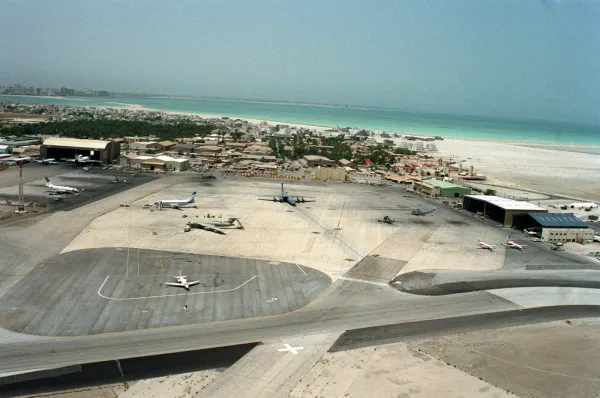
An overview of Bahrain Airport with various military and civilian aircraft parked on the ramps, creative commons image via Picryl Creator: OS2 John Bouvia
For decades, Washington armed the Persian Gulf Arab states extensively. Expansive military bases, aircraft carrier deployments, integrated air defense systems, and bilateral security agreements were presented as ironclad shields against largely manufactured existential threats—particularly from the Islamic Revolutionary Guard Corps and the Iranian state. The United States positioned itself as the ultimate guarantor of Gulf security, promising deterrence through overwhelming force and rapid response capabilities.
This architecture included permanent deployments in Bahrain, Qatar, and the United Arab Emirates, alongside continuous naval patrols through the Strait of Hormuz—a chokepoint through which more than 10 percent of global oil supply passes. Gulf governments invested vast sums in American weapons systems on the assumption that U.S. backing would deter aggression and, if necessary, ensure protection. Strategic alignment with Washington and Tel Aviv was framed as the pathway not only to security, but as the gateway to economic growth, technological modernization, and geopolitical relevance.
Yet the recent U.S.–Israel war against Iran has exposed the limits of that promise.
Despite one of the most heavily militarized American regional footprints in the world, Gulf states aftermath of by U.S.–Israel attack has faced missile strikes, drone incursions, and maritime disruption. Energy infrastructure has been threatened. Oil shipments transiting the Strait of Hormuz have been interrupted, with actions attributed to the Islamic Revolutionary Guard Corps. Shipping lanes have been destabilized, insurance premiums have surged, and global markets have responded with volatility.
Even American assets—military installations and diplomatic facilities—have come under threat. The assumption that dense military infrastructure would translate into strategic invulnerability has proven flawed.
The contradiction is structural: overwhelming conventional superiority does not prevent asymmetric retaliation. Air defense systems can intercept some projectiles, but they cannot eliminate dispersed drone networks, proxy warfare, cyber operations, and calibrated economic disruption. Aircraft carriers cannot guarantee uninterrupted energy flows during prolonged escalation. Military dominance has not produced comprehensive security.
For Gulf Arab states, the lesson is sobering. Arms purchases and formal alliances may deter invasion, but they do not eliminate exposure to gray-zone conflict. The myth was not that the United States lacked power; it was that power alone could engineer durable regional order.
The Collapse of the Containment Assumption
For years, U.S. strategy toward Iran rested on containment. Tehran was portrayed as a state that could be isolated, sanctioned, and gradually weakened—economically constrained, diplomatically boxed in, and internally fragile. Pressure was expected to yield either behavioral moderation or collapse.
On February 28, 2026, the United States and Israel escalated this approach into direct war, reportedly calculating that Iran was sufficiently weakened to be coerced into regime change—or at least regime realignment aligned with U.S.–Israeli strategic objectives. Some anticipated that sustained military pressure would fracture the ruling elite and trigger internal uprising.
That expectation has not materialized.
Rather than collapsing, the Iranian state consolidated. External attack reframed the conflict around sovereignty and national resistance. Political factions closed ranks. The assumption that pressure would generate fragmentation instead reinforced cohesion—at least in the immediate term.
Iran has demonstrated capacity and willingness to disrupt the broader regional order if pushed to the brink. Its ballistic missiles, drone capabilities, and regional partnerships extend deterrence beyond its borders. Through networks in Iraq, Syria, Lebanon, and Yemen, Tehran can impose multidimensional costs on adversaries.
Maritime leverage remains central. The ability to threaten or temporarily close the Strait of Hormuz gives Iran influence disproportionate to its economic size. Even limited disruption reverberates across global energy markets and financial systems.
The core miscalculation was analytical: containment assumed passivity. Instead, Iran adapted. It does not require conventional superiority to shape outcomes; it requires only sufficient retaliatory capacity to raise escalation costs beyond what adversaries are prepared to sustain.
States under pressure do not inevitably implode. They often entrench. What has collapsed, therefore, is not merely a tactical gamble but a long-standing strategic premise—that sustained pressure would produce submission.
Internal Political Consequences
Perhaps the most enduring impact of this war may be internal.
External military aggression has historically strengthened hardline factions within Iran’s political system. Under direct threat, ruling elites invoke sovereignty and resistance as unifying narratives. Dissent becomes easier to frame as disloyalty. Security institutions gain authority under emergency logic.
Rather than weakening the state, outside pressure frequently narrows political space. Reformist and pragmatic factions are marginalized, while hardliners consolidate influence. Survival displaces reform as the dominant political priority.
This pattern has precedent. In 1953, Iran’s elected prime minister, Mohammad Mosaddegh, was overthrown in a covert operation orchestrated by the Central Intelligence Agency (CIA) alongside British intelligence after nationalizing Iran’s oil industry. The coup restored monarchical authority under Mohammad Reza Pahlavi. Rather than strengthening democratic development, the intervention weakened indigenous institutions and entrenched authoritarian rule. Its legacy continues to shape Iranian political memory, reinforcing skepticism toward external intervention.
History suggests that durable political change is more likely to emerge from internal evolution than externally imposed shock. When foreign aggression dominates the national agenda, reform becomes politically hazardous and institutionally sidelined.
The strategic irony is stark: measures designed to fracture Iran’s ruling order may instead harden it. External pressure tends to consolidate authority in the hands of the most security-oriented and uncompromising factions, accelerating political centralization and constricting already limited avenues for reform. In attempting to weaken the state, military escalation risks reinforcing its most rigid elements and narrowing Iran’s political future for years to come.
Internationally, the consequences are likely to extend far beyond Iran’s borders. A more securitized and politically entrenched leadership in Tehran would be incentivized to adopt a sharper, more confrontational regional posture, deepen strategic ties with non-Western powers, and leverage instability as deterrence. Energy markets would face renewed volatility, maritime routes could become recurring flashpoints, and already fragile diplomatic alignments would erode further.
Most consequentially, sustained external pressure could accelerate Tehran’s pursuit of a nuclear weapons capability—transforming nuclear latency into overt weaponization. Such a shift would not only heighten the risk of direct great-power confrontation but also increase the likelihood of cascading nuclear proliferation across the Middle East. What begins as a strategy of coercion may therefore produce the opposite of its intended effect: entrenchment instead of capitulation, escalation instead of deterrence, and a regional order defined less by stability than by permanent brinkmanship.