
Iran, Venezuela, and Cuba: Regime Re-Orientation and the Coercive Logic of American Hegemony
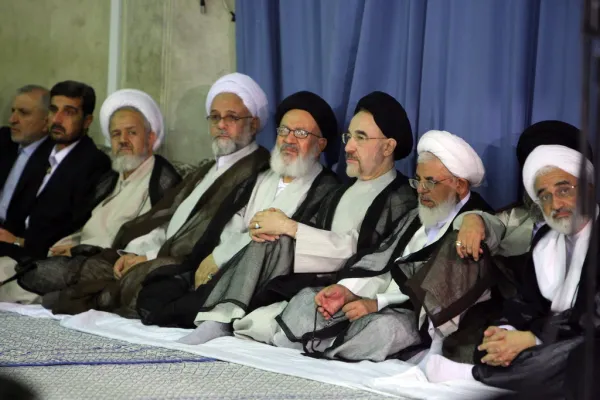
Government officials meet with the Supreme Leader of Iran, Khamenei.ir, CC BY 4.0 <https://creativecommons.org/licenses/by/4.0>, via Wikimedia Commons
In Greek mythology, Zeus reigns as the supreme guarantor of cosmic order. He punishes transgression, enforces hierarchy, and claims stewardship over justice itself. Yet Zeus is equally defined by his exemption from the laws he upholds. Law, in this mythic universe, does not constrain sovereign power; it expresses and organizes it. It structures hierarchy while shielding its apex.
The contemporary international order exhibits a similar paradox. Since 1945, the United States has occupied a position often described in the language of leadership, stewardship, or hegemony. Within the framework of hegemonic stability theory, the United States appears as the system’s indispensable stabilizer: underwriting security, liquidity, and institutional cooperation. In this view, order depends on a dominant power willing and able to supply public goods—open markets, stable currency regimes, security guarantees—and to enforce rules against challengers. Hegemony is presented as functional and stabilizing rather than imperial.
Yet this functionalist description obscures an asymmetry. If hegemonic stability theory explains why a dominant power might sustain order, it says less about how that order disciplines noncompliant states. Here, insights from imperial theory become indispensable. Classical empires ruled through territorial annexation and direct administration. Contemporary hegemony operates differently. It rarely seeks formal sovereignty over territory; instead, it seeks to structure the field of permissible political and economic alignment. Power is exercised not primarily through incorporation, but through calibration.
It is within this intersection of hegemony and informal empire that the concept of regime re-orientation emerges. Regime re-orientation differs from classic regime change. The latter seeks replacement of governing elites. The former seeks behavioral realignment. Regime re-orientation refers to the use of coercive instruments—military, economic, and diplomatic—to compel a state to realign its external strategic behavior without necessarily altering its internal governing structure. It differs from regime change in that compliance, not replacement, is the objective. It is not always necessary to overthrow a government; it is sufficient to compel it to adjust its external alignments—security partnerships, trade flows, financial networks, and regional posture—to conform to the hegemonic order. Sovereignty is tolerated, even affirmed, provided it produces compliance.
This logic clarifies recent U.S. actions toward Iran, Venezuela, and Cuba. In each case, the central issue is not territorial expansion or permanent occupation. Nor is it purely ideological transformation. The strategic objective is alignment within a U.S.-centered security and economic architecture.
In Iran, military strikes framed as anticipatory self-defense operate as instruments of coercive signaling. The issue is not the occupation of Iranian territory; it is the constraining of Iran’s regional autonomy—its deterrent capacity, alliance networks, and strategic depth. The message is structural: participation in the regional order is conditional upon compliance with parameters defined by the hegemon.
In Venezuela, coercive intervention and economic pressure target the country’s external partnerships—particularly energy relationships and financial channels that circumvent U.S. leverage. Again, the objective is not colonial governance. It is the forced recalibration of geopolitical orientation. A Venezuelan state integrated into Western financial circuits and aligned with U.S. regional priorities would pose no structural problem regardless of its internal political form.
Cuba provides the clearest example of regime re-orientation through economic means. Sanctions, embargoes, and secondary financial restrictions aim to isolate Havana until its external alignments shift. The internal ideological character of the regime matters less than its refusal to integrate into the U.S.-dominated economic and security system. The strategy is one of systemic discipline rather than territorial control.
From the perspective of imperial theory, this represents a form of informal empire: domination without annexation, hierarchy without formal sovereignty. From the perspective of hegemonic stability theory, it reveals the coercive underside of public-goods provision. Stability is not neutral; it is structured around the interests of the hegemon. States that benefit from integration experience order as cooperative. States that resist experience it as compulsion.
This duality explains the central paradox of liberal internationalism. The United States presents itself as guardian of a rule-based order. Yet the rules operate asymmetrically. International law and institutional norms function as binding constraints primarily for secondary powers. For the hegemon, they function as instruments—flexible tools to legitimize enforcement against adversaries while accommodating exceptionalism for itself.
Europe’s role in this system further clarifies the structure. Through NATO and economic interdependence, European states are embedded within the U.S.-led order. They benefit from its security guarantees and market access. Consequently, they participate in the legitimization of regime re-orientation campaigns by embedding them in multilateral rhetoric—deterrence, stabilization, humanitarian necessity—even when legal authorization is contested.
This is not merely hypocrisy; it is structural positioning. Europe’s own capacity for global influence depends on the durability of the U.S.-centered order. To challenge regime re-orientation as a principle would risk destabilizing the framework that secures European prosperity and security. Legal universalism thus becomes conditional. Norms are defended robustly when violated by adversaries, but rendered elastic when enforcement serves hegemonic interests.
The controversy surrounding proposals to acquire Greenland illustrates the boundary of this elasticity. When imperial logic gestures inward—when coercive realignment appears directed toward Europe itself—the language of sovereignty becomes uncompromising. The objection is not to hierarchy per se, but to its reapplication within the core of the system. What is tolerated at the periphery becomes intolerable at the center.
The broader theoretical implication is that contemporary hegemony fuses two traditions often treated as distinct: the stabilizing hegemon of liberal institutionalism and the disciplining empire of critical theory. Regime re-orientation is the mechanism that reconciles them. It preserves the appearance of sovereign equality while ensuring structural subordination. It avoids the costs of occupation while achieving alignment. It allows the hegemon to claim defense of order while redefining deviation as instability.
Like Zeus’s justice, the liberal order governs hierarchically. Law articulates the boundaries of acceptable conduct for others while accommodating exceptional authority at the apex. As U.S. hegemony becomes more openly unilateral, the distinction between stabilization and domination grows thinner. The fiction that coercive alignment is synonymous with universal order becomes harder to sustain.
Europe now confronts a narrowing choice: to defend international law as a genuine constraint—including against the hegemon on which it depends—or to continue participating in a system where sovereignty is conditional and regime re-orientation is normalized. The tension between moral universalism and structural dependence can no longer be indefinitely deferred.
Contact Information:
Nader Rahimi
Email: nrahimi@bu.edu