
Iraq: 23 Years Later, Still Not Sovereign
In 2003, George W. Bush’s administration invaded Iraq and overthrew Saddam Hussein on the pretext that his regime possessed and was developing weapons of mass destruction that posed a grave threat to the United States and the world. Those weapons were never found. As the war dragged on, the original justification became increasingly difficult to defend, and the argument gradually shifted toward a different narrative: that America had gone to Iraq to liberate its people, overthrow a dictatorship, and transform Iraq into a democratic and stable country.
On Wednesday, September 30, 2026, the U.S. military announced the completion of its troop withdrawal from Iraq, more than 20 years after invading the country and toppling Saddam Hussein. Sadly, after 23 years, Iraq is neither the functioning democracy that the American intervention promised to create nor a fully sovereign nation free from the continuing influence and military presence of outside powers.
The enormous cost of the war in Iraqi lives, American money, political instability, and human suffering was justified to the American public on the basis of a threat that was never found. Then, as that justification collapsed, the mission was increasingly presented as an effort to bring democracy to Iraq and, more broadly, to transform the Middle East. Yet after more than two decades, Iraq remains deeply troubled by political instability, corruption, competing armed groups, foreign influence, and weak state institutions. The invasion and occupation did not simply remove Saddam Hussein; they profoundly altered the political and social balance of the country. Iraq became deeply fragmented, and Iraqi ethnic and religious communities increasingly became the objects of competing foreign influence, including from the United States, Iran, and Israel.
Iraq—and particularly the Kurdistan region—also became an arena in which foreign intelligence services, political operatives from United States, Iran, and Israel, and armed groups competed for influence. Instead of becoming the stable, sovereign democracy that Washington promised, Iraq became, in many respects, a battleground for competing regional and international interests.
Iraq, like many countries that have been subjected to colonial rule, imperial intervention, or foreign occupation, formally gained independence but continued to struggle with the political, economic, and institutional consequences of that domination. The end of an occupation does not necessarily mean the end of outside influence. A country can have a flag, a parliament, elections, and a government, yet still lack the freedom to make fundamental decisions entirely on its own. Formal independence does not always translate into genuine sovereignty. Iraq has yet to achieve that full measure of sovereignty.
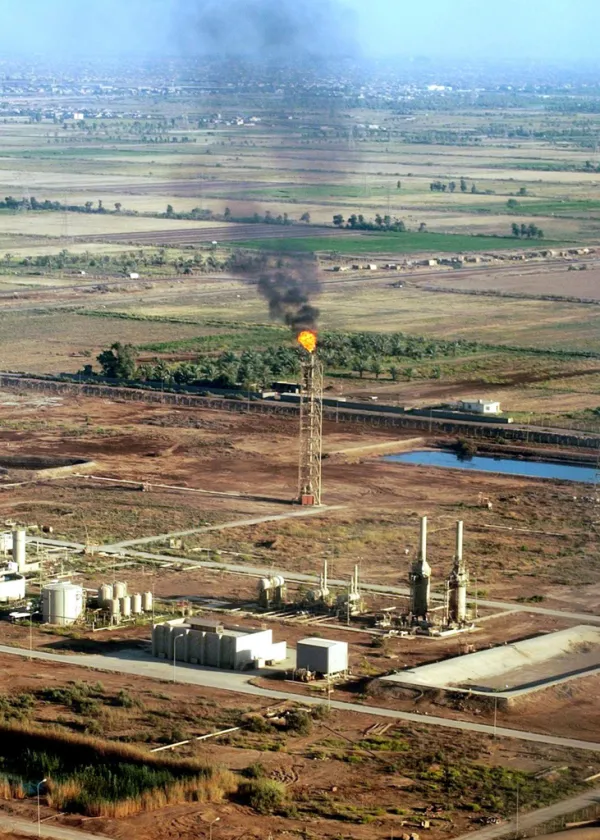
The question of sovereignty is particularly important when it comes to Iraq’s oil wealth. Since the 2003 invasion, the United States has exercised enormous influence over the mechanisms through which Iraq’s oil revenues and international financial transactions have been managed. That influence has given Washington significant leverage over Baghdad’s economic affairs and, by extension, its political decisions, with important implications for Iraq’s relationship with Iran and the wider Middle East.
After the invasion, the U.S.-led Coalition Provisional Authority (CPA) established the Development Fund for Iraq (DFI). The fund was held at the Federal Reserve Bank of New York and was created to collect and manage Iraqi oil revenues and other funds for reconstruction and development. Oil remains the backbone of the Iraqi economy. It accounts for roughly 90 percent of government revenue, making control over the flow of oil income enormously important to the country’s political and economic stability.
This is where the question of Iraqi sovereignty becomes more complicated than simply asking whether American troops are still physically stationed in Iraq. An occupation can end militarily without ending its political and economic consequences.
The withdrawal of the last American troops may therefore mark the end of one dark chapter of the Iraq war, but it does not erase the bloody consequences of the invasion. Nor does it automatically make Iraq fully sovereign. The country remains caught between powerful external actors, competing internal political factions, armed groups, and institutions weakened by decades of dictatorship, invasion, occupation, sanctions, war, and foreign interference.
After 23 years, the fundamental question is not simply whether America has finally left Iraq. It is whether Iraq has finally been allowed to belong to Iraqis. As long as Washington retains extensive leverage over the Iraqi government through its influence over the country’s oil revenues, Iraq’s formal sovereignty will remain very different from its actual political and economic independence.