
Ireland Takes a Stand: The Irish National Team’s Message on Gaza
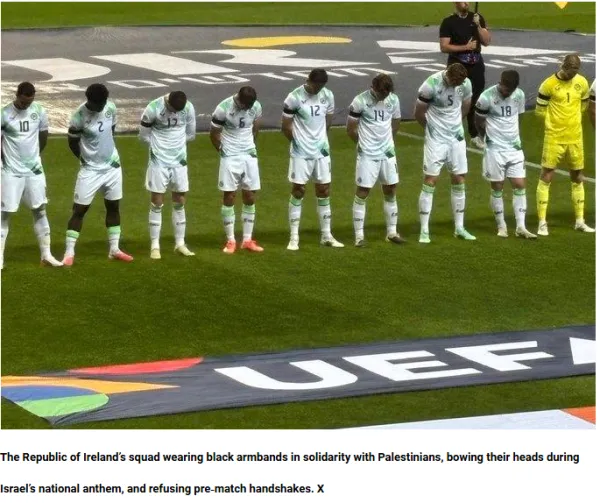
The Republic of Ireland’s national soccer team sent a powerful political message during its Nations League match against Israel in Debrecen, Hungary, on September 27.
Irish players wore black armbands, bowed their heads during the playing of Israel’s national anthem, and declined the customary pre-match handshakes and pennant exchange with the Israeli players. They then went on to defeat Israel 3–0, with goals from Troy Parrott, Adam Idah and Jack Moylan. Source: AP
For many people, the gestures were a symbolic expression of solidarity with Palestinians amid the war in Gaza. For others, they were an inappropriate mixing of politics and sport. Whatever one's view, it was impossible to miss the message the Irish players were sending.
And apparently, some people at Fox News were not happy.
Fox News Takes Offense
A Fox News/OutKick headline declared:
“Irish national soccer team should be ashamed for not shaking hands with Israeli opponents.”
The accompanying commentary described the Irish players' actions as a “virtue signal” and accused them of falling short morally. Fox News
I see it differently.
Ireland did not attack the Israeli players. The Irish players did not prevent Israel from playing. They simply declined to participate in a ceremonial gesture that, under the circumstances, they apparently did not feel comfortable making.
That is a form of political expression.
American athletes have made political statements during sporting events for years. NFL players, most famously Colin Kaepernick, knelt during the U.S. national anthem to protest racial injustice. Whether someone agreed with that protest or considered it appropriate was—and remains—a matter of opinion. The important point is that athletes have long used their public platforms to express political and moral convictions.
Why should Irish footballers be treated differently?
If Fox News believes the Irish players should be ashamed, that is its editorial opinion. But I would argue that the question should be why these particular players felt compelled to make such a statement in the first place.
Gavin Bazunu Took It One Step Further
Irish goalkeeper Gavin Bazunu did not merely participate in the symbolic protest on the field. He withdrew from the squad before the match.
Bazunu said his decision was based on his personal belief that “the killing of innocent people is wrong.” He also specifically said his position was not directed against Israeli people or the Jewish community, but against what he described as atrocities in the region.
The decision was not an easy one for the Irish team as a whole. According to reports, the players held a lengthy discussion before voting to proceed with the match. A significant majority ultimately decided that Ireland should fulfill the fixture.
This was not a case of every Irish player being forced into a single position. There was a genuine debate within the team, followed by a decision to play. Bazunu nevertheless chose to follow his conscience and withdraw.
People can disagree with him. But surely the right to make a peaceful moral statement should not depend on whether we happen to agree with the statement.
The Match Itself
The atmosphere in Debrecen was extraordinary.
The traditional handshakes and pennant exchange did not take place. Irish players wore black armbands and lowered their heads during Israel's national anthem. The stadium was sparsely attended, reflecting the controversy surrounding the fixture and restrictions surrounding the match.
Then Ireland went out and played football.
Troy Parrott opened the scoring. Adam Idah made it 2–0, and Jack Moylan added a third before halftime. The official Football Association of Ireland match report confirms the 3–0 result and identifies all three scorers.
So, yes, there was politics.
But there was also a soccer match—and Ireland won it convincingly.
The Double Standard
What bothers me most about the reaction from some American commentators is what appears to be a double standard concerning political expression by athletes.
In 2017, President Donald Trump sharply criticized NFL players who knelt during the national anthem, including using profane language when discussing those protests. The demonstrations became one of the most contentious political issues in American sports.
Yet athletes continued to exercise their right to express their political views.
So why should an Irish footballer be condemned simply because his political statement concerns Gaza rather than an American political issue?
Freedom of expression does not become more legitimate simply because we agree with the speaker.
And it does not become illegitimate simply because we disagree.
Ireland, Israel and Gaza
Ireland has taken a notably critical position toward Israel's conduct in Gaza, and the controversy surrounding this match did not emerge out of nowhere.
The Irish players were under considerable pressure from supporters and activists to boycott the fixture altogether. Instead, the team ultimately decided to play while some players used the occasion to make a symbolic statement. Source: The Guardian.
That distinction matters.
The Irish Football Association did not simply cancel the game. The players did not walk off the field. They played the match and competed professionally.
But they also made clear that participating in a football match did not require them to put aside their conscience.
I understand why some people object to that position. Israeli officials and supporters have criticized Ireland's stance, while some have characterized aspects of the Irish position as antisemitic. Those are serious accusations and should not be dismissed casually. At the same time, criticism of the Israeli government's policies or military actions is not automatically criticism of Jewish people, and Bazunu explicitly made that distinction in explaining his own decision. Source: The Irish Times.
A Symbol That Reached Far Beyond the Stadium
The significance of the Irish team's actions is not really about a handshake.
A handshake normally represents sportsmanship and mutual respect. But sportsmanship does not require athletes to surrender their personal convictions.
For the Irish players, refusing the customary ceremony appeared to be a deliberate symbolic gesture concerning the suffering of Palestinians in Gaza.
Some people will see that gesture as principled.
Others will see it as political grandstanding.
That debate is legitimate.
What is not legitimate, in my view, is pretending that athletes have never used sports to make political statements. They have done so repeatedly, including in the United States.
The Irish players simply chose a cause that many Americans—and certainly many commentators at Fox News—do not support.
And What About the Children?
There is another dimension to this debate that should not be forgotten: the enormous civilian toll of the war in Gaza, including the deaths of children.
Images and videos emerging from Gaza are deeply disturbing. Some show civilians being killed or wounded while attempting to flee or seek safety. Such material should be independently verified before specific claims about individual incidents are made, but the broader reality of massive civilian suffering is not something that should simply disappear from public discussion.
When people see children dying, some will remain silent.
Others will protest.
Others will boycott.
And others will wear a black armband.
The Irish footballers chose the latter.
A Final Thought
I don't expect Fox News to agree with the Irish national team.
I don't expect Israeli officials to applaud the gesture.
And I don't expect everyone reading this to agree with me.
But I do believe that the Irish players had the right to express their conscience peacefully.
They did not refuse to play. They did not attack their opponents. They did not prevent Israel from taking the field.
https://x.com/OnlinePalEng/status/2104513610152046813?s=20
They played the game—and then they won it 3–0.
Perhaps the most revealing part of this entire episode is that a simple refusal to shake hands became an international political story.
That tells us something about how deeply the war in Gaza has affected the world far beyond the Middle East.
The Irish team made its statement.
Fox News made its statement.
The rest of us can decide for ourselves what we think those statements mean.
Mahmoud El-Yousseph is a Palestinian freelance writer and retired U.S. Air Force veteran. He writes about U.S. foreign policy, Middle Eastern affairs and justice.