
Israeli Troops Won't Let a U.S. Citizen Into His Own Home
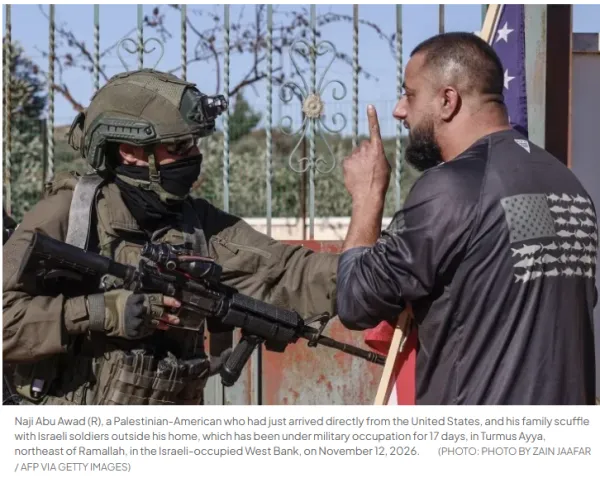
Naji Abu Awad, a Texas resident, was recently prevented from entering his family home in Turmus Ayya, in the occupied West Bank, by Israeli soldiers who declared the area a military zone. According to Abu Awad, the soldiers provided no court order or document authorizing their occupation of his private residence.
The military takeover of the property began on October 25, when Israeli forces forced open the property's gate. Watching through his home's surveillance cameras from Texas, Abu Awad communicated with the soldiers remotely. He explained that his family was abroad, that his brother inside could willingly open the door for an inspection, and asked the soldiers not to damage the property.
Instead, the troops disabled the surveillance cameras, returned the following day, and remained inside without providing a satisfactory explanation.
When Abu Awad arrived from Texas on November 12, carrying an American flag and his luggage, he was still denied entry to his own home. The soldiers showed him a document written entirely in Hebrew. According to Abu Awad, it contained neither a judicial order nor legal authorization permitting the army to occupy his residence.
His questions about why the soldiers were there and when they intended to leave went unanswered. Instead, he was threatened with detention.
Abu Awad is the rightful owner of the house, which he built. Imagine traveling from Texas to your own property, only to be told that you cannot enter because a foreign military has decided to take it over. How does that work? Can someone simply occupy your property and tell you that you no longer have access to it?
If Israel expects American citizens to accept such treatment, Washington should at least demand answers and accountability.
U.S. Ambassador Mike Huckabee: Where Is the Help?
Abu Awad's family reportedly made repeated attempts to obtain assistance from the U.S. Embassy in Jerusalem, but those efforts did not produce a satisfactory resolution.
That raises an uncomfortable question about Ambassador Mike Huckabee's priorities. While he has frequently used social media to defend Israel and its government, what concrete assistance has his embassy provided to an American citizen whose home has been occupied by Israeli troops?
An American ambassador represents the United States and its citizens abroad. The embassy's consular staff can provide information, communicate with local authorities, and help citizens navigate emergencies, although they cannot override another country's military or judicial decisions.
If Abu Awad's family repeatedly sought assistance and received no meaningful response, the ambassador and the State Department owe the American public an explanation.
An ambassador's responsibility is not to defend a foreign government at the expense of American citizens. It is to represent American interests and take the concerns of U.S. citizens seriously.
A Broader Escalation Across the West Bank
The military occupation of Palestinian residential properties is part of a broader pattern of escalating pressure across the West Bank since the Gaza war began in October 2023.
UNICEF's October 2026 West Bank situation update documented at least 1,216 Palestinians killed, including 263 children, and more than 13,300 injured between October 7, 2023, and September 9, 2026.
Israeli military operations and settler attacks have also involved home demolitions, the bulldozing of agricultural land, restrictions on movement, and the uprooting of olive trees. In Turmus Ayya alone, approximately 4,000 olive trees were reportedly uprooted, according to local sources cited by WAFA.
Palestinian officials warn that the cumulative effects of displacement, land seizures, settlement expansion, and the military appropriation of civilian homes are steadily undermining the possibility of establishing a viable Palestinian state, in contradiction of relevant United Nations resolutions.
Turmus Ayya, a town with a substantial Palestinian-American community, has also experienced escalating violence, attacks, killings, and land seizures. Abu Awad's experience highlights the human consequences of this broader crisis.
Naji Abu Awad flew from Texas to his home in Turmus Ayya 21 days ago and found it occupied — so he walked up with an American flag and a suitcase and asked why. Was Washington right to stay silent? Follow for daily reels.
https://www.facebook.com/share/r/1E3dgj6cmB/
No Court Order. No Satisfactory Explanation.
Perhaps the most disturbing aspect of this incident is the apparent lack of an effective response from the U.S. government.
Where are Ambassador Mike Huckabee, Secretary of State Marco Rubio, and President Donald Trump when an American citizen cannot enter his own home?
On November 15, AJ+ (@ajplus) posted this video showing a Palestinian American confronting Israeli soldiers after they seized his family home and turned it into a military outpost. Naji Abu Awad, a U.S. citizen who traveled from Texas, was barred from entering his own home in the occupied West Bank.
https://x.com/ajplus/status/2121966709901004971?a=55qh3_HsJoizQpD13Sk&s=20
The American flag Abu Awad carried from Texas should mean something. American citizenship should not become meaningless the moment a citizen encounters an injustice abroad.
Mahmoud El-Yousseph is a Palestinian freelance writer and retired U.S. Air Force veteran. He writes about U.S. foreign policy, Middle Eastern affairs, and justice.