KBK Foundation’s Black Art Expo: A picture is worth a thousand words
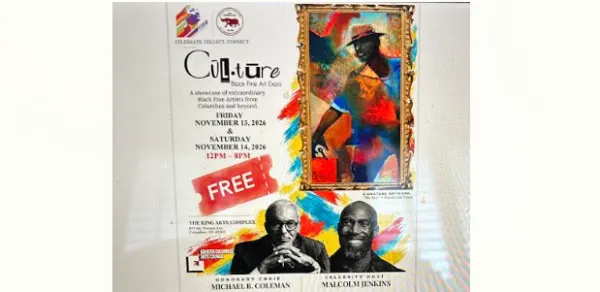
Starting on Friday, November 13, 2026, the King Arts Complex opened its doors to the public as it hosted the KBK Foundation’s Culture: Black Fine Art Expo. Advertised as “a showcase of extraordinary Black Fine Artists from Columbus and beyond” the exhibit was nothing short of breathtaking.
Artists came from all over the country including Atlanta, Pittsburgh and Chicago, Illinois. KBK stands for KBK Enterprises/Foundation. Keith B. Key is a graduate of the Ohio State University and a member of the Eta Nu Nu chapter of the illustrious Omega Psi Phi Fraternity, Inc., here in Columbus, Ohio. A developer, businessman, philanthropist and entrepreneur, Key, has played an important role in Columbus’s and the Ohio State University’s drive to become a world class city and university. He has lent his name and invested his time and resources all of which have benefited greatly the university and city in ways that few of the university’s alumni have matched.
Since its founding, the Black Arts Expo has been well-received and is fast becoming one of the city’s if not entire Midwest’s, highly anticipated events. Although I was initially scheduled to drop in on Thursday evening, November 12, 2026, for a more intimate engagement any such visit that night was made impractical due to my hectic schedule.
A visit to the King Arts Complex would have to wait until Saturday afternoon where I spent two hours perusing the aisles and taking in the various creative artistic expressions that featured images and told stories that resonated with me in a way that few art exhibits have. Based on the brief conversations I had with others that sentiment seemed to be widely shared.
My colleague, Bart Ridgill and I, arrived at the King Arts Complex on Saturday at approximately 12:10 pm and was greeted by the lovely Mrs. Donica Key, wife of Keith B. Key and vice president of the KBK Foundation who was gracious enough to provide us with a tour. Over the next ten minutes, Mrs. Key took it upon herself to introduce us to several of the artists while going over the history of the event before turning us loose to browse on our own. I learned a lot from the exchange.
For the next two hours art lovers streamed in and out of the area where the artists and their works were on display. The atmosphere was welcoming and the mood upbeat. I visited many stations and spoke with several artists.
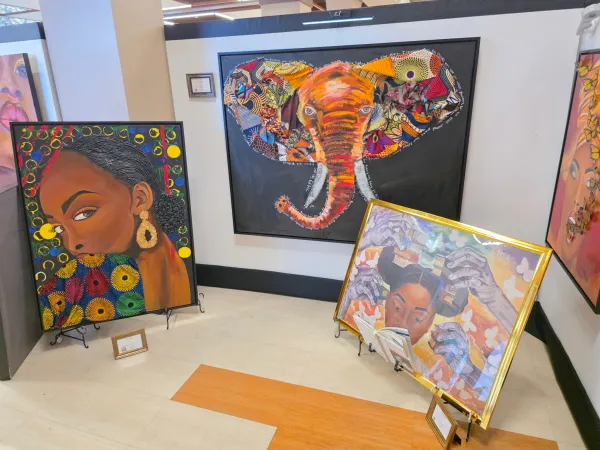
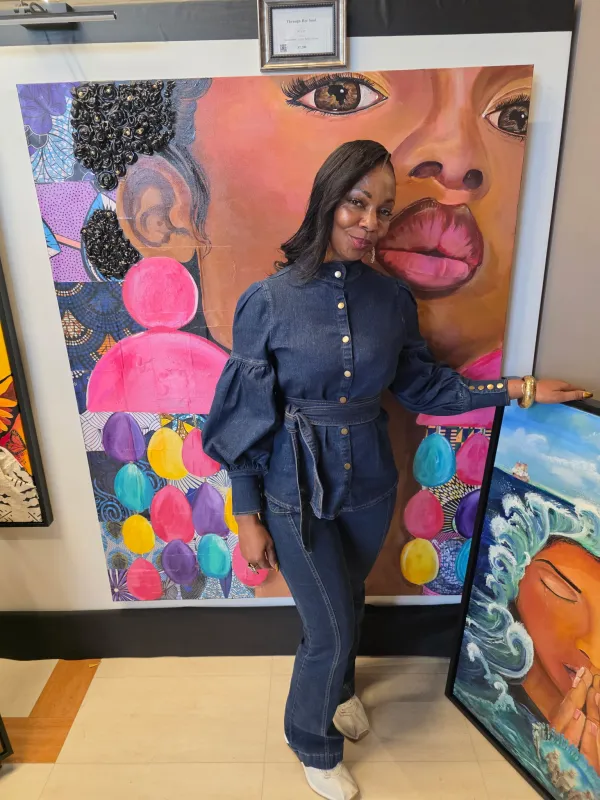
One of the more captivating artists was Irene M. Sparks, owner of Beanie Paints LLC in Pittsburgh, Pennsylvania. A highly intelligent and captivating young lady Sparks’ art places Africana women at the center of analysis. Her work is reminiscent of prominent Afrocentric women artists like Augusta Savage and Lois Mailou Jones two important sculptors and painters of the Harlem Renaissance era and Elizabeth Catlett, the renowned sculptor and printmaker whose remarkable creative outputs were intended to first and foremost raise peoples’ political conscious. In her work pride, dignity and resilience are themes intended to encourage reflection, self-introspection and instill a heightened sense of self-esteem.
Then of course, there is Toyin Ojih Odutola, a Nigerian-born, but deep south raised artist whose claim to fame is related to the skillful ways in which she employs pen-and-ink drawings that prompts people to question traditional representations of Blackness. One of Sparks’ pieces takes a somewhat similar approach. For instance, Sparks’ reasoning for making gray the hands of an African American girl who is ostensibly reading a book immediately made me think of Ojih Odutola’s penchant for fostering mind-bending interpretations of race, namely blackness. Sparks wanted to leave to the viewer’s imagination what to make of her decision to color the girl’s hands gray.
Sparks, a graduate of both Carlow University and the University of Phoenix, struck this writer as pensive and critically thoughtful. Not one to talk before she thinks when she was asked what she wanted people to get out of her work she opined, “I want people to identify and see themselves in my work . . . I want them to see a connection.”
When asked if she majored in art in college she responded, “no I majored in psychology and studied sociology.” “You didn’t major in art while in college?” I asked incredulously? “No, my father, a photographer who recognized my love of art told me to have art as a hobby” Sparks responded. Obviously, Sparks’ father had his daughter’s best interests in mind. Like many parents who send their kids off to college he wanted her to pursue a course of study that would enable her to make a living. “So, you’re self-taught” I shot back to which she responded, “yes, but I have been an artist all my life, but it was about five or six years ago that I completely devoted myself to my art.”
I could not help but ask Sparks about artists who inspired her and much to my surprise after what seemed like thirty seconds of deep thought she cited Maya Angelou. “Angelou, I blurted out, but she’s a poet, writer and spoken word artist” prompting Sparks who immediately recognized my bemusement to say, “but her work spoke to me . . . her poetry spoke to me.”
She continued, “when you asked about who or what inspired me, I have to say that my inspiration comes from what’s happening in society.” “I can see that” I said. Sparks’ inventory is bold, bright and vibrant; it is also empowering and unabashedly Black.
Her work encourages viewers to access previously untapped reservoirs of brainpower, genius and comprehension that one likely didn’t realize they possessed. It wouldn’t surprise me at all if some of Irene Sparks’ works eventually found themselves on the walls of some of the world’s most famous and prominent museums and galleries. By then, I’m sure, Irene Mwimoni Sparks will have become a household name.
Judson L. Jeffries, PhD, MPH, is Professor of African American and African Studies at The Ohio State University. He is a Phi Beta Kappa and the editor-in-chief of the Journal of African American Studies.