
The King, The Court, and The People vs. Poison
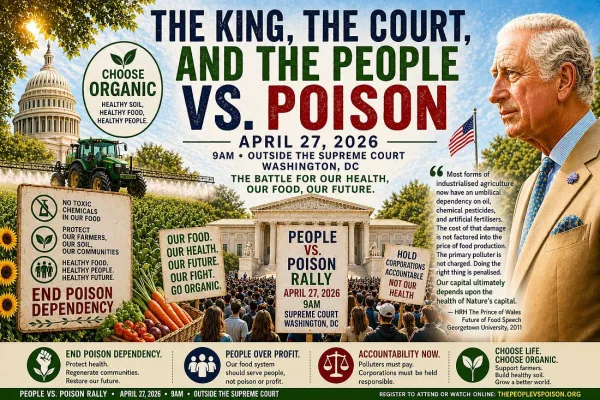
People vs. Poison Rally
Monday, April 27, 2026, from 9am outside the Supreme Court
Register to attend or watch online: https://thepeoplevspoison.org
For background on the broader topics discussed in this article, watch my documentaries: GMO OMG, reveals the rise of glyphosate based agriculture, Organic Rising, examines organic agriculture and its implications for human and environmental health, and Circle of Poison, documents how chemicals banned or restricted in the U.S. are still produced, exported, and return through imported food.
__
On April 27, Washington will become the stage for a rare convergence of power, people, and principle.
In a striking coincidence, King Charles III, arguably the world’s most prominent advocate for regenerative organic agriculture and ambassador for nature, is scheduled to arrive in Washington, DC. His decades of leadership in this field stand as a defining example of principled stewardship, and place him among those I hold in the highest regard.
On that same day, inside the United States Supreme Court, justices will hear oral arguments in Monsanto Company v. Durnell, a case I recently examined in A Poisoned Politics Poisons People: All Three Branches Move to Shield Bayer/Monsanto from Liability Amid One of the Largest Cancer Litigations in American History. Outside the Court, citizens from across the country will gather for the People vs. Poison rally. Dennis and I will be speaking alongside a powerful lineup of advocates standing for life, health, and accountability.
If Bayer and Monsanto prevail, hundreds of thousands of current and future claims could be extinguished. One of the largest cancer litigations in American history would be effectively shut down. A regulatory determination would become a legal shield, and the absence of a warning label would function not as evidence of safety, but as a barrier to justice.
Three events. One place. One day. A convergence that reveals, with unusual clarity, the forces shaping food, law, and human health.
This moment did not emerge in isolation. The last major national push for transparency in our food system centered on GMO labeling, a movement that brought millions of Americans into a shared demand for the basic right to know what is in their food. In that same period, in 2011, King Charles, then Prince of Wales, came to Washington and delivered a clear message: our capital ultimately depends upon the health of Nature’s capital. He called for a fundamental reordering of our relationship with land, food, and the living systems that sustain us.
More than a decade later, that same fault line has returned, now before the Court. What began as a call for transparency has evolved into a test of accountability. The question now reaches beyond what the public is allowed to see. It asks whether those who are harmed have a right to justice.
At the center of this case is a narrow but deeply consequential legal question: whether federal pesticide law under the Federal Insecticide, Fungicide, and Rodenticide Act blocks a state level failure to warn claim when the Environmental Protection Agency has not required a cancer warning on the product label. The Court has deliberately limited its review to this precise issue, making this a focused test of who holds authority over truth and accountability in the marketplace.
In practical terms, this is a case about labels. Labels are where science, law, and public health converge. Control the label, and one shapes what the public is told, what risks are acknowledged, and whether those harmed have a path to justice..
At a time when the language of “No Kings” echoes across American discourse, a British king arrives carrying a message that stands in profound contrast to the systems now being defended at the highest levels of American government.
For decades, King Charles has spoken of harmony as the foundation of a functioning civilization. He has advanced life sustaining models of agriculture, architecture, community and economy.
Long before soil degradation, biodiversity collapse, and chemical dependency entered mainstream awareness, King Charles warned that a society which erodes the living systems that sustain it undermines its own future. He has worked courageously to advance alternatives rooted in restoration including organic agricultural production.
During the height of the last major food battle, that one over GMO labeling, fifteen years ago on May 4, 2011, standing in Washington at Georgetown University, he delivered a speech on the Future of Food that now reads as both warning and diagnosis.
Watch:

Transcript: https://cookingupastory.com/prince-of-wales-speech-on-the-future-of-food/
He spoke plainly about the system we have built. “Most forms of industrialized agriculture now have an umbilical dependency on oil, chemical pesticides, and artificial fertilizers.”
He named the distortion at its core. “The cost of that damage is not factored into the price of food production. The primary polluter is not charged. Doing the right thing is penalized.”
And he grounded the entire system in a truth we have chosen to ignore. “Our capital ultimately depends upon the health of Nature’s capital.” These were not philosophical reflections. They were a warning.
Now, fifteen years later, that warning stands before the Supreme Court on the day he returns to DC.
The case is being presented as a technical question of federal law. It is not. It is a test of whether the public retains the right to hold power accountable.
At issue is whether Bayer can be sued for failing to warn about cancer risks associated with glyphosate, or whether approval of a pesticide label by the Environmental Protection Agency closes the door to those claims entirely.
At the center of this case is a reality that must be named clearly - regulatory capture.
The Environmental Protection Agency has determined (stated not proven) that glyphosate is not carcinogenic and has approved product labels that carry no cancer warning. At the same time, juries across the United States have heard extensive evidence and found in favor of plaintiffs who allege that exposure to glyphosate-based herbicides contributed to their cancer. More than 100,000 claims have been filed. Billions of dollars have already been paid in settlements and verdicts.
This is a direct collision between regulatory determinations and lived reality.
Regulatory capture does not require overt corruption. It emerges through reliance on industry data, institutional pressure, and the normalization of assumptions that favor continuity over disruption. Over time, the system begins to reflect the priorities of the regulated industry itself.
If that system is treated as final and unchallengeable, then regulatory approval becomes a shield. The absence of a warning label does not resolve the question of risk. It determines whether that question can be heard in a court of law at all.
We have seen this pattern before. Tobacco was sold for decades under assurances of safety while evidence of harm accumulated. Regulatory systems failed to act until litigation and public pressure forced the truth into the open.
Years ago, scientists who raised concerns about chemical intensive agriculture were discredited and marginalized. In GMO OMG, a documentary a documentary I co produced, filmmaker Jeremy Seifert journeys around the world to examine how genetically engineered crops designed to withstand direct spraying of glyphosate have reshaped agriculture, intensified chemical dependence, and increased direct human exposure to the chemical. The film explores the case of Gilles-Éric Séralini, whose research on glyphosate triggered global controversy and revealed how dissenting science is handled when it challenges entrenched systems. Those questions have not gone away. They have intensified.
While this Supreme Court case is about truth in labeling, the Administration continues to deregulate additional herbicides, and genetically engineered seeds are now designed to withstand not only glyphosate, but also Dicamba and 2,4 D, a component of Agent Orange. This stacking of resistance traits allows multiple poisons to be applied across the same fields, reinforcing a system of layered chemical dependence rather than reducing it.
2,4 D has been associated with markers of DNA damage and oxidative stress, raising ongoing questions about genetic and long term health effects, particularly under conditions of repeated exposure. The legacy of Agent Orange, as experienced by Vietnam veterans and their families, offers a sobering reference point in understanding how chemical exposure can carry consequences across generations.
At the same time, exposure to Dicamba has been associated with acute health effects, and its well documented tendency to drift has expanded exposure beyond fields into surrounding communities.
Research on Atrazine has shown endocrine disrupting effects in amphibians, including the feminization of male frogs under certain exposure conditions, in which genetically male frogs develop female characteristics, and in some cases functional female reproductive organs, a finding associated with the work of Tyrone Hayes. Atrazine has been banned in the European Union due to concerns over water contamination and environmental and human health risks, yet it continues to be widely used in the United States.
These, plus many more, biologically active cocktails of poisons, are deployed at scale across the landscape, interacting with living systems in ways that are not fully understood. This trajectory reflects a system that expands chemical reliance even as evidence of harm continues to surface.
The current legal battle does not stand alone. The Administration and a Republican controlled Congress are advancing liability protections for chemical manufacturers, reinforcing the very shield now being tested in the courts. At the same time, the “EATS Act” architecture seeks to prevent states and municipalities from setting stronger standards than federal law, meaning that local governments could be blocked from establishing safety buffers around schools and homes where pesticides are sprayed. States could lose the ability to respond to emerging science or protect their citizens based on local conditions.
This is the consolidation of power: Close the courts. Preempt the states. Centralize authority. Remove the mechanisms by which people can defend themselves.
All of this converges in Monsanto Company v. Durnell. The question before the Court is framed narrowly, whether federal pesticide law blocks a state level failure to warn claim when the Environmental Protection Agency has not required a cancer warning on the label. In practice, the implications are far broader. If the absence of a warning becomes a shield against accountability, then the system that has allowed these exposures to expand will be insulated from challenge at the very moment scrutiny is most needed.
In the film Organic Rising, we examine how this system of chemical dependence has taken hold across our food system, and point toward organic and regenerative agriculture as a path that restores the integrity of land, food, and human health.
Food, by its very nature, should sustain life. It should nourish, protect, and strengthen the body. Yet what we are confronting is a system in which that fundamental truth has been inverted. Glyphosate is not the whole story. It is the most visible expression of a much larger reality. Even if it were removed tomorrow, it would be replaced by other chemicals already being deployed across our fields, many of which carry their own risks and unknown long term consequences. This is not a single product problem. It is a system built on chemical dependency, where the burden of risk is carried by people, by communities, and by the land itself.
This is why the path forward must be clear. No matter your understanding of the terms pro and life, we must move away from systems of poison, destruction and death and towards Pro Life Agriculture, a system of food and farming that is rooted in the protection and regeneration of life. This means supporting farmers in transitioning to practices that build soil, eliminate toxic inputs, protect animal welfare, and restore the integrity of our food supply. It means aligning policy, markets, and public investment with systems that sustain life rather than degrade it.
At the same time, while our nation wages illegal war abroad, raising profound moral and human questions, there is a quieter yet equally vast battleground here at home.
Fought in the name of human security and agricultural global dominance, it is a battle being waged against our health, against our farmers, against our food supply. It is being waged against the land beneath our feet and our children’s futures through the daily exposure carried into our bodies without our full knowledge or consent.
On Monday, April 27, that reality comes into sharp focus. The battle is being argued and fought both inside and outside on the steps of the Supreme Court.
The deeper concern is whether the systems of government charged with protecting the public and upholding the law are instead shaping outcomes that leave people more exposed and the legal process further corrupted.
A president, vested with democratic authority, advances systems that consolidate power and defend chemical dependency. A king, often dismissed as symbolic, has spent decades calling for stewardship, balance, and the restoration of living systems.
The irony reveals something essential. Leadership is not defined by title. It is defined by what one serves. One model shields itself from consequence. One calls us back into responsibility. One extracts. One restores.
Democracy is only a democracy when the people rise and lead.
Where will you lead our future?
____
Reminder - watch these award winning documentaries:
GMO OMG: Filmmaker Jeremy Seifert journeys to Haiti, Paris, Norway, and even inside the world of Monsanto in search of answers about genetically modified organisms (GMOs) and how they affect our children, the health of our planet, and our freedom of choice. The film examines the rise of genetically engineered crops designed to withstand heavy spraying of glyphosate, the active ingredient in Roundup. These “Roundup Ready” seeds allow fields to be sprayed directly, driving widespread herbicide use and raising urgent questions about ecological impact, human health, and long term dependence on chemical agriculture.
Organic Rising is the first feature-length film to demystify organic agriculture for the consumer. Initially, the documentary presents the two predominant U.S. agrarian practices, conventional and organic, and how they impact human health and the planet. It simultaneously demystifies the USDA organic regulatory process and farming methods allowing consumers to make informed choices and explore avenues of supporting and maintaining a strong and robust agricultural future.
Circle of Poison, which explores how chemicals banned or restricted in the United States are produced for export and used worldwide, extending their reach and risks beyond national borders, with pathways back through imported food and the interconnected global environment.
The Kucinich Report is a reader-supported publication. To receive new posts and support our work, consider becoming a free or paid subscriber.