
Lawless Empire: The President and His Machismo Commander
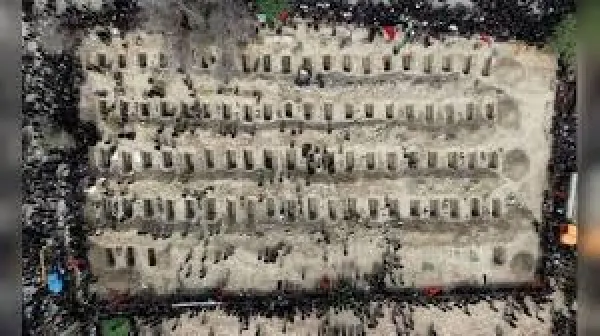
Graves of Iranian school girls killed by the American Empire, Image via Facebook
A real estate developer turned showman becomes president. His name has long been associated with the orbit of a convicted child sex offender. A former television host ends up running the Department of Defense—an institution that under his swaggering vision of power renamed the Department of War.
The president orders an attack and the kidnapping of a foreign leader, ignites a war against another nation—killing its leader and innocent schoolgirls—and sends paramilitary forces—ICE—into the streets of his own country. Under his reign, the Middle East burns. Oil surges, markets tremble, and the price of energy—and everything chained to it—climbs at home and across the globe.
The spectacle might seem laughable if its consequences were not so grave. But the laughter dies quickly. What unfolds feels less like governance than a fever dream of power—something torn from the reels of an old dystopian film—where the grotesque becomes ordinary and men intoxicated with bluster, spectacle, and machismo mistake domination for leadership.
Now Pete Hegseth, once a weekend personality on Fox News, finds himself commanding the most powerful military on earth and serving as the public face of Donald Trump’s war in Iran. The rise would be astonishing even in calmer times; in the middle of a volatile international crisis, it borders on reckless. This administration projects strength through machismo and television theatrics rather than through the sober discipline that national security demands.
Hegseth’s past hardly inspires confidence. In 2017 he was accused of sexual assault; he later paid an undisclosed sum to the accuser in a confidential settlement to avoid a potential lawsuit that he feared could cost him his job at Fox News. That episode alone should have prompted serious scrutiny about whether he belonged anywhere near the top of the military chain of command. Instead, it barely slowed his ascent.
The image projected by this administration is one of bravado over competence, loyalty over expertise, spectacle over responsibility. In a moment when restraint, experience, and independent judgment are desperately needed, the country instead appears to be running an empire by impulse—daring the world to deal with the consequences.
Janessa Goldbeck, chief executive of the Vet Voice Foundation, a nonprofit veterans’ advocacy group, put the criticism bluntly. She described Hegseth as “unequivocally the least qualified person who ever led the Department of Defense,” and warned that he is “a very dangerous person… a white Christian nationalist with the arsenal of the United States government at his disposal and a permission slip from President Trump to deploy carnage wherever he wishes against whomever he wishes.”
Historians tend to judge the strongest defense secretaries by three qualities: deep experience in national security, the ability to manage the vast and stubborn bureaucracy of the Pentagon, and the courage to challenge a president’s assumptions when necessary. By those standards, the current arrangement raises uncomfortable questions. Governing the world’s most complex military institution is not a television segment, and war is not a ratings contest.
The harder question the American people must confront is a simple one: do the president and the man now responsible for directing war actually know why they are waging one against Iran? War is supposed to be the most serious decision a government can make, grounded in clear strategy, defined objectives, and a sober understanding of consequences. Yet what the public sees instead is rhetoric, bravado, and shifting explanations that raise more questions than answers.
Americans have every right to ask whether their president, Donald Trump, is acting purely in the national interest or whether other pressures are shaping his decisions. His past association with Jeffrey Epstein continues to cast a shadow and fuel suspicions that he may be vulnerable to compromise or political leverage. At the same time, critics question whether the confrontation with Iran is driven less by American strategic needs and more by the priorities of foreign leaders such as Benjamin Netanyahu.
If that perception takes hold, it raises a deeply troubling possibility: that the United States is risking lives, resources, and global stability not for its own security but to serve the agenda of another government. No country should enter a war under such a cloud of doubt.
The economic dimension makes the stakes even higher. The first week of Trump’s Iran war alone cost American taxpayers $11.3 billion. The American economy is already under strain from tariff conflicts, market instability, and rising costs that ripple through households and businesses alike. War with Iran would not be quick or cheap. It would demand enormous and sustained military spending, disrupt already fragile global energy markets, and likely drive oil prices sharply upward. Those shocks would not remain overseas—they would filter directly into American life, raising the cost of transportation, food, manufacturing, and nearly every other sector of the economy. What begins as a military decision abroad quickly becomes an economic burden at home.
Before the country accepts those burdens, Americans deserve honest answers. Why this war? What is the strategy? What is the endgame? How long will it last, and what will it ultimately cost in lives, resources, and stability? And most importantly, whose interests are truly being served? In a democracy, decisions of this magnitude cannot rest on bluster, impulse, or political spectacle. They demand transparency, accountability, and a clear explanation to the public that will be asked to pay the price.
Without clear answers, the country risks marching into another unprovoked, and illegal endless war—one whose purpose is unclear, whose costs are inevitable, and whose consequences may haunt a generation.
Contact information
Nader Rahimi
Email:nrahimi@bu.edu