
Lindsey Graham: When the United States Senate Falls Silent
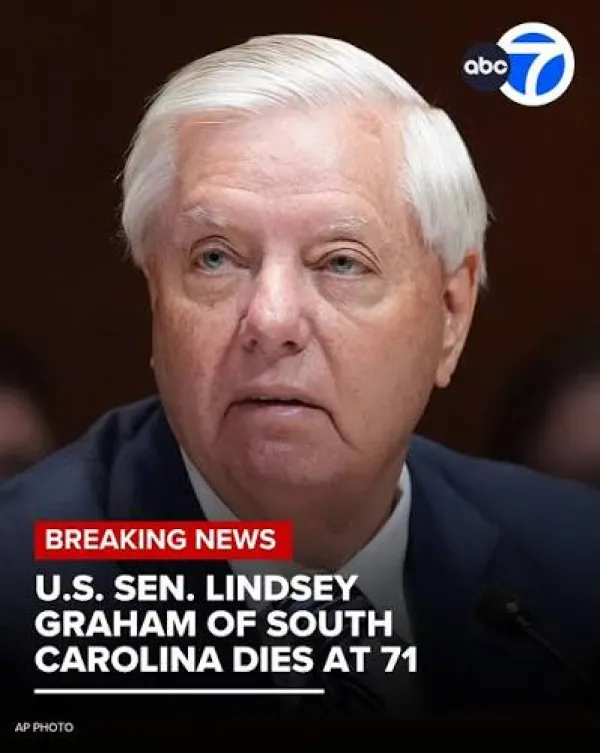
Death is the great equalizer. It strips away titles, dissolves influence, and renders meaningless the privileges that once seemed permanent. The senator, the president, the king, and the laborer all arrive at the same destination carrying only one thing: their deeds.
Senator Lindsey Graham has died at the age of seventy-one. His office has confirmed that he passed away after a sudden illness.
For millions, his death is the passing of another American politician. For others—particularly those who watched the devastation of Gaza unfold over the past two years—it marks the end of one of the most influential American voices advocating policies that profoundly shaped the conflict, and affected Palestinian men, women, and children painfully.
This is not the moment to celebrate. Nor is it the moment to erase history.
It is a moment to remember that every life, especially one lived in public service, eventually reaches the point where no speech can be rewritten, no vote recalled, and no interview clarified. The record is closed.
For decades, Lindsey Graham stood among the strongest defenders of Israel in the United States Senate. His support was neither casual nor occasional. It was comprehensive.
He opposed placing conditions on American military assistance. He argued that Israel should receive whatever weapons were necessary to prosecute the war against the Palestinians. He compared Israel’s campaign in Gaza to the Allied victories over Japan and Germany, invoking Hiroshima and Nagasaki to illustrate what he believed was the necessity of overwhelming force in defeating a determined enemy.
To many Israelis and their supporters, this reflected steadfast loyalty. To almost all Palestinians and much of the international community, it reflected a willingness to justify genocide, ethnic cleansing, and extraordinary levels of destruction in one of the world’s most densely populated civilian territories.
His words often generated as much controversy as his votes. He described Gaza as among the most radicalized places on earth, arguing that hatred toward Jews was taught from childhood, something that is obviously inaccurate. Critics argued that such language blurred the distinction between legitimate resistance and the more than two million civilians living under extraordinarily inhumane conditions, being subjected to genocide for more than two years.
But Graham’s influence extended far beyond rhetoric. He sought to transform his views into lasting American policy.
He was the principal sponsor of the Taylor Force Act, legislation that suspended the much needed American economic assistance to the Palestinian Authority until it ended payments to families connected to individuals convicted of attacks against Israelis. To me, this reflected a Machiavellian belief that the end justifies the means.
His vision for the territory after the war was unmistakable. Israel, he argued, should take Gaza by force, dismantle any resistance against the occupation completely, and rebuild the territory from the ground up under a new governing structure. He endorsed facilitating the voluntary departure of Gazans who wished to leave permanently and encouraged other nations to receive them.
On Palestinian statehood, Graham remained equally consistent. Recognition, he argued, should never precede fundamental reforms. Any future Palestinian state would have to be permanently demilitarized, politically transformed, and incapable of threatening Israel. In this framework, Palestinians’ own national aspirations were largely absent from the equation.
Those positions were not merely rhetorical. They shaped legislation, public debate, and the direction of U.S. policy.
History will continue to debate whether these ideas advanced security or prolonged conflict.
Reasonable people will arrive at different conclusions. But one reality remains beyond debate. Every public servant eventually leaves behind the Senate floor, the television studio, the campaign trail, and the applause of political allies. There comes a point when speeches no longer persuade, influence no longer protects, and political power no longer matters.
No attorney can argue the case. No political immunity remains. No office, reputation, or influence can alter the final accounting. Death closes every political career. But, it does not close the ledger. Every public official leaves behind a record—not only of what was accomplished, but also of the human consequences of the decisions made while entrusted with power.
That is the enduring burden of leadership. History may render one judgment. Conscience another. The final judgment belongs elsewhere.