
The Little Stamp That Carries an American Message
October 4 has a special meaning to me. On this day, 49 years ago, I came to America.
What I enjoy most about living here is the freedom of speech. I have been writing about Palestine and Islam for more than 40 years. Because I disagree with some aspects of our government's foreign policy, I have sometimes been accused of being anti-American or ungrateful.
But disagreeing with my government is my right as an American.
I did not inherit my citizenship. I worked hard to earn it.
The truth is, if I were to say some of the things I say here overseas, I might not see the sun again. For that freedom, I am grateful.
That said, I also love Reuben sandwiches, Italian pasta salad, pineapple upside-down cake—and I love the United States Postal Service.
The next time you put a letter in the mailbox, take a moment to look at the stamp.
It may be only a little square of paper, but sometimes a postage stamp can tell us something about who we are as Americans.
For many Muslim Americans, the words “Eid Mubarak” are instantly familiar. For many of our non-Muslim neighbors, however, they may be words they have never seen before.
That is one reason the story of the United States Postal Service's Eid stamps deserves to be better known.
A Small Stamp, A Remarkable Beginning
On September 1, 2001, the Postal Service issued its first Eid commemorative stamp. The 34-cent stamp featured beautiful gold Arabic calligraphy against a blue background and carried the words “Eid Mubarak,” a traditional greeting that can be translated as “May your religious holiday be blessed.”
It was a small gesture.
But it was also a remarkable one.
Here was the national postal service of the United States placing an Islamic greeting on millions of pieces of American mail.
And the story didn't end there.
A Tradition Takes Root
The original Eid stamp was reissued several times as postal rates changed. Then, in 2011, USPS introduced a new Eid design, again featuring the work of American master calligrapher Mohamed Zakariya.
A green version followed in 2013.
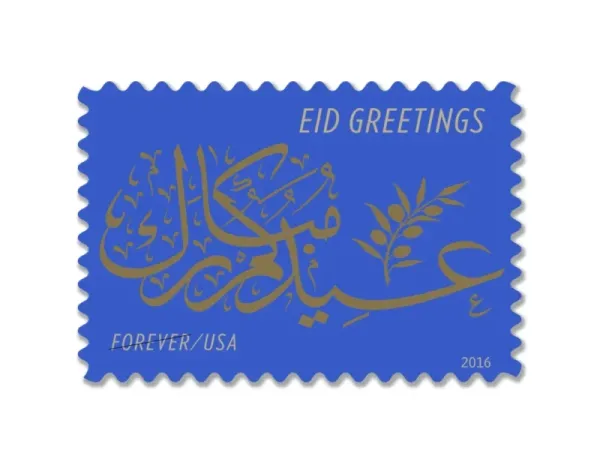
In 2016, USPS introduced the Eid Greetings Forever stamp, featuring gold Islamic calligraphy and an olive branch against a brilliant blue-purple background. The Postal Service explained that the olive branch could symbolize abundance, family, hospitality and peace.
Think about that for a moment.
An American letter could leave a mailbox in Ohio, Pennsylvania, California or Texas bearing an Arabic greeting and an olive branch—and travel to another American household, perhaps to someone who had never before encountered the tradition of Eid.
That is what makes postage fascinating.
Stamps travel farther than we sometimes realize.
What Exactly Is Eid?
For readers unfamiliar with Islam, Eid refers to two major Islamic celebrations: Eid al-Fitr and Eid al-Adha.
Eid al-Fitr marks the conclusion of Ramadan, the Islamic month of fasting, prayer and reflection.
Eid al-Adha is associated with the annual pilgrimage to Mecca, known as Hajj, and commemorates the story of Prophet Ibrahim's devotion and willingness to sacrifice his son Ismail in obedience to God.
Both celebrations are observed by Muslims throughout the world—and by Muslim Americans here at home.
And that last part matters.
Muslims aren't visitors to the American story.
They are part of it.
An American Story, Too
The USPS Eid stamp is not simply a story about Islam.
It is also a story about America.
America has always been a country in which different communities, traditions and faiths have lived alongside one another. Sometimes that coexistence is visible in grand ways—in houses of worship, cultural festivals, neighborhoods and public celebrations.
Sometimes it appears in something much smaller.
A postage stamp.
USPS has issued stamps recognizing a wide range of American religious and cultural traditions, including Hanukkah and Kwanzaa. The Eid stamp became part of that broader postal history in 2001.
And behind the artwork was an American Muslim artist.
Mohamed Zakariya, an accomplished American calligrapher from Virginia, created the calligraphy for the original Eid stamp and subsequent designs.
That detail is worth remembering.
The Arabic calligraphy on an official United States postage stamp was not something imported from some distant place and simply placed on an envelope.
It was created by an American artist.
A Lesson Hiding in Plain Sight
I suspect many Americans have seen an Eid stamp without knowing what it meant.
Maybe someone noticed the unfamiliar Arabic letters.
Maybe someone thought the design was beautiful.
Maybe someone simply put the envelope in the recycling bin after opening the letter.
That's understandable.
We live surrounded by thousands of small things whose stories we never have time to investigate.
But occasionally, one of those small things deserves a second look.
The Eid stamp is one of them.
Because behind those words is a month of fasting.
Behind the holiday is a religious tradition followed by millions of people.
Behind the calligraphy is an American Muslim artist.
And behind the stamp itself is an American institution saying, in its own quiet way, that this tradition belongs within the larger tapestry of American life.
A Message Worth Carrying
There is something almost poetic about the Postal Service being the institution that carries this message.
A letter begins with one person and travels toward another.
A stamp helps make that journey possible.
And for more than two decades, an American postage stamp has carried the words “Eid Mubarak” along with it.
From one mailbox to another.
From one neighborhood to another.
From one American family to another.
Perhaps that's why I love the USPS Eid stamp.
It doesn't demand that everyone share the same faith.
It doesn't ask anyone to change who they are.
It simply introduces a greeting from one American community to the rest of the country.
And maybe that's what America is supposed to look like at its best: not a place where everyone has the same story, but a place where we have enough room to learn one another's stories.
So, the next time you see an Eid stamp on an envelope, don't be too quick to tear it off and throw it away.
Look at it.
Read the words.
And remember that somewhere in America, a Muslim family may be celebrating one of its most important days of the year.
Mohamed Zakariya, an accomplished American calligrapher from Virginia, created the calligraphy for this 2011 and the original 2001 Eid Greeting stamp
Mahmoud El-Yousseph is a Palestinian freelance writer and retired U.S. Air Force veteran. He writes about U.S. foreign policy, Middle Eastern affairs and justice