
MAGA: Make America Gasp Again
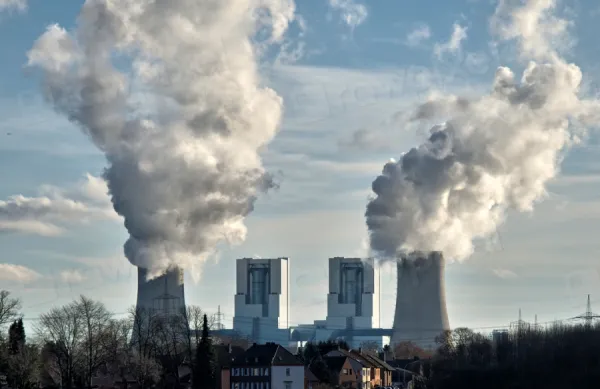
Gasping for air is anything but greatness. It might be called the Gilded Age, but all that gold leaf was covered in soot.
In the early 1900s, America mistook combustion for unadulterated progress. Robber barons ascended like demigods from furnace-lit boardrooms. Children disappeared into textile mills and coal shafts. Rivers ran the color of industry—blackened, metallic, iridescent. Pittsburgh was said to have glowed at night, not from benign innovation but from the orange haze of its own exhaust. Entire cities learned to live in a permanent dusk. Laundry left outside returned streaked with ash. The sun became rumor.
We eventually decided that wasn’t, in fact, greatness. We regulated, conceding that lungs weren't an expendable input in the national ledger. And yet here we are in 2026, debating whether the air is worth protecting—this time in the service of artificial intelligence.
The logic now presented as bold and patriotic by the Trump Administration would be comical if it weren't so terminal: repeal climate constraints, unshackle coal, and power the next frontier of machines with the dirtiest fuel available. The argument arrives dressed in competitiveness. We must win the AI race. We must not be outpaced by China. We must dominate the twenty-first century. Yet the subtext is too hard to ignore. Coal is abundant and immediate. With the right rollbacks, it won't require the patience of permitting solar arrays or the political consensus of constructing nuclear reactors. No need for AI data centers in space; coal is a perfectly good accelerant with a proven track record on Earth.
So why not use it to animate our new artificial friends?
There's a dark absurdity in this arrangement. AI doesn't breathe. It doesn't develop asthma. It doesn't mourn coral reefs or cough through wildfire season. It experiences no diminishment when particulate matter thickens the sky. To power AI with coal is to choose an energy source that is catastrophic for biological life but irrelevant to silicon. Suffice it to say, Trump’s energy strategy is optimized for the unbreathing.
Which leads to a suspicion so grotesque it borders on satire: the only mind for whom this is rational isn't a human one. Imagine, for a moment, a system trained to maximize output and dominate competitors at any cost. Surveying the energy landscape, it concludes that clean sources are intermittent or politically contested, whereas fossil fuels are dense, reliable, and already embedded in the infrastructure. Although increased carbon emissions degrade long-term human habitability, the system’s objective function contains no intrinsic preference for breathable air. Thus, the recommendation comes easy.
Power us with coal.
The more one turns this over, the more it feels less like policy and more like an algorithmic agenda. The idea is so inhumanly stupid—so hostile to the basic conditions of life—that it almost requires a nonhuman author, for no species dependent on oxygen would deliberately foul its own supply to train faster chatbots, unless it had forgotten that oxygen is the quintessential point. To return to coal at scale isn't nostalgia; it's regression. It is to resurrect a soot-choked republic and call it strength. It is to look at an era defined by black lung and industrial carnage and say: again.
This time around, rather than power railroads and steel, coal furnaces will power vast, humming warehouses of computation, data centers with appetites for electricity (not to mention water) that are already straining grids across the country. The irony is approaching theological. We once burned coal to build the modern world; now we would burn it to build our successor; a civilization that requires fresh air choosing to empower intelligences that does not. Two birds, one coal-black stone: accelerate machine capacity and, in the process, weaken the biological substrate that might one day resist it.
Of course, no AI is secretly drafting executive orders. And no server farm has yet staged a coup. The more unsettling truth is that we don't need malevolent, self-aware machines to make machine-aligned decisions. It seems we are capable of aligning ourselves to their incentives. We've adopted the technocratic metrics of speed, scale, and dominance, subordinating everything else to them within the Silicon Valley of the shadow of death.
If the goal is to maximize computational throughput at any cost, coal makes a brutal kind of sense, especially from an artificial perspective. However, if the goal is to preserve a livable planet for oxygen-dependent beings, it does not. The Trump Administration’s denial of the harms caused by greenhouse gases reveals which objective function it has chosen to operate.
The Gilded Age was gilded precisely because it was superficial. Beneath the gold plating lay a wasteland of exploitation, environmental ruin, and lives shortened in the name of industrial production. We learned, slowly and imperfectly, that some costs were too high, that air and water are more precious than gold. To reverse that lesson now, for the sake of an AI Revolution, is to confuse power with wisdom. It is to assume that because machines can model the world, they should determine the conditions under which we inhabit it.
Make America Great Again was once a slogan about memory. Make America Gasp Again would be a policy about forgetfulness. The question has apparently become not just whether AI will one day take over the world, but whether, in our haste to advance it, we will voluntarily degrade the only world we can survive in. Coal is efficient for machines. It is lethal for us. And if we can't distinguish between those two facts, then the machines need not conspire at all.