
Manufacturing Threat, Managing Power: A Critical Analysis of the U.S.-Israel War with Iran
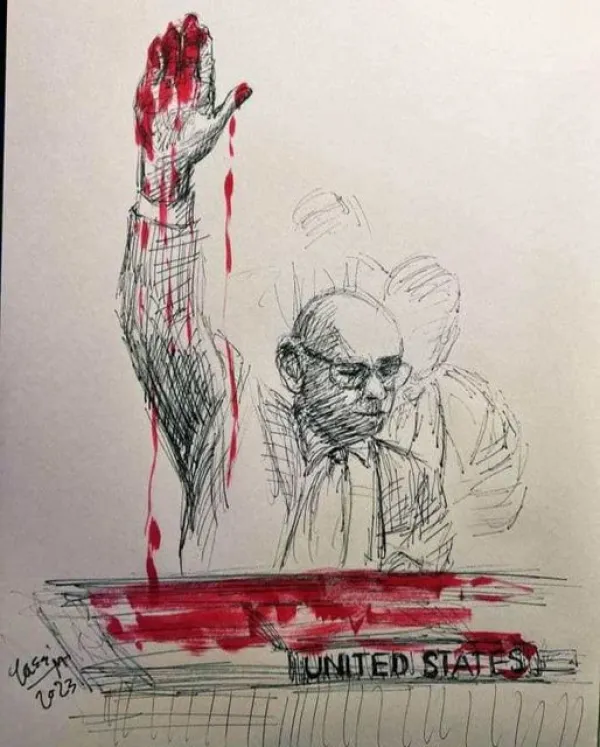
Image via FB, credit Nabeel Rajab.
War is often explained through a familiar set of causes: competition for power and security, economic interests, nationalism, ideology, and state weakness. These factors remain useful, but applied uncritically, they risk becoming formulaic—describing conflict in general without explaining this conflict in particular. The 2026 war involving the United States, Israel, and Iran exposes the limits of these standard explanations and demands a sharper, more critical analysis centered on power, strategy, and intentionality.
At first glance, the war appears to fit the classic “security dilemma” model. Longstanding tensions over Iran’s nuclear program, missile capabilities, and regional influence created mutual suspicion. Each side viewed the other as a threat, reinforcing a cycle of escalation. This narrative suggests that war emerged from fear and misperception. But this explanation quickly breaks down under closer scrutiny. The opening phase of the conflict was not a reactive escalation—it was a coordinated, large-scale offensive. On February 28, 2026, the United States and Israel launched thousands of strikes within days, targeting not only military, civilian and educational infrastructures but also senior leadership, including Iran’s supreme leader. Yet despite the scale and coordination of the initial offensive, the campaign has thus far failed to achieve its apparent aims of leadership decapitation and political capitulation, underscoring the limits of even the most calculated applications of force.
While many legal scholars and international observers questioned the legality of the operation under international law, those concerns had limited practical effect on decision-making in Washington. Rather than constraining action, legal norms appeared secondary to strategic objectives, reinforcing the perception that, in moments of high-stakes power competition, the enforcement of international law remains uneven and contingent on the interests of dominant states.
The timing of the attack complicates the conventional narrative surrounding the ongoing conflict with Iran. The strikes occurred while negotiations over Iran’s nuclear program were still underway, which weakens the claim that military force represented a last-resort response to an imminent threat. Instead, the escalation appears more consistent with a strategic shift away from diplomacy toward coercive action. More critically, it raises the possibility that the negotiation process functioned less as a genuine pathway to compromise and more as a means of managing international optics, buying time, or shaping favorable conditions for military intervention.
This interpretation gains weight when considering the broader context. At the time of escalation, Iran was already under significant strain—facing internal unrest, severe economic sanctions, and the aftereffects of earlier regional setbacks, including the 2025 Israel–Iran 12-day war. Taken together, these conditions suggest that the timing of the attack may have been calibrated to exploit a moment of relative weakness rather than to counter an immediate or unavoidable threat.
This context suggests that vulnerability, rather than immediate danger, may have been the decisive condition shaping the use of force. In other words, the war was initiated not when Iran posed its greatest threat, but when it appeared least capable of effectively responding. Statements from figures such as Benjamin Netanyahu, along with supportive rhetoric from segments of the U.S. political establishment, reinforced this logic by emphasizing the urgency—and perceived opportunity—of acting before Iran could recover or further consolidate its capabilities.
This is where a hegemonic or structural perspective becomes essential. From this angle, the war is better understood not simply as a response to immediate danger, but as an effort to preserve a favorable balance of power. The United States, as a global hegemonic power, and Israel as a regional one, both have enduring interests in maintaining strategic dominance in the Middle East—particularly over areas tied to energy flows and global trade. The Strait of Hormuz—through which a significant portion of the world’s oil supply passes—has already emerged as a central flashpoint, with the conflict disrupting shipping and generating wider economic consequences. Control over such chokepoints is not merely defensive; it enables states to exert influence over the terms of global economic exchange itself.
Israel’s role in this war is similarly rooted in hegemonic strategy. Its objective extends beyond immediate survival to the preservation of overwhelming regional superiority and the systematic neutralization of potential rivals. Over time, Israel has acted to eliminate or weaken competing centers of power—from Iraq and Syria to non-state actors such as Hamas in Gaza and Hezbollah in Lebanon—thereby consolidating a favorable strategic environment.
Within this context, Iran represents a qualitatively different challenge. Despite its relative weakness compared to the United States, it remains one of the few actors capable of contesting Israeli dominance through asymmetric warfare, proxy networks, and advanced missile capabilities. From this perspective, Iran’s status as an independent and resilient regional power—rather than any single action it takes—constitutes the core strategic concern. The logic that follows is therefore preventive rather than reactive: to constrain, degrade, or eliminate a challenger before it can meaningfully alter the regional balance of power.
This helps explain a central feature of the war that standard theories tend to obscure: why a comparatively weaker state is targeted with such intensity. If the conflict were genuinely about neutralizing an immediate threat, deterrence, containment, or limited strikes might have been sufficient. Instead, the scale and scope of the response suggest a broader objective—one that extends beyond defense into the deliberate suppression of a potential competitor.
From this perspective, early and overwhelming force is not an overreaction but a calculated strategy. The extensive U.S. naval deployments, blockade measures, and seizure of Iranian oil shipments point to a sustained effort to degrade not just Iran’s military capabilities, but its broader military and economic capacity to operate as an independent regional power. This shifts the logic of the war: it is no longer about responding to what Iran has done, but about constraining what Iran might become.
Framed this way, the conflict begins to resemble systemic containment rather than conventional warfighting—a form of coercion designed to limit the political and economic agency of a rival state. Such a strategy blurs the line between security and domination, raising uncomfortable questions about whether the language of threat is being used to justify the long-term management—and reduction—of another state’s strategic potential.
However, reducing the conflict to hegemonic dominance alone risks oversimplification. Iran is not a passive recipient of external pressure but an active participant in the regional power struggle. Its missile program, network of regional alliances, and efforts to project influence reflect a coherent set of strategic ambitions. At the same time, political leadership in Tehran often frames these actions through an explicitly anti-imperialist lens, positioning Iran as resisting external domination rather than pursuing expansion for its own sake.
The conflict, therefore, is not simply a one-sided imposition of power but a reciprocal struggle in which each side interprets the other as inherently expansionist and threatening. This mutual perception is central to the persistence of the conflict: both sides justify their behavior as defensive and necessary, even as their strategies—ranging from military strikes to regional power projection—carry clear offensive dimensions.
Here, constructivist insights deepen the analysis. The United States and Israel do not simply see Iran as a state with capabilities; they construct it as a particular kind of threat— ideological, and potentially existential. A deeper layer of this dynamic can be understood through the lens of Orientalism. From this perspective, Iran is not only treated as a strategic rival but represented in ways that emphasize difference and resistance to integration into a U.S.-led international order. These representations do not merely reflect reality; they shape it by narrowing the range of acceptable policy responses and making coercive action appear more necessary and justified. Iran, in turn, frames the United States and Israel as aggressive, interventionist powers seeking domination. These mutually reinforcing narratives sustain the conflict by making compromise politically and ideologically difficult.
A critical or Marxist perspective adds yet another layer, highlighting how the war is embedded within a broader global system. The Middle East’s importance and Iran strategic location in the Persian Gulf is not incidental—it is tied to energy, trade, and the functioning of the global economy. Military intervention, from this viewpoint, serves to stabilize an international order that disproportionately benefits dominant powers. The disruption of oil flows and the immediate impact on global markets during the conflict underscore how deeply intertwined military action and economic structure are . Yet this perspective, too, has limits: it can flatten the agency of regional actors and overlook the genuine security concerns that decision-makers perceive.
Ultimately, the 2026 war with Iran reveals something deeper about the nature of modern conflict: wars are increasingly not fought simply in response to immediate threats, but as proactive efforts to shape the future distribution of power. The line between defense and offense has become blurred to the point of near irrelevance, as states justify preemptive and preventive actions under the language of security. What appears as deterrence is often indistinguishable from strategic suppression; what is framed as stability can function as the maintenance of dominance.
This case demonstrates that modern war is less about reacting to danger and more about managing uncertainty in a competitive and unequal international system. Dominant states do not wait for threats to fully materialize—they act earlier, and often decisively, to prevent shifts in the balance of power. At the same time, weaker or resistant states pursue asymmetric strategies to challenge constraints imposed upon them. The result is not a breakdown of order, but a persistent condition of managed instability, where conflict becomes a tool of system maintenance rather than an exception to it.
In this sense, the Iran war is not an anomaly but a pattern—revealing that contemporary conflict is less a breakdown of the international system than a mechanism through which it operates. Rather than being governed primarily by rules or norms, the system functions through the continuous negotiation and enforcement of power, where coercion and strategic calculation take precedence over formal constraint. The distinction between defense and offense becomes increasingly blurred, as states justify preventive and preemptive action under the language of security while pursuing broader strategic objectives.
In this context, the Iran war demonstrates that contemporary conflicts—particularly in cases involving the United States under President Donald Trump—is less constrained by international law than structured by the logic of power itself, where coercion, enforcement, and ongoing contestation define the boundaries of action. A similar pattern is evident in U.S. policy toward countries such as Venezuela and Cuba, where sustained reliance on sanctions, economic pressure, and diplomatic isolation reflects a broader strategy of coercive influence that operates in a legally contested space. In these cases, as in Iran, the language of legality and norms often coexists uneasily with practices shaped more decisively by asymmetries of power than by consistent adherence to international legal constraints.