
Mohamed Yusuf Is Fighting for His Life. The Defendant Is Home
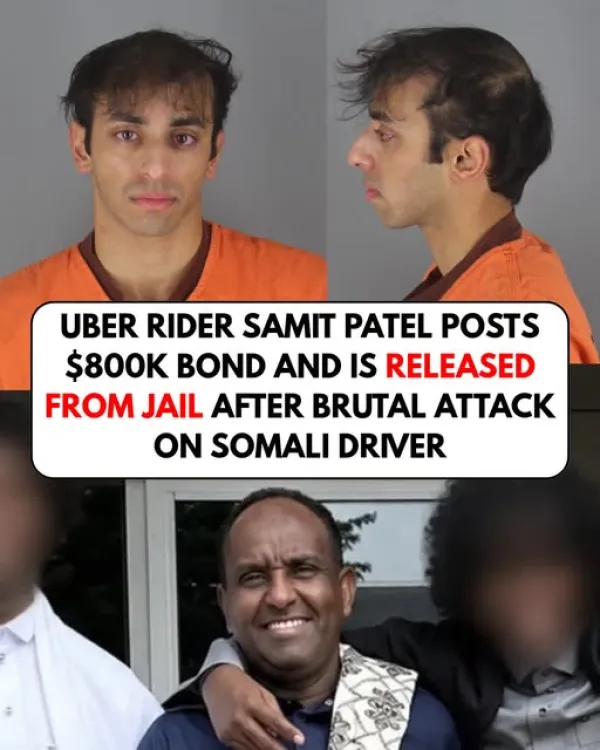
Hindutva activist Samit Patel was released from jail on $800,000 bond following the attack on Somali American Uber driver Mohamed Yusuf in Minnesota. Many Muslims see this as a travesty of justice. Photo credit: X
The defendant in the high-profile attack on an Uber driver in Hopkins, Minnesota, has posted an $800,000 conditional bond and been released from jail. Samit Patel’s release conditions include no contact with witnesses, except his parents, who called 911; no firearms; no leaving Minnesota without permission; and probation supervision.
He also may not use alcohol. Court papers describe Patel as “belligerently drunk” when police spoke with him after the crime. He must also remain on electronic home monitoring.
Patel is charged with second-degree attempted murder and first-degree carjacking in the brutal attack on 51-year-old Uber driver Mohamed Yusuf, a father of five. According to the criminal complaint, Patel asked Yusuf his name. When Yusuf answered “Mohamed,” Patel reportedly said, “I hate this name,” before attacking him.
The complaint says Patel choked Yusuf with a seat belt, pulled him from the vehicle, ran him over with Yusuf’s own car, and left him in a ditch. Yusuf suffered severe, life-threatening injuries. He was reported to be in a coma, and his prognosis remains poor.
This is a travesty of justice. An $800,000 conditional bond may sound substantial, but what about Yusuf’s safety and the concerns of the public? What about his five children and the rest of his family, who must watch a loved one fight for his life while the defendant is home?
I still remember the February 2015 murders of three Muslim students near the University of North Carolina at Chapel Hill: Deah Barakat, his wife, Yusor Abu-Salha, and her sister, Razan Abu-Salha. At a news conference after the killings, an attorney for the suspect’s wife told reporters that Craig Stephen Hicks had a concealed-carry permit. The impression left with many of us was disturbing: Does having a concealed-carry permit somehow make the killing of Muslims—or anyone else—less alarming or less deserving of accountability?
Now consider the court papers’ description of Patel as “belligerently drunk” when police spoke with him after this attack. The contrast raises troubling questions about how firearms access, intoxication, and public safety are addressed before violence occurs.
The message this case risks sending is chilling: A person can be armed legally, become intoxicated, and still count on the justice system to provide release after a horrific attack. And when the victim is Muslim, many will wonder whether his suffering receives the same urgency and attention as anyone else’s.
Some people are more afraid of speaking out than they are of dying. Silence may protect their comfort, but it rarely changes the world. When injustice goes unchallenged, victims and their families are left to carry the burden alone.
Mohamed Yusuf oldest son Mustaph give an more update about his father to CBS news media.
https://x.com/kingofSomaliaa/status/2123375446498988304?a=Hv533fe8O2SxXydNz5E&s=20
Mohamed Yusuf deserves justice. His family deserves answers. And the public deserves a justice system that takes victims’ safety seriously.
Mahmoud El-Yousseph is a Palestinian freelance writer and retired U.S. Air Force veteran. He writes about U.S. foreign policy, Middle Eastern affairs, and justice.