
Movie Review: Once Upon a Time in Harlem
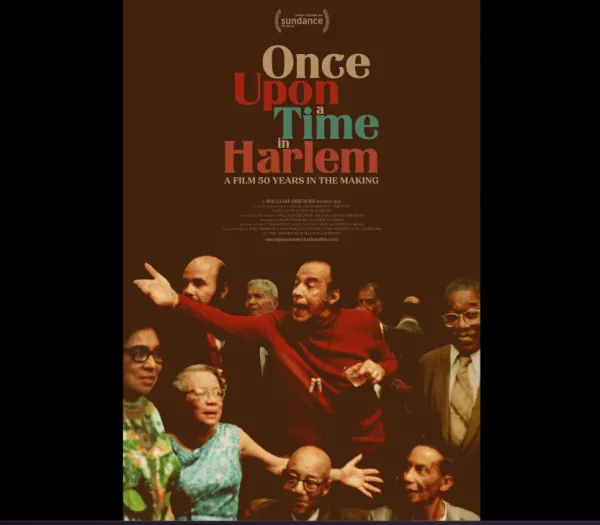
Once Upon a Time in Harlem is a documentary extrapolated from 16mm footage of a nearly thirty-five-year-old meeting of many of Harlem’s most prominent members of the literati. These characters, some more colorful than others include writers, editors, critics, publishers, directors, playwrights, musicians and the like.
The film starts slowly as guests trickle into Duke Ellington’s Manhattan apartment located at 333 Riverside Drive just south of Harlem near West 106th Street which was later renamed Duke Ellington Blvd in 1977. For those unfamiliar with the rich cultural, social and political happenings in Harlem during the early 20th century its influence in the world of arts and letters, both domestically and internationally is unmistakable. The period to which I am referring, of course, is the Harlem Renaissance known to others as the New Negro Movement.
Few can deny that the Harlem Renaissance was a child of the Great Migration as hundreds of thousands of African Americans fled the racist environs of the South to Northern cities in search of a better life for themselves and their families. This development had a profound influence on Black identity and American culture via visual art, and theater as well as music and literature.
The entire film is a spirited conversation among some of the Harlem Renaissance’s key figures that centers on the social, political and cultural significance of one of the most important movements of any century. Much is made, rightly so, of the importance of preserving that history and its place in Americana as well as Black History. Of course, by 1972 many of the early writers by then had transitioned such as Zora Neale Hurston, Claude McKay, James Weldon Johnson, Countee Cullen and philosopher Alain Locke editor of The New Negro and the first Black Rhodes Scholar. Entertainers Paul Robeson, Josephine Baker, and Cab Calloway were still alive, yet were not present. Josephine Baker was living in France at the time. Ellington was also conspicuously absent for reasons unknown.
Although not of the period, historians John Henrik Clarke and Nathan Irvin Huggins were present. Huggins’ presence can only be explained by the fact that a year earlier his much talked about book Harlem Renaissance (1971) was a finalist for the National Book Award. At the time Huggins was a professor of history at Columbia University. Although not a native New Yorker Clarke by 1972 was a well-known figure in academic circles serving as chairman of the Black and Puerto Rican Studies Department at Hunter College in New York. Years earlier he co-founded the African Heritage Studies Association, and before that the Harlem Writers Guild in 1950. At forty-five and fifty-seven years of age Huggins and Clarke were undoubtedly among the youngest, if not the youngest guests there.
Regardless as to who was or was not present, the discussion was robust and informative. For those who believe themselves experts on the Harlem Renaissance they are in for a treat as they will find there is much, they did not know. This meeting was a veritable Black who’s who on the New York scene. Even Omega man Ted Potson, aka the Dean of Black Journalists, was there. Potson was the first African American reporter employed at a mainstream white-owned and operated daily newspaper, spending more than three decades at the New York Post.
Arna Bontemps, another Omega man and a good friend and co-author with Langston Hughes chimed in occasionally, as did Omega man Frank Horne. Bontemps edited the 1972 anthology The Harlem Renaissance Remembered. Horne, an optometrist and poet was one of the few guests who was both born and raised in New York city. A prize-winning poet Horne’s work was published in some of the most prestigious journals of that era including the Crisis and Opportunity.
Once Upon a Time in Harlem, a modified title obviously appropriated from the 1984 crime thriller Once Upon a Time in America, is a master class in the history of the Harlem Renaissance. It is not a fast-paced moving film but is well worth the less than two-hour investment. I highly recommend this work; it is time and money well spent.
Judson L. Jeffries, PhD, MPA, a Phi Beta Kappa, is Professor of African American and African Studies at The Ohio State University. He is a regular contributor to the Columbus Dispatch.