
Ohio waved through hundreds of data centers. Now a new report says Ohioans are paying the price — and breathing the exhaust
This article first appeared here.
While Amazon builds data centers next to elementary schools and American Electric Power (AEP) scrambles to keep the lights on, Ohio has spent a decade making it nearly impossible to build the one thing that could have solved the problem: clean energy.
That is the central finding of a new report released Monday by Save Ohio Parks, a statewide environmental advocacy group, at a press conference held just blocks from an Amazon facility that sits directly across a residential street from homes in Hilliard’s Carr Farms neighborhood.
The report, titled From Demand Drivers to Development Partners: Data Centers that Work for Ohioans, documents how Ohio’s explosive data center growth — more than 200 facilities statewide, ranking the state fifth in the nation — is straining the electric grid, driving up residential energy bills, and pushing the state toward more fracking on public lands.
“Ohio should leverage the data center buildout to expand its leadership in carbon-free energy manufacturing,” the report states. Instead, it found, the state is doing the opposite.

A self-inflicted crisis
Ohio electric bills climbed 30 percent between 2015 and 2025. In Columbus, the average monthly home electric bill jumped $27 in 2025 alone. One analyst projected an additional 10 to 15 percent increase by 2026.
An independent market monitor for PJM Interconnection, the regional grid operator, found data centers were responsible for 63 percent of the increase in capacity prices across the region — translating to an average $16 per month hike on Ohio residential bills.
The report concludes that “ratepayers are subsidizing the cost of building energy infrastructure to support the data center buildout.”
AEP Ohio has taken some steps to address the problem. A new rate package requires data centers to commit to paying for at least 85 percent of their requested capacity for 12 years, even if they use less power — a move designed to stop developers from filing speculative interconnection requests and then walking away. It appears to be working. Interconnection requests dropped from 30 gigawatts in 2025 to 5.6 gigawatts as of March 2026. But the rate only covers AEP’s service territory. And it does nothing about the pollution.
The energy crunch did not have to happen.
Since 2014, Ohio legislators have systematically dismantled the state’s renewable energy standards, tripled wind turbine setback requirements, and passed Senate Bill 52, which allows county commissioners to ban solar and wind projects outright. As of last fall, 37 Ohio counties had passed solar exclusion zones. The Ohio Power Siting Board has recommended denial of seven solar projects, with five others withdrawing from the state entirely.
The result: more than 5.3 gigawatts of solar and wind generation capacity was never built in Ohio — almost exactly the 5.6 gigawatts of data center interconnection requests currently pending with AEP as of March 2026.
“The data center energy crunch would not exist had Ohio built out its renewable energy potential,” the report states flatly.
Gas plants in backyards
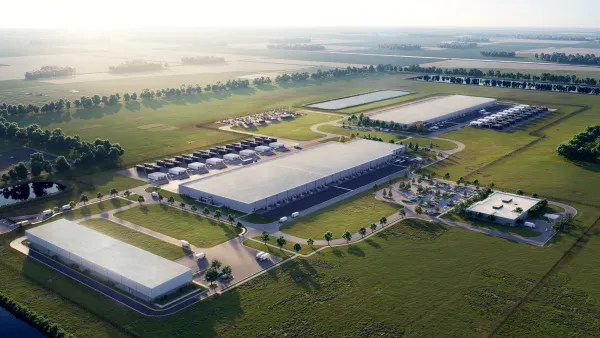
To avoid the long wait for grid interconnection, data centers have increasingly turned to on-site gas combustion — effectively building utility-scale power plants in residential neighborhoods.
In New Albany, a Meta data center plans to install 400 megawatts of on-site gas generation, potentially making it the first data center in the world to exceed one gigawatt of total capacity. Gas plants carry a typical lifespan of 25 to 30 years. That means decades more fracking — and decades more radioactive wastewater injected underground — to keep them running.
In Hilliard — where Monday’s press conference was held — a planned data center includes 158 diesel backup generators. According to filings with the Ohio Power Siting Board, a co-located gas fuel cell installation could emit up to 1.45 million pounds of carbon dioxide per day. The site sits adjacent to a park and an elementary school where children are in class while that gas burns.
Residents were not given the chance to weigh in. The case file at the Ohio Power Siting Board contains no public notice, no public information session, and no public hearing. Ohio’s 2025 energy law, House Bill 15, created an accelerated 45-day review for behind-the-meter gas projects that requires none of those things.
What the report demands
Save Ohio Parks is calling for an immediate moratorium on new data center approvals until regulations on energy, water use, and community benefits are in place. It also calls on Ohio lawmakers to require data centers to meet their energy needs entirely with solar, wind, and battery storage — either on-site or through off-site investments, including in residential solar and battery storage for nearby homes.
The group wants Ohio to pass virtual net metering legislation, restore renewable energy standards gutted by House Bill 6 in 2019, and either repeal Senate Bill 52 or extend its local veto provisions to cover gas and oil projects — not just solar and wind.
On water, the report calls for mandatory public reporting on consumption and Water Usage Effectiveness, along with requirements to capture and reuse cooling system condensate and substitute reclaimed wastewater for potable water.
It also calls for an end to nondisclosure agreements between data center developers and local governments — a practice that has kept residents in the dark about facilities being built in their own communities.
Who is at the table
Industry groups argue that data centers are an economic engine. The Ohio Chamber of Commerce credits the sector with supporting 95,217 jobs in 2024 and adding $11.8 billion to the state’s GDP. The Ohio Business Roundtable puts more than 10,000 construction workers at Central Ohio data center sites alone. Other groups dispute those figures, and the report does not independently verify the industry’s job claims.
What is harder to dispute is the political backlash building across the state.
Numerous Ohio townships have already passed moratoriums, including Washington Township in December 2025 and Waterville near Toledo, which cited a need to “protect the community from what we don’t know.”
In March, a group of rural Ohioans submitted language for a statewide constitutional ballot initiative that would ban data centers larger than 25 megawatts. The Ohio Ballot Board approved the group to begin collecting signatures. They need more than 413,000 valid signatures from at least half of Ohio’s 88 counties by July 1 to appear on the November ballot.
Ohio’s tax agency, meanwhile, expects the state will forgo $142 million in sales tax revenue from data center equipment exemptions in fiscal year 2026 alone — a subsidy the report argues should be made contingent on meeting energy and water requirements, or eliminated altogether.
The full report can be found here: https://drive.google.com/file/d/1ds0ERPYCx_c7UWMQnT3a1boYhaTqsfrw/view?usp=sharing