
Palestinians Hold the Key to Israel's Political Future After Netanyahu
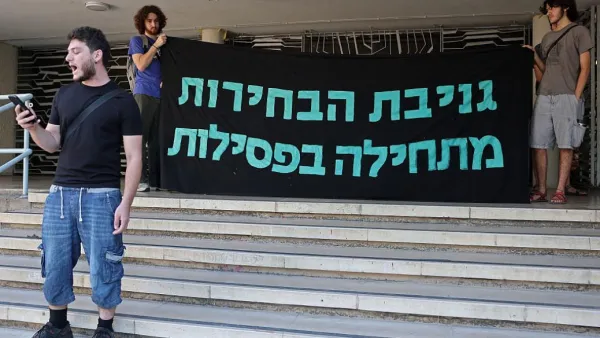
Protesters against the barring of the Joint-List of Israel's Palestinian parties hold a banner that reads 'Election theft starts with disqualifications' during a protest outside the Likud HQ [Jack GUEZ / AFP via Getty Images]
Before examining Israel's election results, it is worth addressing some terminology commonly used by Israeli officials and repeated by mainstream media when discussing Palestinians.
Calling Palestinians with Israeli citizenship "Israeli Arabs" overlooks their Palestinian identity and history. Many prefer the term Palestinians of '48, referring to Palestinians whose families remained within the borders of the state established in 1948, following the Nakba.
Other terminology deserves scrutiny:
- Rubber bullets: These are often rubber-coated steel projectiles, not harmless rubber ammunition. They can cause serious injuries, permanent disabilities, and even death.
- Terrorism and resistance: Describing all Palestinian resistance as terrorism ignores the distinction between resistance to occupation and attacks deliberately targeting civilians. International humanitarian law prohibits attacks on civilians, regardless of who carries them out.
- The separation wall: Palestinians and critics of Israeli policy commonly call it the Apartheid Wall, reflecting their objections to its route and impact on Palestinian communities.
- Evictions: Where Palestinians are forcibly removed from their homes as part of a broader policy of displacement, the issue goes beyond ordinary eviction.
- The Israeli military: Palestinians and their supporters frequently use the term Israeli Occupation Forces (IOF), rather than the Israel Defense Forces (IDF).
- Al-Aqsa compound: Muslims refer to the compound as Al-Haram al-Sharif, or the Noble Sanctuary. Jews commonly call the same site the Temple Mount. The Dome of the Rock is one of its prominent structures.
These terms are not merely semantic disagreements. They reflect competing narratives about identity, history, occupation, and political rights.
An Attempt to Exclude Palestinian Parties
Two months before the October 27 election, Prime Minister Benjamin Netanyahu's Likud party announced plans to petition Israel's Central Elections Committee to disqualify the Arab-led Ra'am and Joint List parties.
Likud argued that there was no place in the Knesset for parties it accused of harming Israeli soldiers or refusing to designate Hamas and Hezbollah as terrorist organizations.
On September 23, the committee voted to disqualify both parties. However, Israel's Supreme Court overturned those decisions on October 2, allowing them to participate.
Palestinian Parties Hold the Balance of Power
The election results tell an important story:
- Netanyahu's bloc: 53 seats.
- Opposition bloc: 48 seats.
- Arab-led parties: 19 seats (Joint List: 11; Ra'am: 8).
A majority in Israel's 120-seat Knesset requires 61 seats.
In other words, neither major political bloc secured enough seats to govern independently. The opposition and Arab-led parties together have 67 seats, making Palestinian political representation potentially decisive in coalition negotiations.
However, political arithmetic does not automatically translate into political influence. Opposition leaders must be willing to cooperate with Arab representatives, and those representatives must decide what arrangements serve their constituents.
Palestinian citizens of Israel are not simply spectators in Israeli politics. They are voters, elected representatives, and citizens whose political choices can influence the country's future.
After decades of marginalization and attempts to exclude their political representatives, their electoral strength is increasingly difficult for Israel's political establishment to ignore.
Mahmoud El-Yousseph is a Palestinian freelance writer and retired U.S. Air Force veteran. He writes about U.S. foreign policy, Middle Eastern affairs, and justice.