
POETIC JUSTICE: A Love Letter to Columbus
Dear Columbus,
Consider this a love letter, even if it begins with a harsh reality.
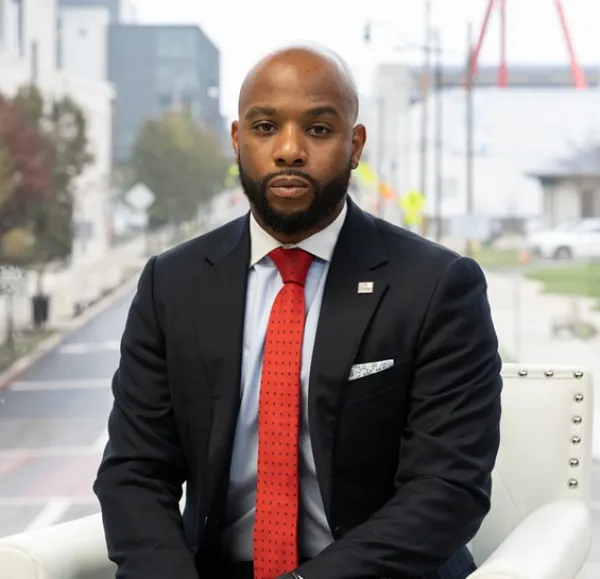
A little over a week ago, a police officer stood in front of cameras and lied. He lied loudly into a microphone, attempting to plant evidence on my character by fabricating the cost of my suit and the brand of my shoes, all to set up a rehearsed line calling me a “poverty pimp.”
For those unfamiliar with the term, a “poverty pimp” is someone accused of profiting personally from the communities they claim to serve. It has clear historically racial undertones and that is without question. It is a slur designed to discredit the messenger before the message lands and before change can actually be achieved. It is a term and tool of distraction.
The accusation does not survive an honest review of the record. Fifteen years of cases, the families I have stood next to, and the division directives and policies that have changed because of those cases speak to who I am and what this work has cost me. Brian Steel, the head of the local Fraternal Order of Police, chose those words because the playbook required him to, and because he is very willing to lie to run the plays that help officers in trouble, get out of trouble.
Poetic justice is an outcome in which vice is punished and virtue rewarded, usually in a manner peculiarly or ironically appropriate. What I have not been able to understand is why, in trying to make me out to be a poverty pimp, Steel would so easily open himself up to becoming everything the officers he represents do not want their spokesperson to be. A police officer willing to lie in specific detail. To fabricate prices. To fabricate brands. And then, in the same breath, to contrast the villain he had just painted against himself, the hero in a Jos. A. Bank shirt.
He criminalized my clothing. He made me a suspect. He tried to permanently damage my credibility and displace me as a Black man in this movement, as someone who actually, and quite literally, has skin in the game. I have worked hard for 15 years of a legal career to lead with honesty, integrity, and ethics. In just a few seconds of a rant, he attempted to rip that to shreds based entirely on lies.
The chaos that has resulted must be called out, because it is directly his responsibility. The danger cannot be understated. Emmett Till was beaten to death based on a lie. Lies have devastating consequences. For the head of the FOP to brazenly lie about a family’s civil rights attorney and the incoming President of NAACP Columbus Branch in a live press conference, in the aftermath of an historic police shooting conviction, should be disqualifying behavior.
I am writing this letter because of what that moment revealed. Not about him. About a system that has been running the same playbook for generations, against the same kinds of people, in the same kinds of ways, with the same kinds of outcomes. Poverty pimp was just the poetic justice we needed to understand and move forward past the playbook.
★ ★ ★ ★ ★
This playbook is as old as state-sanctioned violence against Black bodies in America itself.
It came for my great-great-great-grandfather, Jimmy Gibson, a sharecropper murdered by white men in the early 1900s with zero consequence. It came for my maternal grandfather, Roy Henderson, who survived only by outrunning a lynch mob in the 1950s. And it came for my paternal grandfather, Timothy Walton, who survived a 1966 police shooting only because the officer’s partner, O.J. Bradley, finally told the truth.
In each generation, the playbook came for my family and either worked or just barely missed. By inches. By moments. By the courage of one truth-teller, or by one fast set of legs. And here I am, in 2026, telling you that the same playbook just killed Casey Goodson Jr. as he walked into his own house, then allowed the officer to evade full accountability by criminalizing the victim while the head of the police union pushed a propaganda campaign to establish Jason Meade’s credibility over Casey’s.
This playbook survives by erasing humanity. Shitbags. Animals. Wolves. Occupational hazards. Pimps.
These are the dehumanizing words Brian Steel reaches for the moment a microphone is in front of him. He thinks in absolute binaries: Heroes vs. Villains. Humans vs. Wolves. Good vs. Evil. He cannot cite the racial statistics of violent crime while simultaneously using subhuman names, or invoking a “pimp and prostitute” dynamic, without blowing a deafening dog whistle. If he admits his officers’ victims are human, his entire system collapses.
You saw this double standard after the trial. Steel praised the Meade family for shedding few tears and called them outstanding people and “our side,” yet condemned the Goodsons for weeping after five and a half years of agonizing patience, dignity and pain. Meanwhile, Meade’s brother spit on a reporter during the first trial, and his father trash-talked me to my face inside the courtroom during the second. Because we do not call out in the same ways Steel is allowed to and certainly do not wish to villainize an entire family to manufacture a contrast between “good” and “bad,” those things go unreported.
We are depicted as antagonists despite never committing any wrongdoing, by someone who possesses unquestioned power to do so, while simultaneously protecting and portraying the true offenders as flawless.
Steel admitted that when a citizen simply looked at him in the hallway after the verdict and said, “we did this,” his immediate thought was, do you want to fight or something? That is not what an objectively reasonable officer thinks when a citizen speaks. If that is his first reflex in a courthouse hallway and he is the representation of what 4,500 Central Ohio police officers think and feel, does that make any of us feel safer? Does it instill an irrational fear of threat on both sides of a police encounter?
Is that a part of the playbook, too?
★ ★ ★ ★ ★
The playbook does not only run on the dead. It very much runs on the living, as well.
Right now in Whitehall, the FOP is running it on Mayor Michael Bivens, the first Black mayor that city has ever elected; Councilmember Lori Elmore, the first Black councilmember Whitehall has ever elected; and Councilmember Amy Harcar, a white ally who advocates for Black and Brown communities.
The FOP has orchestrated smear campaigns and backed special recall elections against all three, framing routine policy disagreements as scandals and demanding investigations the facts do not support. Meanwhile, Whitehall Councilmember Gerald Dixon stands accused of sexual misconduct involving minors and faces no such recall campaign.
He was also endorsed by the FOP.
The same union that drags Black bailiffs and Black judges in press releases has gone to enormous lengths to defend officers indicted for homicide and convicted of murder, and to look the other way when their own endorsed candidates need criminal accountability. You start to see the pattern when you look at who they extend the benefit of the doubt to, who they do not, and who they flat out launch campaigns against.
He will do and say whatever it takes to achieve his goals. For years before each Meade trial, he called the case a political prosecution by special prosecutors with “far-left ideologies.” Both special prosecutors are registered Republicans. The framing of two 70-plus-year-old white Republican men politically prosecuting a hero is so ridiculous that exposing his dishonesty should be a bipartisan effort.
Steel has asked us to believe in a coordinated conspiracy between the Columbus Police, the FBI, the County Prosecutor’s Office, and the U.S. Attorney’s Office, all aligned to politically prosecute one officer. What he refuses to recognize is that his own theory draws attention to the glaring deficiencies in how criminal justice is administered every day, against people who do not have a union running press conferences for them. And there is poetic justice in the clarity of this: the man he has chosen as his poster child for criminal justice reform, at the expense of Casey Goodson Jr., is a Sheriff’s Deputy, a pastor, a former Marine, and a white male member of the FOP.
For years, multiple officers, separately and without coordination, have described hearing Brian Steel tell a room of his members: He will never lie, cheat, or steal from officers, but he will lie, cheat, and steal for police officers. The line is consistent across every retelling. That is why I have studied his words so carefully. This has never been a feud. It has been a reckoning with what he has told his own members he is willing to do. So I listen to all of the potential and actual lies, and I respond where I can with real truth.
★ ★ ★ ★ ★
This letter marks the end of one phase of what I have been doing publicly and the beginning of a phase the work has been waiting on for over a decade.
I have watched him do this before. When I released Connor Grubb’s name after he killed Ta’Kiya Young, Steel retaliated by releasing random pictures of Ta’Kiya to the public in an effort to criminalize and blame her. He released a past police report while stating “Criminal history doesn’t make an incident less tragic but helps paint a picture what led to it.” That was also the moment he first called protesters “terrorists,” inventing its use in this conversation to position citizens as the bad guys in his binary frame. When I used it to refer to him, he cried foul.
What some have called a feud was never personal on my end. Every time I pushed back, I was inviting a public figure to respond with the precision and dignity his position demands. Every time, he chose instead to escalate, to lie, to dehumanize, and to distract. The pattern is his, not mine. I refused to look away from it, and that refusal is what some have mistaken for feuding. The lies cannot be allowed to speak louder than the truth.
I did it because John Lewis told us to get in good trouble, necessary trouble. I did it because there was a population in this city who had stopped paying attention and stopped believing we can touch the untouchables. I did it because there were young people who had never seen a Black professional push back at someone like the head of the FOP without flinching. I refused to teach by example that the only way to survive in proximity to civic bullying is to stay quiet and be respectable about politics.
My politics are revolutionary, and no matter my tactics or my approach, no one should ever question that.
I did it to stand on business.
Poverty Pimp was the poetic justice that confirmed the pattern. There is no more debate about what he does. The record now speaks for itself. That is the system. The question now is whether we still consent to it.
★ ★ ★ ★ ★
It has been suggested that I should sit down privately with Brian Steel to make peace. Let me address the absurdity of that request. I am being asked to treat a man as an equal partner who has shown absolutely no reason for me to believe that he respects me, sees me, or hears me. Until his lack of credibility is addressed through a complete 180 and public apology for his years of behavior, or a change in FOP leadership, there is nothing to discuss. Not with him and I one-on-one.
I do invite him to be the guest speaker at our June NAACP General Body meeting though, since he has proudly claimed his NAACP membership throughout this process. I invite him to speak directly to our body, and to allow a Q&A from which I will remove myself as a participant. From there, my executive committee and general body can lead on how we shall proceed, and I will follow the will of the people. Whatever that will may be.
★ ★ ★ ★ ★
The silent majority of officers in this city wants what the community wants, and I have been in their corner. He will speak using his platform as head of the union, to act as if he is speaking for a monolith of officers who believe exactly what he says they believe. That is the thin blue line, actualized. He ostracized Whitehall officers, by name, and called them “free riders” for deciding to no longer pay union dues under his leadership.
He even applies the playbook internally to divide and conquer.
My refusal to engage with a dishonest operator should never be confused with a lack of support for rank-and-file officers. My representation of Columbus police officer Karl Shaw resulted in an amended division directive that has protected every officer who came after him for the past six years. That same advocacy drives my work on the Ethics and Equity Advisory Council for Axon Enterprise, impacting over 17,000 public safety agencies, and my recent lobbying on Capitol Hill alongside law enforcement officers such as one of the “toughest” sheriffs in the country for bipartisan de-escalation legislation supported by the National FOP and community organizers alike.
You can see this same commitment to systemic change in the recent passage of Issue 5. When Collin Jennings was killed during a mental health crisis in 2024, his family and I did not rush to demand a murder indictment. Instead, my former client Chana Wiley, whose brother Jaron Thomas died following a similar crisis with police in 2017, stepped in to help guide the family’s messaging toward policy reform and to amplify the work of the Columbus Safety Collective. Chana and the CSC helped push Issue 5 through to create an alternative crisis response system that protects both citizens in distress and responding officers. This is what we can achieve when we refuse to let progress be clouded by lies about “defunding the police” or wanting to send every officer who pulls a trigger to prison.
It should not require a decade of fighting to secure a commonsense win that helps everyone.
I do not need to sit down with Steel to deliver on the progress needed for my clients, my community, or my members. I have been working towards that this entire time and helped lead that progress despite his opposition. This has not been an emotional exercise on my part. Every step of this, I have been fully in control of what I believe to be necessary, and where I believe this moment needs to go, and I am moving based on the years of experience I have gained hearing the pain of the people, and working to turn that pain into power and progress.
★ ★ ★ ★ ★
What is beginning now is the slow, careful building of the systems and institutions this city has needed all along.
Officers who can speak honestly without fearing reprisal. Families who can grieve without being smeared. Police chiefs who can refuse to be intimidated by the FOP. Citizens who can begin to disentangle the difference between law enforcement and the labor union that has been claiming to speak for them.
People who can hear truth louder than they can hear the lies.
A man who cannot admit error cannot help build anything that requires honesty. He has chosen his role. The rest of us get to choose ours.
Pastor Kevin Hairston said it cleaner than I can: Fear cannot be the foundation of civic leadership. Vision must be. I still believe Columbus has the potential to become one of the strongest examples of unity, collaboration, economic growth, and community healing in America, but only if we stop viewing one another as threats and start viewing one another as partners in shaping the future.
This is my love letter to Columbus.
To the Black community that has carried this work for generations.
To the officers who have wanted to speak and have not yet found the way.
To the families of the dead, who have given me the privilege of standing next to them in the worst moments of their lives.
To the white residents who have been waiting for a way to participate without being asked to abandon their own integrity.
To the moderate, the radical, the religious, the secular, the elected, the unelected, the young, and the old, all of whom have been told they have to pick a side in a fight he manufactured.
You do not have to pick the side he gave you. You can pick a different one. The side that says we are not threats to one another. The side that says our neighbor’s truth, however ugly, deserves the same dignity as our own and the same accountability as any other person. The side that says the foundation of this city has to be vision, not fear, and certainly not lies.
★ ★ ★ ★ ★
The lesson of Officer Bradley is the lesson my grandfather carried for the rest of his life: The truth, told once, by one person, can free another person to heal.
Let us name what is what. Let us trust each other to do it.
More than anything else, I want my leadership to be remembered as one that decentralized power in Columbus and returned all power to all of the people.
The truth shall set us free. These truths shall set us free.