
Private equity is deliberately leaving single-family homes in Columbus unrented and empty: “They treat them like stocks”
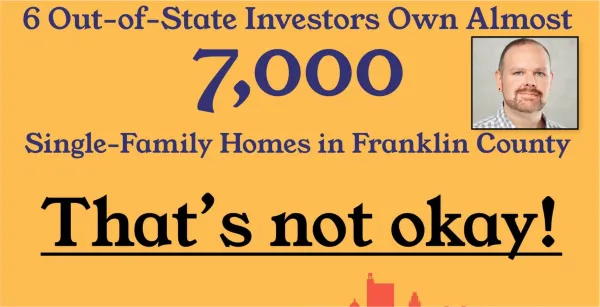
Many are aware private equity has purchased thousands of single-family homes in Columbus and now renting them at rates many struggle to afford.
Arguably worse is how these private equity companies such as Homes for America, VineBrook and Blackstone have been keeping a dirty little greedy secret: They are deliberately leaving a substantial number vacant during Columbus’s unprecedented housing affordability crisis.
Mayor Ginther and City Council have echoed time and time again: We need to build more housing. Yet they have never called out how private equity is deliberately keeping an unknown number “homeless,” so to speak.
“Private equity treats them like stocks is the best comparison,” says Jordan McLaughlin, who’s leading the grassroots effort Evict Private Equity Columbus, and pictured above. “Think of them as a place to plant their money. Wait for a while for the market price to increase and then sell it. They don’t want to put someone in there who they think can destroy the property and lower its property value.”
Private equity began snatching up single-family homes across the nation after the 2008 housing crash and their buying spree accelerated during and after the pandemic. Roughly 7,000 single-family homes in Columbus and Franklin County are currently owned by private equity. The number of these homes which are intentionally kept vacant is unknown, but McLaughlin believes he has a good idea where they are clustered.
“We do not have an exact number; there’s no mechanism to measure that. What we can do is look at the areas where private equity is operating,” he says. “And in those areas, they have a significantly higher vacancy rate compared to the rest of Columbus. So, we know where they are doing it, we just don’t know the exact numbers.”
McLaughlin’s activism was inspired by his own personal experience when he and his partner tried to buy a house several years ago. Every time they found a house they liked, private equity would swoop in and make a better offer.
“The house was sold, and we took an offer that was $40,000 over asking price with no inspection and it was all cash,” is what they would be told, says the 42-year-old. “And that happened to us three times. And it’s what I hear constantly talking to other people. That this is the constant experience. These companies are sweeping us out from being first-time homebuyers.” For the time being, McLaughlin and his partner have decided to keep renting and are not looking to purchase a home.
The Free Press believes the ultra-rich are more determined than ever to pigeonhole young people into renting tiny and overpriced apartments so to maximize profit. McLaughlin believes this as well, and private equity is also part of this grand scheme.
“The long-term goal is a permanent renting class. That seems to be the goal for these development firms, and the mayor and some City councilmembers take money from them. There are some City councilmembers who I think are doing the right thing, and I don’t think they are bad people, they are just being misled,” he said, adding Mayor Ginther already has received $250,000 from developers just this year.
McLaughlin also scoffs at the argument that housing prices have become high in Columbus “because everyone is trying to move here” and thus due to demand.
“In Toledo, their population is declining. Yet their housing prices have increased 35 percent. That doesn’t make any sense. Because their inventory should be getting bigger so that should be bringing prices down, but that’s not what’s happening in Toledo,” he said.
Mayor Ginther and City Council have said they want developers to build 200,000 additional housing units over the next ten years to meet the city’s growing population demand. Developers who will be incentivized with some of the nation’s most generous tax-free property abatements and Community Reinvestment Areas (CRAs).
“They’re getting tax breaks and everything to build these apartments and then they get a continual income stream from them because they own them forever,” says McLaughlin. “If you’re going to give tax breaks to companies, I want them to be the ones building single-family homes, building duplexes, building condos that can then be purchased by owner occupants. The idea that we are subsidizing landlords to be able to be continually to make money off these people instead of building financial security for the people who live here, that’s my contention with them.”