Salima Al‑Na'eli: The Libyan Heroine Who Terrified the Italian Occupation
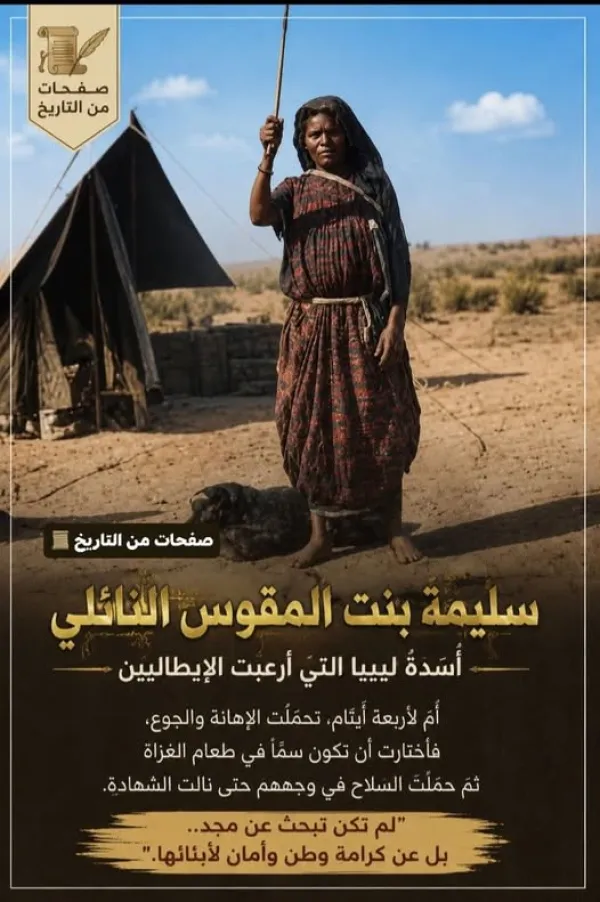
Salima Al-Muqawwas Al-Na'eli is the Libyan lioness who instilled fear in the hearts of the Italian army occupying. She was not looking for fame, but rather to live at home with dignity, safety and security for her children and herself. Photo credit: Pages from history.
When I hear the name Libya, the names of Gaddafi and Omar Al‑Mukhtar come to mind, as well as the 2011 US/NATO bombing of Libya that led to the overthrow and death of Muammar Gaddafi and left the country in total ruin.
I would like to share the inspiring story of a Libyan woman you should know—one whose sacrifices in the struggle against the brutal Italian occupation have long been overlooked. Her name is Salima bint Al‑Muqawwas Al‑Na'eli. Salima is derived from the Arabic root word Salim (سليم), which conveys the ideas of safety and security. Yet this woman struck fear into the hearts of the Italian occupiers. For context, Italy occupied Libya from 1911 to 1943—a period of 32 years.
Salima sold her home and sent her children away… then waged a solitary war against the Italian occupation. She was not merely an ordinary Libyan woman living through the era of colonization; she embodied the story of a nation walking on two feet.
A widow and mother of four orphans, she was compelled to work inside an Italian army camp—not out of desire for money or status, but simply to secure food for her hungry children. Every day, she stood among soldiers who boasted of killing her compatriots. She heard their laughter echoing over the suffering of Libyans, all while suppressing a fire within her that grew hotter with every insult.
One day, when she complained of illness and her inability to work, she found no mercy. Instead, an Italian officer struck her across the face, forcing her to continue. It was a slap to a woman’s face, yet it awakened within her an unbreakable warrior spirit. She returned home and made a decision that would change her life forever.
She sold her humble house, sent her children to relatives far from the fires of war, and purchased a deadly poison. The following night, while preparing a meal for the occupation soldiers, she laced the cauldron with poison. She let them taste a fraction of the agony they had inflicted upon her people—then vanished before they realized what had happened.
From that moment on, Salima was no longer a cook in the invaders’ camp; she had become a fighter in the ranks of the Mujahideen. She participated in numerous battles against the Italian occupation, proving herself one of the bravest to ever bear arms. When she advanced toward the enemy, she never retreated; when the fighting intensified, she stood on the front lines. Her renown reached as far as Europe, where foreign newspapers wrote about her with admiration, and many regarded her as one of the boldest female figures in the resistance against colonialism.
It would be unfair not to mention another Libyan who led the resistance against Italian colonization: Omar Al‑Mukhtar. He was a Libyan revolutionary and Islamic scholar who became a symbol of national heroism and anti‑colonial struggle. He once said, “We do not surrender; we either triumph or die.” Known as the “Sheikh of the Mujahideen” and the “Lion of the Desert,” he led the resistance starting at the age of 53. He fought for over two decades before being executed by colonial forces in 1931.
Speaking of Libyan heroes, I would also like to recognize and pay respect to Hamza Al‑Warfalli, a young man from Benghazi who left his family, friends, and job to travel to Gaza because he could not bear to watch innocent civilians starved and bombed. He joined the Qassam Brigades—an armed wing of Hamas—and was killed in combat. Regardless of political views, his personal decision reflected a willingness to sacrifice for what he believed was a just cause. The name Hamza means “lion” or “brave man” in Arabic.
Meanwhile, Salima did not content herself with fighting alone; she organized a group of Libyan women to join the battle for freedom, believing that defending the homeland was not the exclusive domain of men. Wounded repeatedly on the battlefield, she always returned with even greater resolve. Ultimately, she attained martyrdom, struck by an artillery shell while facing the enemy—steadfast, advancing, never retreating.
Salima is gone, but she left behind an unforgettable lesson:
- Homelands are not protected by arms alone; they are safeguarded by hearts that refuse humiliation, whatever the cost.
- Salima wrote her name in the ink of courage, blood, and sacrifice.
- She is an unsung Libyan heroine whose remarkable sacrifices to free Libya from Italian occupation have too often been overlooked.
- Her courage and valor should not be forgotten.
- For that reason, I wrote these words—to honor Salima’s memory, because she was a Libyan heroine who terrified the Italian occupation army.
Mahmoud El‑Yousseph is a Palestinian freelance writer and retired U.S. Air Force veteran. He writes on U.S. foreign policy, Middle East affairs, and justice. Email: elyousseph6@yahoo.com
Caption for additional image: Libya’s son—the martyr Hamza Al-Warfalli who left his family, friend to travel to Gaza because he could not bear to watching innocent people being starved to death and bombed to smithereens. He joined Hamas and was martyred in fighting the Israeli Death Forces (IDF) at point-blank range with utmost courage and valor. Photo credit: The Yeshiva Word News.